


The 3 Types of Quran Recitation A Complete Guide
Many Muslims read the Quran daily but remain unsure about the ideal speed for their recitation, especially in prayer or during lessons. The Quran allows for varying paces, and mastering the 3 types of recitation At-Tahqeeq, At-Tadweer, and Al-Hadr is essential for accuracy and confidence. This comprehensive guide was created by the Quran Bliss Academy Editorial Team, certified educators with over a decade of experience teaching non-Arab Muslims worldwide, to provide every learner with a clear, professional path to perfect their Quranic recitation.
What Are the 3 Types of Quran Recitation?
The three types of Quran recitation refer to the different levels of recitation speed used while applying Tajweed rules correctly. These levels help learners balance accurate pronunciation, fluency, and reflection while reading the Quran. Each type serves a specific purpose depending on the reader’s level, but all require proper application of Tajweed to preserve the meaning of the Quran.
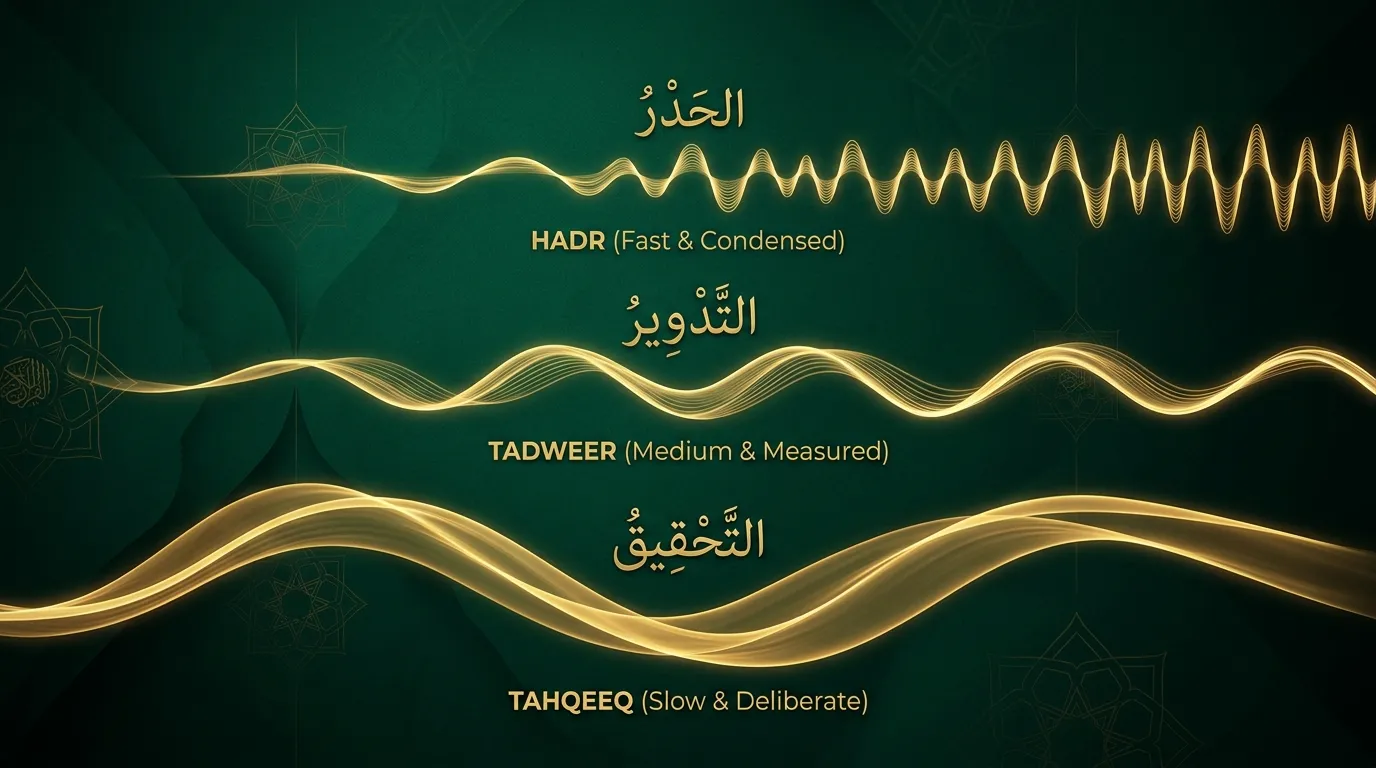
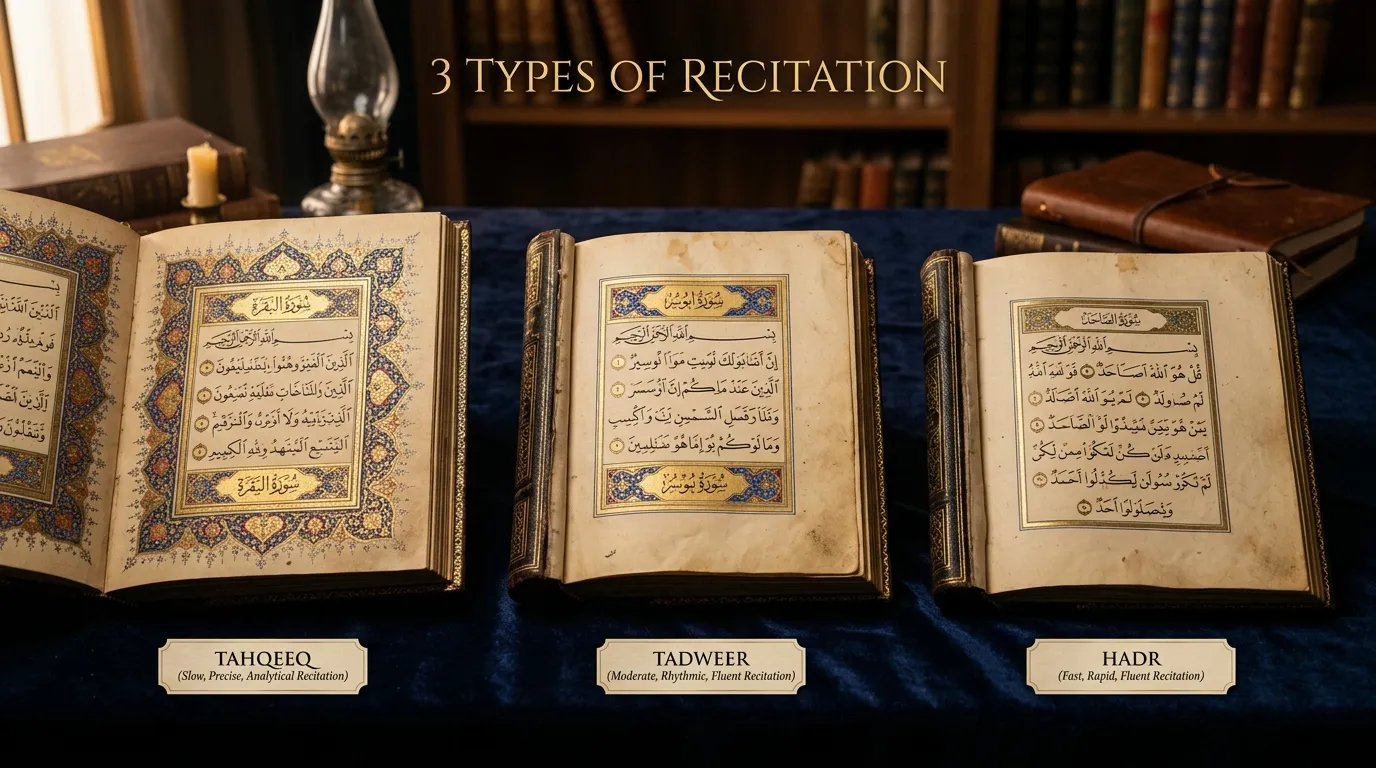
At-Tahqeeq (Slow Recitation)
The slowest and most deliberate style. Every letter is pronounced with full Tajweed care, which makes it the standard choice for beginners and for anyone enrolled in a Quran Recitation with Tajweed Course.
At-Tadweer (Moderate Recitation)
A balanced pace between slow and fast. Among the types of recitation of Quran, this is the one most reciters use day to day because it keeps clarity intact while still reading at a natural speed.
Al-Hadr (Fast Recitation)
The fastest of the three. It is reserved for reciters who have already mastered Tajweed, since speed must never come at the cost of accuracy.
Distinction Between Recitation and Tajweed
Many new students often ask: is reading quran without tajweed wrong? This common confusion usually stems from failing to make a clear Distinction Between Recitation and Tajweed. Simply put: recitation speed is about your pace, whereas Tajweed is the science of correct pronunciation. They are not two separate choices; Tajweed is the precision that gives life to your pace.
Intentionally ignoring Tajweed rules when one is capable of learning them compromises the accuracy of the verses. Therefore, Tajweed is not an optional “extra”—it is the foundation required for every level, from slow to fast.
How Tajweed Connects to Every Recitation Level?
Many students treat recitation speed and Tajweed as two separate tasks, but in reality, Tajweed is the precision that gives life to your pace.
Think of it this way: if recitation speed is the “tempo” of your reading, Tajweed is the “technique.” Just as a musician cannot play a complex piece quickly without first mastering the notes, a reciter cannot speed up without first mastering the rules. Ignoring Tajweed rules even at the slowest pace can alter the meaning of the Quranic words.
This is why scholars categorize the three levels not just by speed, but by the level of control required:
- At-Tahqeeq: Focuses on Precision. It is the training ground where you perfect your articulation.
- At-Tadweer: Focuses on Balance. It allows you to recite naturally while keeping your Tajweed rules intact.
- Al-Hadr: Focuses on Mastery. It is the final stage, reserved for when your precision is so automatic that speed no longer threatens your accuracy.
The Bottom Line: Whether you are reciting slowly or quickly, your primary goal remains the same: “reciting in a measured way” (Quran, 73:4). Always prioritize accuracy over velocity; speed is a reward for those who have mastered the rules.
Qira’at vs. Recitation Levels
New students often assume the 3 types of quran recitation and Qira’at are the same thing, since both involve “different ways” of reciting. They are not, and mixing them up causes real confusion later on.
Aspect | Qira’at | Recitation Levels |
Definition | Authentic transmission methods | Speed styles under Tajweed |
Focus | Pronunciation, letters, wording | Speed and fluency |
Examples | Hafs ‘an ‘Asim, Warsh ‘an Nafi’ | Tahqeeq, Tadweer, Hadr |
Impact on Meaning | Adds nuance, core meaning unchanged | No change at all |
Who Uses It | Advanced learners, scholars | All learners, beginner to advanced |
In short: Qira’at is about how the Quran was transmitted, while recitation levels are about how fast or slow it’s read. One affects wording slightly; the other only affects pace.
Why These Recitation Styles Exist
It can feel strange at first that the Quran allows more than one accepted pace or style. Scholars explain this as part of its accessibility, not a source of confusion.
- Makes recitation accessible across different linguistic and cultural backgrounds
- Allows beginners to build accuracy first, then gradually build speed
- Reflects the same core meaning across every recitation style, with zero contradictions
Practical Demonstrations of the 3 Types of Quran Recitation
The 3 types of quran recitation highlight subtle differences in pronunciation and word forms, without altering the fundamental meaning of the Quranic text. These distinctions appear in vowels, letters, or even slight variations in words, all authentically preserved through traditional transmission.
Variation in a Vowel
In Surah Al-Fatihah, verse 4, the recitation of Hafs ‘an ‘Asim reads “مَالِكِ يَوْمِ الدِّينِ” (Māliki yawmid-deen), meaning “Master of the Day of Recompense.” In contrast, Nafi’, Ibn Kathir, and other Qira’at recite “مَلِكِ يَوْمِ الدِّينِ” (Maliki yawmid-deen), meaning “King of the Day of Recompense.” Both interpretations are valid, emphasizing different aspects of Allah’s attribute.
Variation in Letters
In Surah Al-Baqarah, verse 259, Hafs ‘an ‘Asim recites “وَانظُرْ إِلَى الْعِظَامِ كَيْفَ نُنشِزُهَا” (kayfa nunshizuhā), meaning “how We raise them.” Ibn Kathir and Abu ‘Amr read “كَيْفَ نُنشِرُهَا” (kayfa nunshiruhā), meaning “how We resurrect/revive them.” Both readings describe the same event from slightly different perspectives, enriching understanding of the verse.
These examples demonstrate why learning different types of quran recitation is essential for students seeking to master online quran recitation with tajweed. Platforms like Quran Bliss offer structured courses to explore quran recitation types and quran recitation styles, ensuring learners understand both meaning and pronunciation accurately.
The presence of multiple authentic recitation styles in the Quran is not a limitation but a reflection of Allah’s mercy and the miraculous nature of His words. There is profound wisdom behind these different types of Quran recitation.
Facilitating Ease and Accessibility for All
The foremost purpose, as highlighted in teachings from the Prophet (peace be upon him), is to make the Quran accessible for Muslims across diverse linguistic and cultural backgrounds.
Platforms like Quran Bliss allow students to learn Quran recitation with Tajweed online, making it easier for anyone to connect with the Quran regardless of their native language.
Enhancing Depth and Understanding
Each Qira’a contributes unique nuances, enriching the overall meaning without creating contradictions.
By exploring the different Quran recitation styles, learners gain a deeper insight into the Quranic message, ensuring a more comprehensive and spiritually fulfilling understanding.
Benefits of Practicing All Three Recitation Levels
Many of our students at Quran Bliss Academy report real improvement once they stop rushing and work through each level in order.Practicing all 3 types of recitation helps you build a well-rounded foundation, ensuring you are comfortable reciting in any setting from personal reflection to formal prayer.
- Pronunciation accuracy: slow practice with At-Tahqeeq builds correct articulation (makhraj) without rushing
- Natural fluency: moving into At-Tadweer develops smooth reading without losing clarity
- Deeper reflection: slower recitation leaves more room to think about meaning, which speaks directly to the importance of recitation of holy quran as an act of worship, not just reading
- Reading confidence: progressing through all three styles of Quran recitation removes hesitation on longer passages
How to Choose the Right Level as a Beginner
A common challenge we see among beginners is picking a pace before their pronunciation is ready. The order below avoids that mistake.
- Start with At-Tahqeeq. Many beginners start here, often after building letter recognition in a Quran Course Noorani Qaida.
- Prioritize accuracy over speed. Mistakes formed early are far harder to correct later.
- Practice in short, daily sessions. Consistency builds memory faster than long, irregular study.
- Move to At-Tadweer gradually. Shift pace only once pronunciation feels stable.
- Get feedback from a teacher. Studying with a qualified teacher catches mistakes before they become habits, whether through a private tutor or structured Learn Quran recitation online program.
If you’re ready to move past guesswork, Quran Bliss Academy offers guided lessons covering each of these recitation styles step by step, with a certified teacher listening and correcting as you go.
conclusion
Whether you are beginning your journey with At-Tahqeeq or striving for the mastery of Al-Hadr, consistent, expert guidance is the key to progress. Your recitation should be a source of tranquility, not confusion. By mastering the 3 types of recitation, you unlock a deeper, more accurate connection to the Quran. Ready to transform your journey? Join our specialized Quran Recitation with Tajweed Course today.
Frequently Asked Questions
When people first hear the term, they usually mean the three recognized speeds: Tahqeeq (slow), Tadweer (moderate), and Hadr (fast), each governed by the same Tajweed rules.
Tadweer meaning, in simple terms, is the moderate pace between slow and fast recitation. It’s the speed most reciters use for everyday reading and prayer.
Yes. Structured online courses walk learners through each recitation style with live correction from a teacher, which is far more effective than self-study alone.
No. Variations in pace add nuance and ease, but the Quran’s core meaning stays identical across every recitation style.
Yes. Whether reciting slowly or quickly, Tajweed governs pronunciation and rhythm, and skipping it affects accuracy at every level. What are the 3 types of Quran recitation?
What does Tadweer mean in Quran recitation?
Can I learn the 3 types of recitation online?
Do the different Quran recitation styles change the meaning?
Is it necessary to learn Tajweed for all recitation levels?
Quran Recitation
with Tajweed
Master accurate Qur’an recitation with clear Tajweed rules.
Learn More