

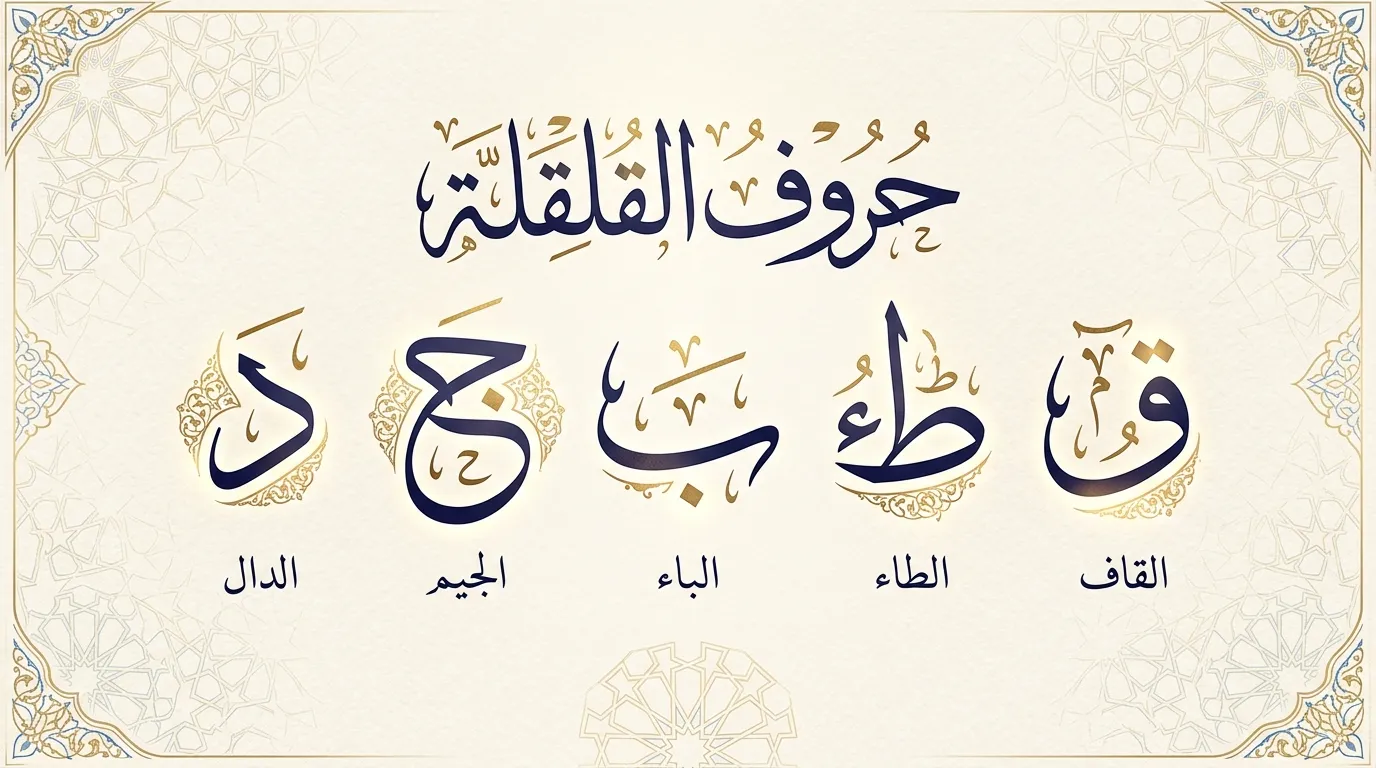
Learn Qalqalah Letters in Arabic Tajweed for Kids & Adults
Picture reciting Surah Al-Ikhlas. You reach the final word, but the stop sounds flat and clipped. This common hurdle comes down to one missing skill: mastering the qalqalah letters in arabic. To help you transform these endings into confident, echoing stops, the Quran Bliss Academy Editorial Team certified educators with a decade of experience guiding global students toward Tajweed mastery crafted this guide. Once you learn how these five letters bounce, your recitation will instantly achieve the precise, beautiful resonance of a trained reciter.
What Is Qalqalah in Tajweed?
Every student beginning formal Quran study eventually asks the same question: why does this letter sound different when I stop on it? The answer lies in Qalqalah, one of the most foundational rules of pronunciation. To grasp this, it helps to understand the difference between makhraj and tajweed; while one dictates where the sound originates, the other governs its beautiful execution.
Understanding the Mechanics of Qalqalah
To master this rule, it helps to look at both its linguistic roots and its practical application in Tajweed:
- The Linguistic Meaning: The Arabic word qalqalah (قلقلة) literally means to shake, vibrate, or disturb. Saying the word aloud mimics the exact motion it describes.
- The Technical Definition: In Tajweed, it means disturbing a sakin letter one carrying a sukoon at its exact point of articulation. This disturbance produces a brief, clean echo without moving the jaw or adding an extra vowel sound.
- The Core Purpose: It is not a new letter sound; it is a quality added to an existing letter to prevent it from sounding choked, flat, or swallowed during recitation.
This precise rule sits within the broader meaning of tajweed in islam, which exists to protect the transmission of the Quran from mispronunciation across generations and diverse language backgrounds.
Why Does Qalqalah Exist? The Phonetic Reason
Many learners assume Qalqalah is just a stylistic flourish, but it is rooted in pure phonetics. The five letters of qalqalah share two characteristics: Jahr (complete stoppage of airflow) and Shiddah (complete stoppage of sound). When a letter with both traits carries a sukoon, the sound naturally risks becoming choked or inaudible.
The Qalqalah bounce exists specifically to release that blockage, ensuring the letter is heard clearly rather than disappearing into silence.
Letters of Qalqalah in Arabic, Meet the Five
Walk into any beginner Tajweed class, and you will see teachers write one short phrase on the board: قطب جد (Qutb Jad).
Scholars grouped all the qalqalah letters in arabic into this single mnemonic so students don’t have to memorize scattered letters separately. Each letter in this phrase represents a specific sound that requires the characteristic echo:
Letter | Arabic | Transliteration | Position of Sound | Echo Strength |
Qaf | ق | Q | Back of the throat | Strong |
Ta | ط | T | Tip / blade of tongue | Strongest |
Ba | ب | B | Lips | Medium |
Jeem | ج | J | Middle of the tongue | Medium |
Dal | د | D | Tip of the tongue | Light |
Among non-native speakers, the letters of qalqalah in arabic that feel least natural at first are typically ط and ق, simply because English does not require a forceful release on those points of articulation. With repetition, however, every student manages to feel the bounce.
The Golden Rule: When to Apply Qalqalah

A common question is whether Qalqalah applies every time one of these five letters appears. It does not—the rule only applies when the letter carries a sukoon. This triggers the echo in two distinct ways:
- Original Sukoon (Within a Word): Written explicitly on the letter, such as the ج in يَجْعَلونَ.
- Implied Sukoon (When Stopping): Created when you stop at the end of a verse, causing the final letter to become sakin even without a written sukoon mark. If the letter instead carries a fatha, kasra, or damma, Qalqalah does not apply.
Handling Tanween at the End of an Ayah
One specific detail trips up students: what happens to tanween when you stop at the end of a verse?
When stopping at the end of a verse, any final vowel or tanween is automatically dropped, and the letter becomes sakin. For example, in a word like أَحَدٌ, it technically ends with a tanween damma, but when stopping, the “n” sound is completely dropped, and the د becomes sakin—instantly triggering a strong Qalqalah Kubra echo.
Levels of Qalqalah: The Three Types Explained
Not every Qalqalah sounds the same, and recognizing why is what allows advanced reciters to sound effortless. Scholars classify the rule into three distinct levels, based on the letter’s position and whether the reciter stops or continues.
Qalqalah Sughra (Minor Echo)
This is the lightest of the qalqalah sughra examples, occurring when a qalqalah letter carries a sukoon in the middle of a word and the reciter continues reading without pausing.
Arabic: “وَخَلَقْنَاكُمْ أَزْوَاجًا”
English: “And We created you in pairs”
Reference: (Surah An-Naba, 78:8)
Here, the ق in خَلَقْنَا carries a sukoon mid-word, producing a light bounce before the reciter continues.
Qalqalah Wusta (Medium Echo)
This middle level occurs when a qalqalah letter falls at the end of a word, but the reciter carries on to the next word without a full stop.
Arabic: “لَمْ يَلِدْ وَلَمْ يُولَدْ”
English: “He neither begets nor is born”
Reference: (Surah Al-Ikhlas, 112:3)
If the reciter continues past وَلَمْ يُولَدْ rather than stopping, the د receives a medium-strength bounce.
Qalqalah Kubra (Major Echo)
This is the strongest level, and the one most listeners notice from expert reciters. It occurs when a qalqalah letter falls at the very end of a verse and the reciter stops there.
Arabic: “قُلْ هُوَ اللَّهُ أَحَدٌ”
English: “Say: He is Allah, the One”
Reference: (Surah Al-Ikhlas, 112:1)
When stopping on أَحَدٌ, the د produces a strong, clearly audible bounce a textbook example of Qalqalah Kubra.
What Are Examples of Words With Qalqalah Letters?
Reading about a rule in the abstract rarely makes it stick. Hearing how each of the five qalqalah letters behaves inside an actual Quranic word is what finally makes the concept click for most students.
Letter | Quran Word | Surah Reference | Level of Echo |
ق (Qaf) | الْفَلَقِ (When stopping) | Al-Falaq (113:1) | Kubra (Major) |
ط (Tah) | بَسَطَ (In mid-word: بَسَطْـ) | Al-Baqarah (2:247) | Sughra (Minor) |
ب (Ba) | وَتَبَّ (When stopping) | Al-Masad (111:1) | Kubra (Major) |
ج (Jeem) | الْبُرُوجِ (When stopping) | Al-Burooj (85:1) | Kubra (Major) |
د (Dal) | أَحَدٌ (When stopping) | Al-Ikhlas (112:1) | Kubra (Major) |
Pay close attention in each row to whether the reciter is stopping on the letter or continuing this single detail changes the level of qalqalah and the intensity of the echo every time.
How to Learn, Recognize, and Memorise the Letters of Qalqalah
In our experience teaching students across more than 20 countries at Quran Bliss Academy, knowing the letters intellectually is only the starting point real mastery comes from deliberate, structured practice. Here is the five-step method we walk every student through.
Step 1: Feel the Echo Physically
Say the letter ب with sukoon: أبْ. Notice how the lips press together and then release that tiny release is the Qalqalah. Repeat the same exercise with ق, ط, ج, and د, noticing how each has a different articulation point but the same bouncing release.
Step 2: Practice Each Letter in Isolation
Start with whichever letters feel easiest for your mouth. For most non-native speakers, ب and د feel most natural early on. Practice each letter ten times with sukoon before moving into full words.
Step 3: Apply the Rule to Short Surahs
The three shortest surahs in the Quran Al-Ikhlas, Al-Falaq, and An-Nas are packed with qalqalah examples, which makes them an ideal entry point for anyone working through quran tajweed rules for beginners. Recite them slowly, pausing deliberately at every qalqalah letter to produce the correct bounce.
Step 4: Record Yourself and Compare With a Qari
Record your recitation and compare it side-by-side with a verified Qari, such as Sheikh Al-Sudais or Sheikh Al-Husary. Listen specifically for differences in echo intensity, especially during Qalqalah Kubra when stopping at the end of a verse.
Step 5: Get Feedback From a Certified Tajweed Teacher
Self-practice builds awareness, but only a qualified teacher reliably catches subtle errors such as over-bouncing, under-bouncing, or accidentally adding a vowel after the echo. A common challenge we see among beginners at this stage is correcting habits that have already become automatic, which is exactly why structured quran tajweed lessons with live correction make such a difference.
How to Practice Qalqalah Like a Pro Even as a Beginner
Once the five steps above feel comfortable, students often ask how to move from “correct” to “natural-sounding.” The shift usually comes down to a few professional habits rather than new rules.
- Practice with a mirror to confirm your jaw stays still the bounce comes from the point of articulation, never from jaw movement.
- Slow your recitation pace deliberately when a qalqalah letter approaches, rather than rushing through it.
- Listen to the same verse from three different reciters to notice natural variation in echo strength.
- Pair Qalqalah practice with related rules such as the leen letters in arabic, since both rules govern how sound behaves at the end of a word.
Common Pitfalls Related to Qalqalah in Tajweed
In our live classes at Quran Bliss Academy, we consistently notice non-native Arabic speakers making the same five mistakes. Recognizing these pitfalls is the fastest way to correct your recitation:
- Skipping the echo entirely, which results in a flat, clipped sound that can alter the letter’s identity.
- Making the echo too explosive or exaggerated, making the recitation sound choppy instead of like a gentle drum tap.
- Adding a hidden vowel sound right after the bounce, making a clean stop sound like an extra vowel.
- Applying Qalqalah to voweled letters that carry a fatha, kasra, or damma, where the rule does not apply at all.
- Forgetting the implied sukoon at the end of a verse and pronouncing the original tanween or vowel instead of triggering the required echo.
How Qalqalah Compares to Other Tajweed Rules?
To truly master Qalqalah, it helps to understand how it uniquely operates compared to other foundational Tajweed rules that govern sakin letters. Seeing this contrast ensures you don’t confuse different pronunciation mechanics:
Qalqalah vs. Iqlab
Students often confuse these two, but they serve completely different purposes. While Qalqalah adds an echo to five specific consonants, knowing what is iqlab in tajweed helps you understand the rule of converting a noon sound into a meem sound when followed by the letter Ba.
Qalqalah vs. Idgham
These two rules actually have opposite goals. While Qalqalah deliberately separates and highlights a letter’s sound with a bounce, mastering what is idgham in tajweed deals with merging and blending two letters together into one.
Makhraj vs. Tajweed
To put it all into perspective, it helps to distinguish between these foundational terms. Makhraj refers strictly to the exact articulation point in the mouth where a letter is produced, while Tajweed is the complete umbrella of rules including Qalqalah that governs how those letters should sound beautifully.
Self-Study vs Guided Practice: Which Path Fits You?
Many students ask whether they can master qalqalah letters arabic through apps and recordings alone, or whether a teacher is genuinely necessary. The honest answer depends on your stage and goals.
Feature | Self-Study | Guided Teacher | Best For |
Pace | Fully flexible | Structured, consistent | Busy schedules vs steady progress |
Error correction | Delayed or missed | Real-time, live | Anyone serious about accuracy |
Confidence with Kubra/Wusta | Often uneven | Reliably consistent | Students preparing to lead prayer |
Start Learning Qalqalah the Right Way
Many students at Quran Bliss Academy report that Qalqalah is the single rule that most noticeably transforms their recitation. If you are working on your foundations, our guide to learn quran reading is a perfect starting point.
Real mastery comes from live practice. Our certified instructors listen to your recitation in real time, helping you correct subtle mistakes before they become habits.
If you prefer the flexibility of studying from home, you can easily learn tajweed online with customizable lesson times built to fit naturally around a UK schedule.
Conclusion
Mastering the qalqalah letters in arabic is one of the fastest ways to elevate the clarity and beauty of your Quranic recitation. With consistent practice, that confident bounce naturally becomes second nature. Quran Bliss Academy is here to support you every step of the way, guiding you from your very first sukoon to a polished, beautiful recitation.
Frequently Asked Question
What are the 5 qalqalah letters in Arabic?
They are ق (Qaf), ط (Tah), ب (Ba), ج (Jeem), and د (Dal), easily memorized together using the classic phrase قطب جد (Qutb Jad).
Why are these specific letters chosen for Qalqalah?
These letters naturally choke off abruptly when paired with a sukoon; the characteristic echo exists specifically to release that trapped sound cleanly.
Does Qalqalah apply if the letter has a vowel?
No, it never applies to voweled letters. The rule activates only when one of the five letters carries an original or implied sukoon.
What is the difference between Qalqalah Sughra and Qalqalah Kubra?
It depends on position: Sughra happens mid-word with a light bounce, while Kubra happens when stopping at a verse end, creating a much stronger echo.
Can I learn Qalqalah without a teacher?
While audio tools help, subtle mistakes are hard to catch alone. Most students progress much faster with live, personalized correction from a certified instructor.

Quran Recitation
with Tajweed
Master accurate Qur’an recitation with clear Tajweed rules.
Learn More