

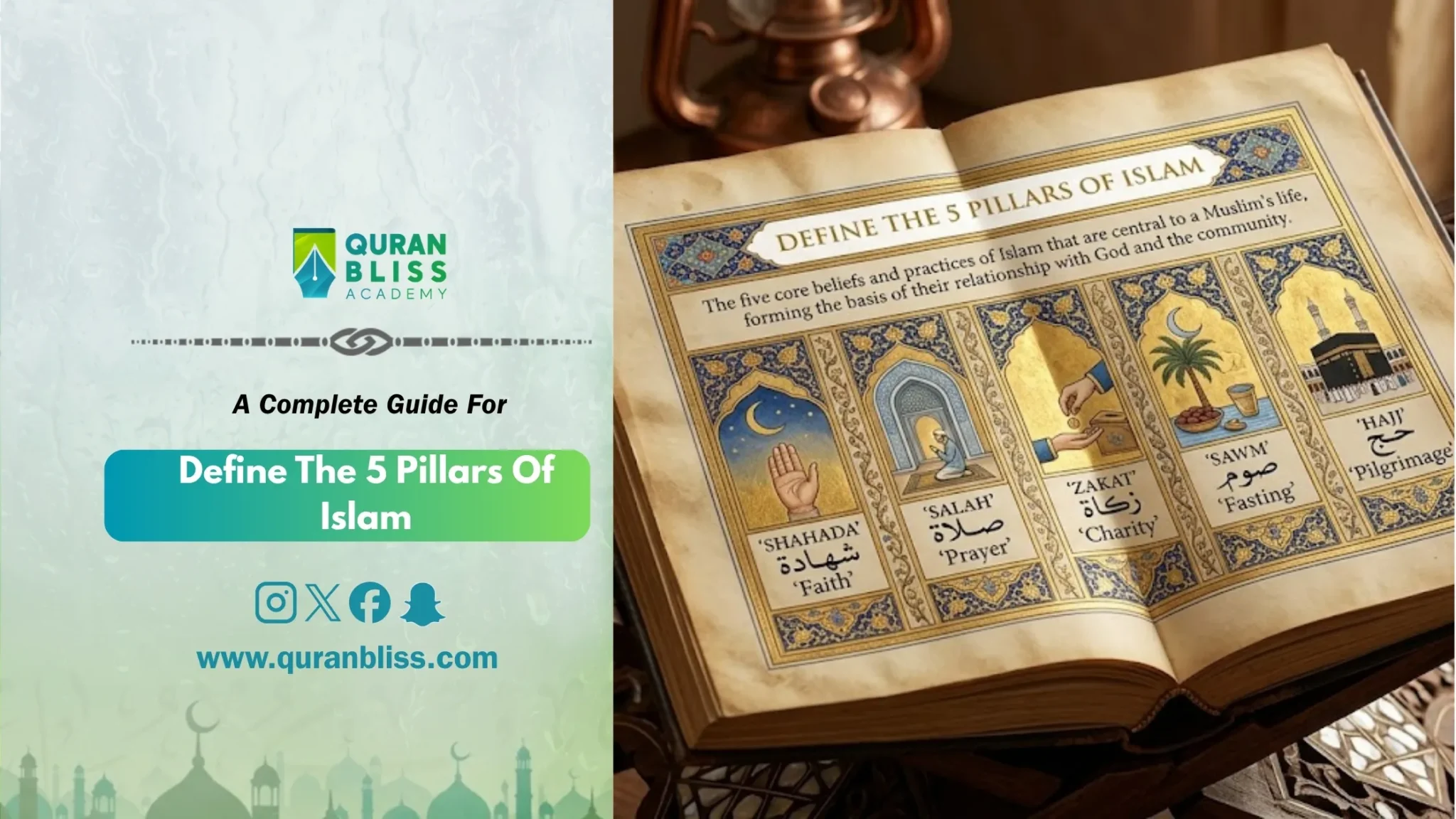
Define the 5 Pillars of Islam: What They Are, What They Mean & Why They Matter
What holds a Muslim’s life together, across every culture, language, and corner of the world? The answer is the same: the Five Pillars of Islam. These five foundational acts of worship are not just rituals. They are the architecture of a Muslim’s entire relationship with Allah, with themselves, and with humanity.
Whether you’re exploring Islam for the first time, helping a child understand their faith, or deepening your own knowledge, this guide defines each of the 5 Pillars clearly, precisely, and with the spiritual depth they deserve.
What Are the 5 Pillars of Islam?
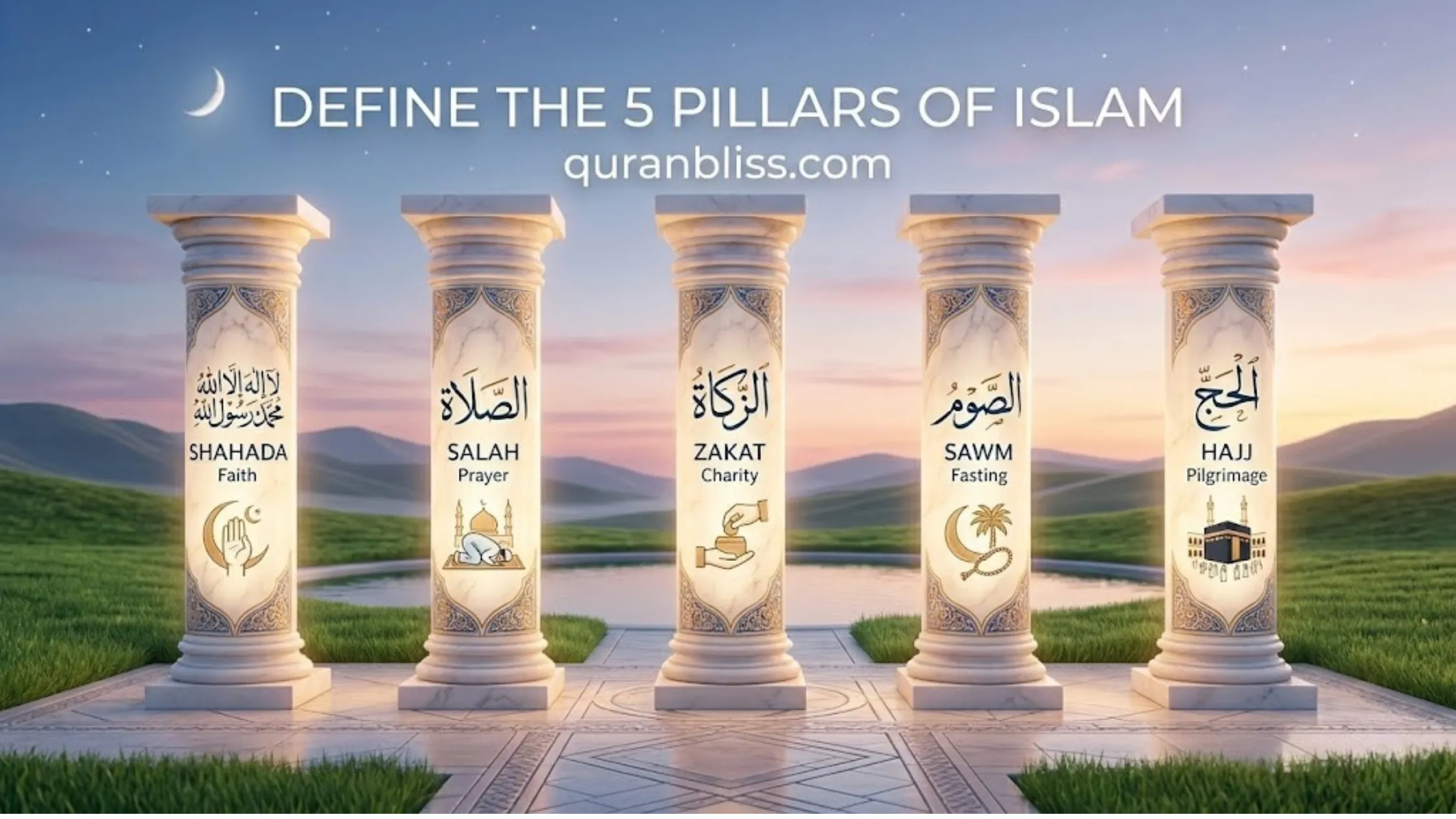
The Five Pillars of Islam are the foundation of a Muslim’s faith and daily worship. They include Shahada (faith), Salah (prayer), Zakat (charity), Sawm (fasting Ramadan), and Hajj (pilgrimage to Makkah).
Why Are They Called “Pillars”?
The Arabic term is Arkan Al-Islam (أَرْكَانُ الإِسْلَام), the Pillars of Islam. Just as physical pillars support a building and keep it standing, these five practices support the entire structure of a Muslim’s faith and life. Remove one, and the building weakens. Uphold all five, and the structure stands firm.
They represent the minimum, non-negotiable obligations every capable Muslim must fulfill, and together, they create a complete rhythm of worship that spans every day, every week, every year, and every lifetime.
Where Do the 5 Pillars Come From?
The 5 Pillars are rooted in one of the most famous hadith in all of Islam, the Hadith of Jibril (Gabriel). The Angel Jibril ﷺ appeared to the Prophet Muhammad ﷺ in the form of a man and asked him to define Islam. The Prophet ﷺ replied:
“الإِسْلَامُ أَنْ تَشْهَدَ أَنْ لَا إِلَهَ إِلَّا اللَّهُ وَأَنَّ مُحَمَّدًا رَسُولُ اللَّهِ، وَتُقِيمَ الصَّلَاةَ، وَتُؤْتِيَ الزَّكَاةَ، وَتَصُومَ رَمَضَانَ، وَتَحُجَّ الْبَيْتَ إِنِ اسْتَطَعْتَ إِلَيْهِ سَبِيلًا”
“Islam is to testify that there is no god but Allah and Muhammad is His messenger, to establish prayer, to pay Zakat, to fast in Ramadan, and to perform Hajj to the House if you are able.”
, Sahih Muslim (8)
This single narration gave us the definitive list of the Five Pillars, directly from revelation.
The 5 Pillars at a Glance
Here is a quick reference to all five pillars before we explore each one in depth:
Pillar | Arabic Name | Meaning | Frequency | Status |
1. Faith | Shahada | Declaration of belief in Allah & Muhammad ﷺ | Once (lifelong) | Obligatory |
2. Prayer | Salah (صَلَاة) | 5 daily prayers facing the Kaaba | 5× daily | Obligatory |
3. Charity | Zakat (زَكَاة) | 2.5% of qualifying wealth to the needy | Annually | Obligatory* |
4. Fasting | Sawm (صَوْم) | Complete fast during Ramadan | 1 month/year | Obligatory |
Pillar 1: Shahada, The Declaration of Faith
Shahada is the declaration that “There is no god but Allah, and Muhammad ﷺ is the Messenger of Allah.” It is the foundation of Islam and the first step into the Muslim faith.
What Is the Shahada in Arabic and English?
The Shahada is the Islamic declaration of faith, the single most important sentence in a Muslim’s life:
أَشْهَدُ أَنْ لَا إِلَهَ إِلَّا اللَّهُ وَأَشْهَدُ أَنَّ مُحَمَّدًا رَسُولُ اللَّهِ
“I bear witness that there is no god but Allah, and I bear witness that Muhammad is the Messenger of Allah.”
, The Shahada (First Pillar of Islam)
What Does the Shahada Actually Mean?
The Shahada has two parts, each carrying profound weight:
- “Lā ilāha illallāh”, There is no deity worthy of worship except Allah. This is Tawhid, pure, absolute monotheism. It rejects all false gods, idols, and rivals to Allah’s sovereignty.
- “Muhammadun Rasulullah”, Muhammad ﷺ is the Messenger of Allah. This affirms that the Quran is divine revelation, that the Prophet’s Sunnah is authoritative, and that Islam is the final, complete message to humanity.
When Do Muslims Say the Shahada?
The Shahada is not said just once. It echoes throughout a Muslim’s entire life:
- At the moment of converting to Islam, it is the entry point into the faith
- In every Adhan (call to prayer) and Iqamah, five times a day
- In the Tashahhud of every Salah, said during sitting position in prayer
- At the moment of death, Muslims strive to make it the last words they speak
The Spiritual Wisdom Behind the Shahada
شَهِدَ اللَّهُ أَنَّهُ لَا إِلَهَ إِلَّا هُوَ وَالْمَلَائِكَةُ وَأُولُو الْعِلْمِ قَائِمًا بِالْقِسْطِ
“Allah witnesses that there is no deity except Him, and [so do] the angels and those of knowledge, [that He is] maintaining [creation] in justice.”
, Surah Al-Imran, 3:18
The Shahada is not merely a verbal declaration, it is a complete worldview. Once uttered with conviction, it reorients every decision, relationship, and priority around the recognition that only Allah deserves ultimate obedience.
Pillar 2: Salah (The Five Daily Prayers)
Salah is the obligation of praying five times a day to maintain a strong connection with Allah. These daily prayers bring peace, discipline, and spiritual guidance to a Muslim’s life.
What Are the 5 Prayer Times and Their Names?
Prayer Name | Arabic | Time | Raka’at |
Fajr | الفجر | Before sunrise | 2 Fard |
Dhuhr | الظهر | After midday | 4 Fard |
Asr | العصر | Afternoon | 4 Fard |
Maghrib | المغرب | Just after sunset | 3 Fard |
Isha | العشاء | Night | 4 Fard |
Each prayer has a specific time window. Missing a prayer intentionally without a valid excuse is a serious matter in Islam, though missed prayers can be made up (Qada).
How Is Salah Performed?
Salah follows a precise sequence combining physical movements and verbal recitations:
- Perform Wudu (ritual ablution), purifying with water
- Face the Qibla (direction of the Kaaba in Makkah)
- Make Niyyah (intention) for the specific prayer
- Begin with Takbirat al-Ihram: say “Allahu Akbar” (Allah is the Greatest)
- Recite Al-Fatiha + additional Quran verses while standing (Qiyam)
- Bow (Ruku’), then stand, then prostrate (Sujud), twice per Rak’ah
- End with the Tashahhud and Taslim: “Assalamu Alaikum Wa Rahmatullah”
Why Does Islam Require 5 Prayers a Day, The Deeper Wisdom
The Prophet ﷺ illustrated the wisdom of Salah with a beautiful metaphor:
“أَرَأَيْتُمْ لَوْ أَنَّ نَهْرًا بِبَابِ أَحَدِكُمْ يَغْتَسِلُ مِنْهُ كُلَّ يَوْمٍ خَمْسَ مَرَّاتٍ، هَلْ يَبْقَى مِنْ دَرَنِهِ شَيْءٌ؟”
“If there were a river at the door of one of you in which he bathed five times daily, would any dirt remain on him?” [The Companions said: No.] He said: “That is the likeness of the five prayers, by them Allah wipes away sins.”
, Sahih Bukhari (528)
Salah is a daily reset, five appointments with Allah that structure the entire day around consciousness of the Divine. It prevents moral decay, builds discipline, and maintains an unbroken connection between servant and Lord.
Friday Prayer (Jumu’ah), What Makes It Special?
On Fridays, the Dhuhr prayer is replaced by Salat al-Jumu’ah, a congregational prayer preceded by a Khutbah (sermon). It is obligatory for adult Muslim men. Allah describes it:
يَا أَيُّهَا الَّذِينَ آمَنُوا إِذَا نُودِيَ لِلصَّلَاةِ مِن يَوْمِ الْجُمُعَةِ فَاسْعَوْا إِلَى ذِكْرِ اللَّهِ
“O you who believe! When the call for prayer on Friday is made, hasten to the remembrance of Allah and leave off trade.”
, Surah Al-Jumu’ah, 62:9
Salah is one of the cornerstones of a Muslim’s spiritual life. If you’re looking to experience Islam’s acts of worship in their most powerful form, learning how to perform Umrah step by step is a beautiful next journey, where Salah itself takes on new meaning as you pray inside Masjid al-Haram.
Pillar 3: Zakat (Obligatory Charity)
What Is Zakat and Who Must Pay It?
Zakat (زَكَاة) literally means “purification” and “growth.” It is the obligatory annual charity that every Muslim must pay, provided they meet two conditions:
- Nisab: Their wealth exceeds the minimum threshold (equivalent to ~85 grams of gold or ~595 grams of silver in today’s value)
- Hawl: That wealth has been held for a full lunar year
How Is Zakat Calculated? The 2.5% Rule Explained Simply
Zakat is 2.5% of your total qualifying wealth, savings, investments, gold, silver, trade goods, that has remained above the Nisab for one full lunar year.
Example: If you have $20,000 in savings for a full year and the Nisab is $5,000, you pay 2.5% of $20,000 = $500 in Zakat.
Zakat does not apply to your home, personal car, clothing, or daily-use items. It targets accumulated, non-essential wealth.
Who Receives Zakat? The 8 Eligible Categories
Allah specified in the Quran exactly who may receive Zakat, leaving no room for misuse:
إِنَّمَا الصَّدَقَاتُ لِلْفُقَرَاءِ وَالْمَسَاكِينِ وَالْعَامِلِينَ عَلَيْهَا وَالْمُؤَلَّفَةِ قُلُوبُهُمْ وَفِي الرِّقَابِ وَالْغَارِمِينَ وَفِي سَبِيلِ اللَّهِ وَابْنِ السَّبِيلِ
“Zakah expenditures are only for the poor and the needy, and for those employed for it, and for bringing hearts together, and for freeing captives, and for those in debt, and for the cause of Allah, and for the stranded traveler.”
, Surah At-Tawbah, 9:60
Category (Arabic) | Who Receives Zakat |
Al-Fuqara (الفقراء) | The poor, those who lack basic necessities |
Al-Masakin (المساكين) | The destitute, even poorer than Al-Fuqara |
Al-‘Amilin (العاملين عليها) | Zakat collectors/administrators |
Al-Mu’allafat Qulubuhum | New Muslims or those whose hearts are to be won |
Ar-Riqab (الرقاب) | Historically: freeing enslaved people |
Al-Gharimin (الغارمون) | Those overwhelmed by debt |
Fi Sabilillah (في سبيل الله) | In the cause of Allah (scholars, students, etc.) |
Ibn Al-Sabil (ابن السبيل) | Stranded travelers with no access to funds |
Zakat vs Sadaqah, What’s the Difference?
Feature | Zakat | Sadaqah |
Obligation | Obligatory (Fard) | Voluntary (Nafl) |
Amount | Fixed: 2.5% of Nisab | Any amount, any time |
Recipients | 8 specific categories only | Anyone in need |
Timing | Annually (after Hawl) | Any time |
Reward | Fard + purification of wealth | Nafl, unlimited blessings |
The Social Justice Wisdom Behind Zakat
Zakat is Islam’s built-in economic justice system. When every Muslim who qualifies pays 2.5% annually, the collective wealth that flows to the poor becomes enormous. It prevents the permanent concentration of wealth among the elite and ensures that money circulates throughout society.
Imam Ali said: “No one goes hungry except by the wealth of the rich being withheld.” Zakat is the structural solution to that injustice.
Pillar 4: Sawm (Fasting in Ramadan)
Sawm is fasting during the holy month of Ramadan, where Muslims abstain from food, drink, and sinful behavior from dawn until sunset. It teaches patience, self-discipline, gratitude, and strengthens a Muslim’s connection with Allah.
What Is Sawm and When Does It Happen?
Sawm (صَوْم) means to fast, to completely abstain from food, drink, and sexual relations from Fajr (dawn) to Maghrib (sunset). This is obligatory for every Muslim during the entire month of Ramadan, the 9th month of the Islamic lunar calendar.
Ramadan lasts 29 or 30 days depending on the sighting of the crescent moon. It is the month in which the Quran was first revealed to the Prophet Muhammad ﷺ.
What Are the Rules of Fasting?
The fast is broken (invalidated) by:
- Eating or drinking anything intentionally, including water
- Smoking or inhaling substances intentionally
- Sexual relations
- Intentional vomiting
Accidentally eating or drinking (forgetting you’re fasting) does NOT break the fast. The Prophet ﷺ said that Allah fed and watered that person, simply stop and continue fasting.
Who Is Exempt From Fasting?
Islam provides mercy-based exemptions. The following groups may skip or delay fasting:
- Travelers: May break fast and make it up later
- Sick individuals: May delay if fasting worsens their condition
- Pregnant or breastfeeding women: May skip and make up later or pay Fidyah
- Elderly who cannot fast: Pay Fidyah (feeding a poor person per missed day)
- Menstruating women: Must break fast and make up the days after Ramadan
- Children: Not obligated until puberty
The Spiritual and Psychological Wisdom of Fasting
يَا أَيُّهَا الَّذِينَ آمَنُوا كُتِبَ عَلَيْكُمُ الصِّيَامُ كَمَا كُتِبَ عَلَى الَّذِينَ مِن قَبْلِكُمْ لَعَلَّكُمْ تَتَّقُونَ
“O you who believe! Fasting is prescribed for you as it was prescribed for those before you, so that you may attain Taqwa (God-consciousness).”
, Surah Al-Baqarah, 2:183
The goal of Sawm is not hunger, it is Taqwa. Fasting trains the soul to overcome desires, builds empathy with the poor, and creates an unparalleled sense of community as Muslims worldwide fast simultaneously.
Modern psychology confirms what Islam taught 1,400 years ago: structured fasting (like intermittent fasting) improves cognitive function, emotional regulation, and physical health. But the Muslim’s Sawm goes further, it is worship, surrender, and spiritual renewal all at once.
Ramadan is also the most spiritually rewarding time to perform Umrah. Explore our complete step by step Umrah guide to understand how the Lesser Pilgrimage combines with Ramadan’s blessings for a transformative spiritual experience.
What Is Laylat al-Qadr and Why Is It Inside Ramadan?
Laylat al-Qadr, the Night of Power, falls within the last ten nights of Ramadan (most likely the 27th night). Allah describes it:
لَيْلَةُ الْقَدْرِ خَيْرٌ مِّنْ أَلْفِ شَهْرٍ
“The Night of Power is better than a thousand months.”
, Surah Al-Qadr, 97:3
Worship on this single night equals more than 83 years of continuous worship. This is why Muslims intensify prayer, Quran recitation, and du’a during the last ten nights of Ramadan, seeking this hidden treasure.
Pillar 5: Hajj (The Pilgrimage to Makkah)
Hajj is the sacred pilgrimage to Makkah that every Muslim who is physically and financially able must perform once in a lifetime. It is a journey of faith, unity, and complete devotion to Allah.
What Is Hajj and When Does It Take Place?
Hajj (حَجّ) is the annual Islamic pilgrimage to Makkah, the fifth and final pillar. It takes place during the first two weeks of Dhul Hijjah, the 12th and final month of the Islamic lunar calendar, with the main rituals concentrated on the 8th through 13th days.
Millions of Muslims from every nation, race, and language gather simultaneously, standing side by side in white Ihram garments, all equal before Allah. It is the largest annual human gathering on Earth.
Who Is Required to Perform Hajj?
Hajj is obligatory once in a lifetime for every adult Muslim who meets all three conditions:
- Physical ability: Healthy enough to make the journey and perform the rituals
- Financial ability: Can afford the trip without going into debt or harming dependents
- Safety of the route: No dangerous conditions preventing travel
If any of these conditions are not met, Hajj is not obligatory, and Allah does not burden a soul beyond what it can bear.
The Main Rituals of Hajj
- Enter Ihram at the Miqat boundary
- Arrive in Makkah, perform Tawaf al-Qudum (arrival Tawaf)
- Travel to Mina on the 8th of Dhul Hijjah
- Stand at Arafat on the 9th, the single most essential rite of Hajj
- Spend the night at Muzdalifah, collect pebbles
- Return to Mina, throw pebbles at Jamarat (stoning the devil)
- Perform animal sacrifice (Udhiyah/Qurbani) on Eid al-Adha
- Shave or trim hair, exit Ihram
- Return to Makkah, perform Tawaf al-Ifadah and Sa’i
- Farewell Tawaf (Tawaf al-Wada’) before departing
What Is the Spiritual Significance of Hajj?
وَأَذِّن فِي النَّاسِ بِالْحَجِّ يَأْتُوكَ رِجَالًا وَعَلَى كُلِّ ضَامِرٍ يَأْتِينَ مِن كُلِّ فَجٍّ عَمِيقٍ
“And proclaim to the people the Hajj; they will come to you on foot and on every lean camel; they will come from every distant pass.”
, Surah Al-Hajj, 22:27
Hajj is the ultimate equalizer. When you stand at Arafat in white Ihram, no designer clothing, no status, no nationality, you are just a servant of Allah alongside millions of other servants. The Prophet ﷺ said about an accepted Hajj:
“الْحَجُّ الْمَبْرُورُ لَيْسَ لَهُ جَزَاءٌ إِلَّا الْجَنَّةُ”
“An accepted Hajj has no reward except Paradise.”
, Sahih Bukhari (1773)
Hajj vs Umrah, What’s the Difference?
Feature | Hajj | Umrah |
Obligation | Fard (once in lifetime) | Sunnah Mu’akkadah |
Timing | Dhul Hijjah 8–13 only | Any time of year |
Duration | 5–6 days (fixed) | A few hours to 2 days |
Key ritual | Standing at Arafat (Wuquf) | No Arafat |
Reward | “No reward except Jannah” | Expiation between two Umrahs |
Common Misconceptions About the 5 Pillars
Is Hajj Mandatory Even If You Can’t Afford It?
No. This is one of the most misunderstood aspects of Hajj. Allah explicitly conditions the obligation on istita’ah (ability). If performing Hajj would put you in debt, leave your family without provision, or endanger your health, it is NOT obligatory for you at that time.
The day you gain the ability, Hajj becomes obligatory. It should not be indefinitely postponed once you are able, but Islam never imposes hardship beyond capability.
Does Missing a Prayer Make You a Non-Muslim?
Scholars differ on this question, and it is one of the most debated in Islamic jurisprudence. The mainstream position (Jumhur of scholars) is that deliberately abandoning Salah entirely out of denial of its obligation is disbelief, but missing prayers out of laziness is a major sin that does not remove one from Islam, though it requires immediate repentance and making up the prayers.
The point is never to use this as comfort for neglecting Salah, but to understand that Islam distinguishes between a Muslim who struggles with their obligations and one who rejects them entirely.
The 5 Pillars of Islam for Kids, Explained Simply
Teaching children the 5 Pillars early plants the seeds of a lifelong faith. Here’s how to explain each one in child-friendly language:
- Shahada, “We believe with all our heart that Allah is the only God, and that Prophet Muhammad ﷺ is His messenger who taught us how to live.”
- Salah, “We talk to Allah five times every day through prayer, in the morning, at noon, in the afternoon, at sunset, and at night. It’s our special time with Allah.”
- Zakat, “Every year, Muslims who have enough money share some of it with people who need help. It’s like giving a hug through your money.”
- Sawm, “During the special month of Ramadan, Muslims don’t eat or drink during the day to feel close to Allah and learn to be patient and kind.”
- Hajj, “Once in their life, Muslims travel to the holy city of Makkah to visit Allah’s House, the Kaaba, and pray together with millions of Muslims from all over the world.”
Deepening Your Understanding of Islamic Worship
The 5 Pillars are your foundation, but Islam’s depth extends far beyond them. If you’re looking to build on this knowledge, our complete guide on how to perform Umrah for beginners walks you through the Lesser Pilgrimage in full detail, a beautiful way to put your faith into physical action and experience the Kaaba firsthand, long before Hajj.
To define the 5 pillars of Islam is to describe the heartbeat of a Muslim’s existence. The Shahada anchors the identity. Salah structures every single day. Zakat purifies wealth. Sawm purifies the soul. And Hajj unites the Ummah before Allah in the most extraordinary gathering on Earth..
Want to take the next step in your Islamic journey? Learn how to perform Umrah for beginners, or explore our guides on the steps of Hajj and the blessed days of Dhul Hijjah. Your faith deserves to be lived, not just learned.
Frequently Asked Questions About the 5 Pillars of Islam
The Five Pillars in order are: (1) Shahada, declaration of faith, (2) Salah, five daily prayers, (3) Zakat, obligatory charity, (4) Sawm, fasting in Ramadan, and (5) Hajj, pilgrimage to Makkah. This order is based on the Hadith of Jibril narrated in Sahih Muslim.
Yes, all five pillars are mentioned in the Quran, though not all in a single verse. Salah and Zakat are mentioned together over 80 times. Sawm is commanded in Surah Al-Baqarah (2:183). Hajj is commanded in Surah Al-Imran (3:97). The Shahada is referenced across numerous verses about Tawhid and bearing witness to Allah’s oneness.
Failing to uphold the pillars is a serious matter, each has different consequences. Denying the Shahada removes one from Islam. Abandoning Salah is a major sin (scholars differ on whether it constitutes disbelief). Not paying Zakat when obligatory is a major sin with divine warning. Neglecting Sawm intentionally is a major sin. Failing to perform Hajj despite ability is condemned strongly in hadith. Islam always encourages returning to repentance rather than despair.
Yes. The Shahada is the foundation upon which all others stand. Without it, no other pillar is valid. It is the entry point into Islam and the lifelong declaration that everything a Muslim does is rooted in belief in Allah and His messenger. The other four pillars are expressions of that belief in action.
A non-Muslim cannot perform the pillars as acts of Islamic worship, because the prerequisite is the Shahada, acceptance of Islam. However, non-Muslims may physically visit Madinah (with some restrictions near the Prophet’s mosque) and are welcome to observe and learn about Islam’s practices. Acts like fasting or charity done by non-Muslims are virtuous deeds, but they are not counted as the Islamic Pillars without the foundation of faith. What are the 5 pillars of Islam in order?
Are the 5 pillars mentioned in the Quran?
What happens if a Muslim doesn't follow the 5 pillars?
Is Shahada the most important pillar?
Can non-Muslims perform any of the 5 pillars?
Islamic Studies Course
for Adults
Deepen your understanding of Islam’s teachings.
Learn More
The 5 Pillars of Islam
Understand the fundamental principles of Islamic faith and practice.
Learn More