
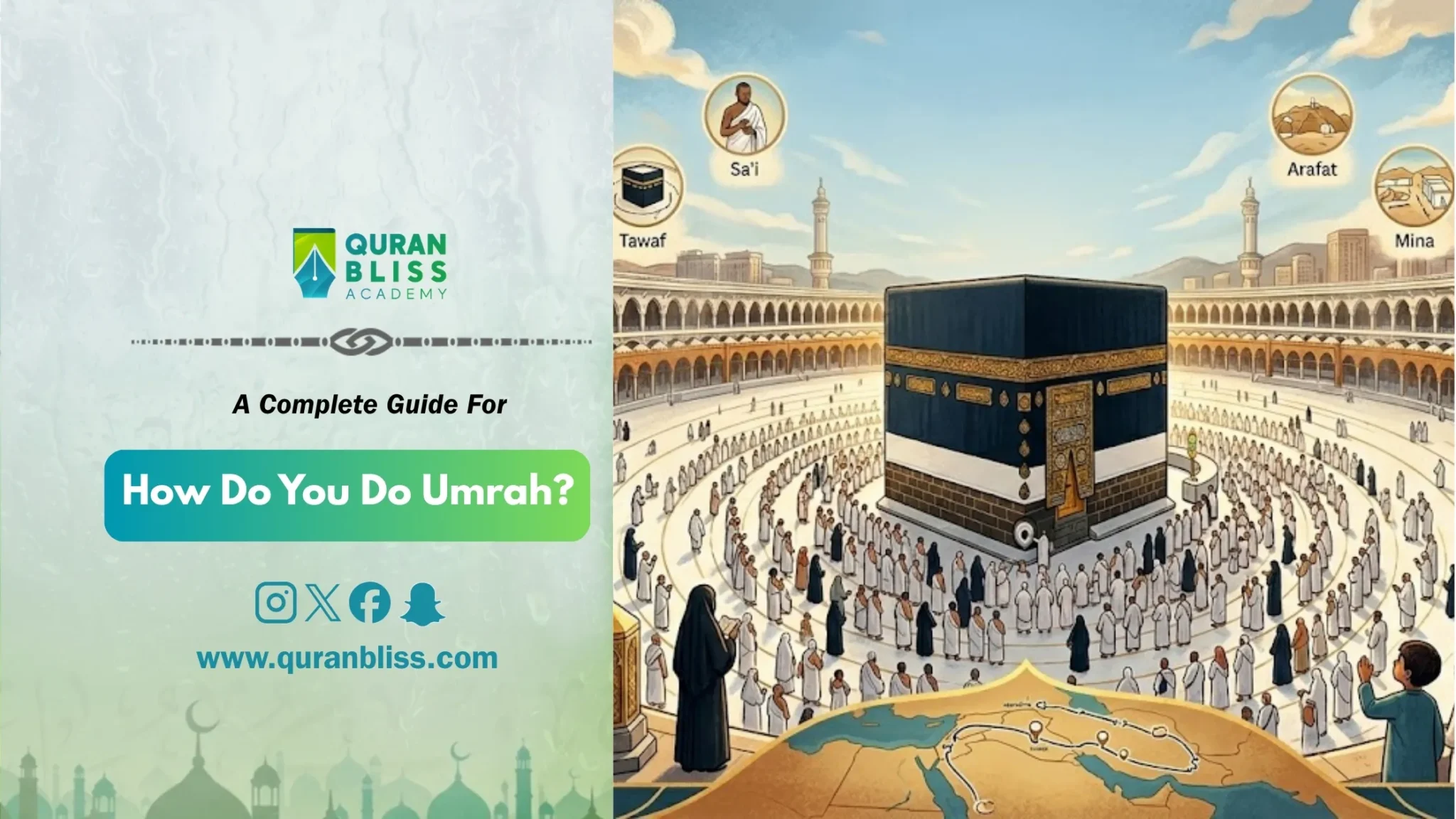
How Do You Do Umrah? A Complete Step-by-Step Guide for Beginners
Have you been dreaming of standing before the Kaaba, making Tawaf around the House of Allah, and returning home spiritually renewed , but you’re not sure where to start? You’re not alone. Thousands of Muslims perform Umrah for the first time every year, and the most common question is always the same: how do you do Umrah, exactly?
This complete, step-by-step guide walks you through every ritual , from entering the state of Ihram to the final cut of hair that marks your Umrah complete. Whether you’re a first-timer or refreshing your knowledge, you’ll find everything you need right here.
What Is Umrah and Why Does It Matter?
Umrah is more than a journey to Makkah — it is a journey of the heart. Through this blessed pilgrimage, Muslims seek forgiveness, spiritual renewal, and a deeper connection with Allah away from the distractions of daily life.
The Meaning of Umrah in Islam
The word Umrah (عُمْرَة) comes from the Arabic root meaning “to visit a populated place.” In Islamic terminology, it refers to the Lesser Pilgrimage , a voluntary visit to the Masjid al-Haram in Makkah, where you perform specific acts of worship.
Unlike Hajj, Umrah can be performed at any time of year and is not obligatory. However, it is considered a highly recommended Sunnah , an act our Prophet Muhammad ﷺ encouraged strongly.
Umrah vs Hajj , What’s the Difference?
Many Muslims wonder how Umrah differs from Hajj. Here is a clear side-by-side comparison:
Feature | Umrah (Lesser Pilgrimage) | Hajj (Major Pilgrimage) |
Obligation | Sunnah Mu’akkadah (highly recommended) | Fard (obligatory once in a lifetime) |
Time | Any time of year | Only in Dhul Hijjah (8–13) |
Duration | A few hours to 1–2 days | 5–6 days (fixed rituals) |
Steps | Ihram, Tawaf, Sa’i, Halq/Taqsir | Includes Arafat, Muzdalifah, Mina, stoning |
Crowd level | Varies (Ramadan is busiest) | Millions gather simultaneously |
Understanding the pillars of your faith makes every act of worship more meaningful. If you’d like to explore further, our guide on define the 5 pillars of islam explains how Umrah and Hajj connect to the broader framework of Islamic practice.
The Spiritual Rewards of Performing Umrah
The Prophet Muhammad ﷺ described the immense reward of Umrah in authentic hadith:
“الْعُمْرَةُ إِلَى الْعُمْرَةِ كَفَّارَةٌ لِمَا بَيْنَهُمَا، وَالْحَجُّ الْمَبْرُورُ لَيْسَ لَهُ جَزَاءٌ إِلَّا الْجَنَّةُ”
“From one Umrah to the next is an expiation for whatever comes between them, and an accepted Hajj brings no less a reward than Paradise.”
, Sahih Bukhari (1773) & Sahih Muslim (1349)
Umrah wipes away sins committed between two pilgrimages. It is a powerful opportunity for spiritual rebirth, renewal of faith, and drawing closer to Allah.
How Do You Do Umrah? The 4 Main Steps
Umrah consists of 4 essential steps performed in this exact order:
Step | Name | What You Do | Status After |
1 | Ihram | Purify, dress, make Niyyah, recite Talbiyah | In sacred state |
2 | Tawaf | Circle the Kaaba 7 times counter-clockwise | Still in Ihram |
3 | Sa’i | Walk between Safa & Marwah 7 times | Still in Ihram |
4 | Halq/Taqsir | Shave or trim hair | Ihram ended |
Each step carries deep spiritual meaning and specific rules. We’ll cover every detail in the sections below , so keep reading to perform Umrah correctly and with full confidence.
How to Prepare for Umrah Before You Travel?
Spiritual Preparation: Intention & Repentance
Before anything else, prepare your heart. Umrah is an act of worship , and every act of worship begins with sincere Niyyah (intention). Make genuine Tawbah (repentance) for past sins. Resolve to return to being a better Muslim.
Read about the rituals in advance so you understand the meaning behind each step. Knowing why you’re doing something transforms a physical act into a spiritual one.
Physical Preparation: What to Pack, What to Avoid
For men: pack two white seamless sheets of unstitched cloth for Ihram. Avoid any stitched clothing, perfume, or scented soap after you enter Ihram.
For women: pack modest, loose-fitting clothing in any color (no specific Ihram garment required). Cover your hair fully, but your face and hands remain uncovered.
Essential items to bring:
- Ihram garments (men) / modest loose clothing (women)
- Comfortable walking shoes , you will walk miles
- Personal medications, unscented soap, and toiletries
- Small du’a (supplication) booklet or app
- Waist pouch or small bag for documents and cash
Documents & Visa Requirements
Saudi Arabia requires an Umrah visa, which is typically arranged through an authorized travel agent or online via the Nusuk platform (nusuk.sa). Ensure you have:
- Valid passport (at least 6 months validity)
- Umrah visa issued by Saudi authorities
- Meningitis vaccination certificate (ACWY)
- Confirmed hotel bookings in Makkah
Entering Ihram (The Sacred State)
What Is Ihram and Why It’s the Foundation
Ihram is not just clothing , it is a state of sacred consecration. When you enter Ihram, you signal to Allah and to yourself that you are leaving the world behind and entering a space of pure devotion. Everything begins here.
You must enter Ihram before or at the Miqat , a designated boundary surrounding Makkah. There are five Miqat points depending on your direction of travel. Crossing the Miqat without Ihram invalidates your Umrah.
Ghusl, Grooming, and Putting On Ihram Garments
Before entering Ihram, perform the following:
- Perform a full Ghusl (ritual bath) , this is Sunnah but highly recommended
- Trim nails, remove unwanted body hair, and groom yourself , these become forbidden after Ihram
- Apply perfume to your body before putting on Ihram , not after (perfume on Ihram clothing is forbidden)
- Men: wear two pieces of white, unstitched cloth , one wrapped around the waist (Izar), one draped over the shoulders (Rida’)
- Women: wear clean, loose, modest clothing covering the entire body except face and hands
Men’s Ihram vs Women’s Clothing
- Men must wear the two unstitched white garments and may not wear sewn clothing, socks, or shoes that cover the ankle.
- Women have no specific Ihram garment , they dress modestly as usual. Women must NOT wear a face veil (Niqab) or gloves while in Ihram.
Making the Niyyah and Reciting the Talbiyah
At the Miqat, make your intention for Umrah and recite:
لَبَّيْكَ اللَّهُمَّ عُمْرَةً
“Labbayk Allahumma ‘Umratan” , “Here I am, O Allah, for Umrah”
, Intention (Niyyah) for Umrah
Then begin reciting the Talbiyah continuously until you start Tawaf:
لَبَّيْكَ اللَّهُمَّ لَبَّيْكَ، لَبَّيْكَ لَا شَرِيكَ لَكَ لَبَّيْكَ، إِنَّ الْحَمْدَ وَالنِّعْمَةَ لَكَ وَالْمُلْكَ، لَا شَرِيكَ لَكَ
“Here I am, O Allah, here I am. Here I am, You have no partner, here I am. Verily all praise and blessings are Yours, and all sovereignty. You have no partner.”
, The Talbiyah (recite repeatedly until beginning Tawaf)
Men recite the Talbiyah loudly. Women recite it quietly.
What’s Forbidden During Ihram?
Once in Ihram, the following are prohibited until you exit:
- Cutting hair or nails
- Using perfume or scented products
- Sexual relations or romantic talk with spouse
- Hunting or killing land animals
- Covering the head (for men) or face/hands (for women)
- Wearing stitched clothing (for men)
- Arguing, using foul language, or sinning
Performing Tawaf Circling the Kaaba
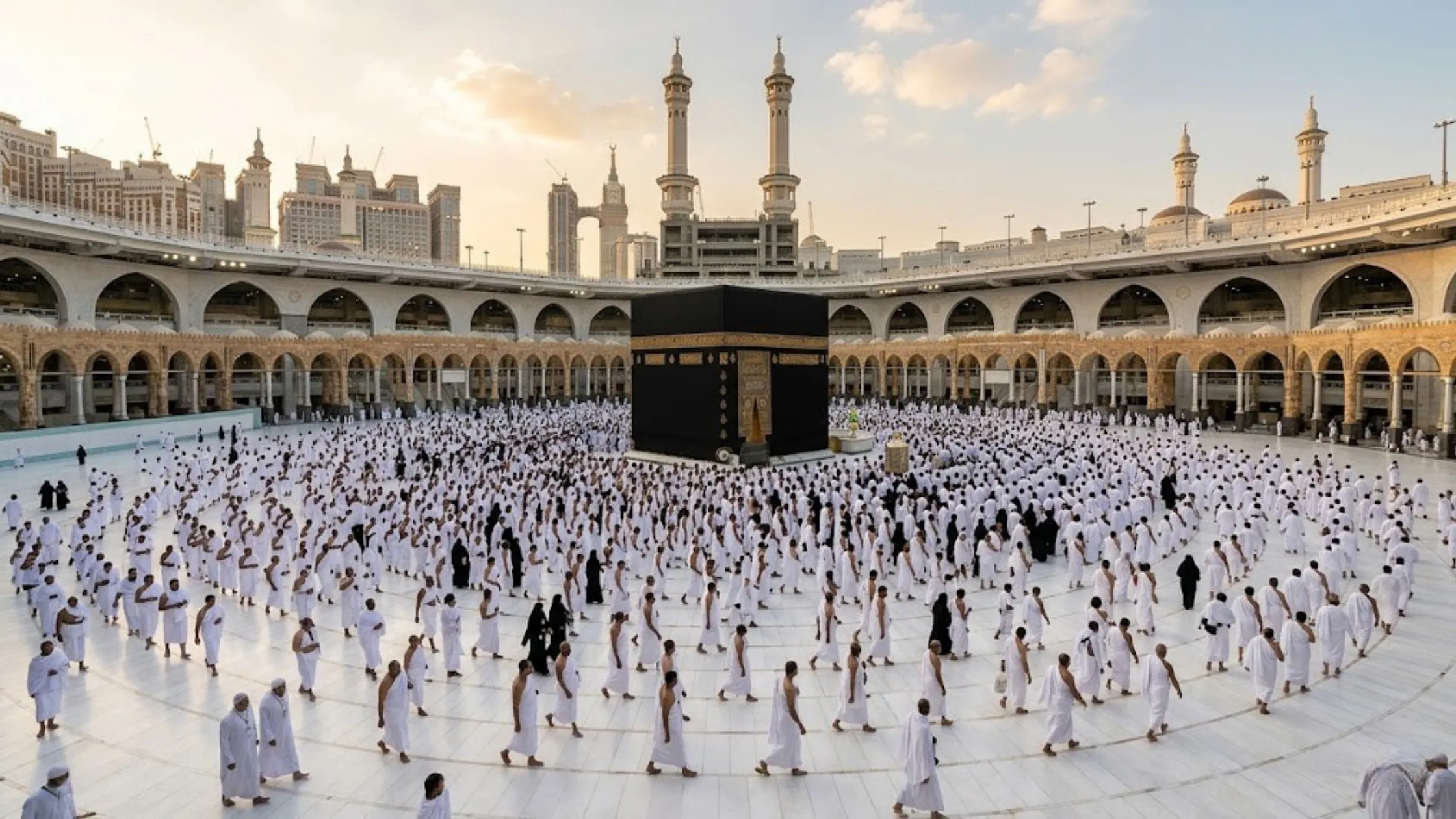
Tawaf is one of the most emotional moments of Umrah, where pilgrims circle the Kaaba seven times in worship and remembrance of Allah. As millions move together around the House of Allah, the act symbolizes unity, devotion, and complete submission to Him.
What Is Tawaf and How Many Rounds?
Tawaf means to circle the Kaaba , the sacred cube-shaped structure at the center of Masjid al-Haram. You will complete exactly 7 rounds (Shawt, plural: Ashwat), moving counter-clockwise, starting and ending at the Black Stone (Hajar al-Aswad).
Tawaf is an act of devotion symbolizing the unity of Muslims worldwide, all turning toward the same House of Allah.
Starting Point: The Black Stone (Hajar al-Aswad)
The Black Stone is embedded in the eastern corner of the Kaaba. To start each round, face the Black Stone and either:
- Touch and kiss it (if possible without causing harm to others), or
- Touch it with your right hand, or
- Point toward it with your right hand and say: بِسْمِ اللَّهِ، اللَّهُ أَكْبَرُ (Bismillah, Allahu Akbar)
Due to the crowds, most pilgrims will only be able to point. This is perfectly valid. Do not push or harm others to reach the Stone.
Special Rules for Men: Idtibaa & Ramal
Men perform two special acts during Tawaf al-Umrah only (not obligatory Tawaf):
- Idtibaa: Drape the Ihram cloth under the right armpit and over the left shoulder, leaving the right shoulder bare throughout all 7 rounds.
- Ramal: Walk briskly with short steps and swagger during the first 3 rounds only. Walk normally for the remaining 4 rounds.
These acts apply to men only. Women perform Tawaf at a normal pace.
What to Recite During Tawaf
There is no specific prescribed du’a for each round. You are free to recite any du’a, Quran, or dhikr (remembrance of Allah) throughout Tawaf. The following du’a is recommended when passing the Yemeni Corner (before the Black Stone corner):
رَبَّنَا آتِنَا فِي الدُّنْيَا حَسَنَةً وَفِي الْآخِرَةِ حَسَنَةً وَقِنَا عَذَابَ النَّارِ
“Our Lord, give us good in this world and good in the Hereafter, and protect us from the punishment of the Fire.”
, Surah Al-Baqarah, 2:201 (recommended du’a between Yemeni Corner and Black Stone)
Praying 2 Rak’ahs After Tawaf (Maqam Ibrahim)
After completing all 7 rounds, perform 2 rak’ahs of prayer, ideally behind Maqam Ibrahim (the station of Prophet Ibrahim ﷺ). If this is too crowded, you may pray anywhere in the mosque.
In the first rak’ah, recite Surah Al-Kafirun after Al-Fatiha. In the second rak’ah, recite Surah Al-Ikhlas.
Drinking Zamzam Water and Visiting the Multazam
After your 2 rak’ahs, drink Zamzam water with intention and du’a. The Prophet ﷺ said:
“مَاءُ زَمْزَمَ لِمَا شُرِبَ لَهُ”
“Zamzam water is for whatever purpose it is drunk for.”
, Ibn Majah (3062)
You may also visit the Multazam , the section of the Kaaba wall between the Black Stone and the door. Press your body against it and make sincere du’a. This is a blessed spot where supplications are accepted.
Performing Sa’i (Walking Between Safa and Marwah)
Why Sa’i Matters , The Story of Hajar
Sa’i commemorates one of the most powerful acts of faith in Islamic history. When Prophet Ibrahim ﷺ left his wife Hajar (Hagar) and infant son Ismail ﷺ in the desert valley of Makkah, she ran seven times between the hills of Safa and Marwah searching desperately for water.
Her unwavering trust in Allah was rewarded , the well of Zamzam miraculously appeared. Every Muslim who performs Sa’i honors her legacy and connects to this profound story of tawakkul (reliance on Allah).
How to Perform Sa’i Step by Step
After Tawaf and your 2 rak’ahs, proceed to the Mas’a , the enclosed corridor between Safa and Marwah:
- Begin at Safa (going toward Marwah = 1 lap)
- Walk at a normal pace (men jog lightly between the green marker lights)
- Reach Marwah (= 2nd lap ends)
- Return from Marwah to Safa (= 3rd lap)
- Continue until you complete 7 laps, ending at Marwah
Safa → Marwah = 1 lap. You start at Safa and end at Marwah on your 7th lap. Many beginners mistakenly count round trips as one circuit.
Du’a at Safa and Marwah
At Safa, face the Kaaba, raise your hands, and recite:
إِنَّ الصَّفَا وَالْمَرْوَةَ مِن شَعَائِرِ اللَّهِ
“Indeed, Safa and Marwah are among the symbols of Allah.”
, Surah Al-Baqarah, 2:158
Then say Allahu Akbar three times and make any du’a. Repeat the same at Marwah at the start of each return lap.
Men vs Women During Sa’i
Men should jog lightly (Harwala) between the green fluorescent marker lights in the middle of the corridor. Women walk at a normal pace throughout the entire Sa’i. Both men and women may perform Sa’i on the upper level of the Mas’a if needed.
If you’re planning your trip around the blessed month of sacrifice, our dedicated guide on Dhul Hijjah 2026 covers the best days to perform Umrah and the extra acts of worship that maximize your rewards during these sacred ten days.
Halq or Taqsir (Shaving or Cutting Hair)
Why This Step Completes Your Umrah
Halq or Taqsir is the final ritual of Umrah. Without it, your Umrah is incomplete and you remain in the state of Ihram. This act symbolizes humility, surrender to Allah, and the shedding of one’s old self.
Rules for Men: Shaving vs Trimming
- Halq (complete head shave) is the more rewarded option for men. The Prophet ﷺ made du’a three times for those who shave their heads, and once for those who trim.
اللَّهُمَّ اغْفِرْ لِلْمُحَلِّقِينَ , اللَّهُمَّ اغْفِرْ لِلْمُحَلِّقِينَ , اللَّهُمَّ اغْفِرْ لِلْمُحَلِّقِينَ , وَلِلْمُقَصِّرِينَ
“O Allah, forgive those who shave their heads , (x3) , and those who trim.”
, Sahih Bukhari (1728)
- Taqsir (trimming at least 1 cm from all around the head) is permissible but considered less reward. Barbers are available inside and around Masjid al-Haram.
Rules for Women: Fingertip Trim Only
Women do NOT shave their heads. Instead, they cut a fingertip-length (approximately 2–3 cm) from the ends of their hair. This can be done privately anywhere , no barber required.
What Becomes Permissible After Exiting Ihram
Once you complete Halq or Taqsir, your Ihram ends and all previously forbidden acts become permissible again , including wearing regular clothing, using perfume, and all normal daily activities. Your Umrah is now complete. Alhamdulillah!
Common Mistakes to Avoid During Umrah
Mistakes in Ihram
- Crossing the Miqat without entering Ihram (requires a penalty/dam)
- Wearing stitched clothing or socks over the ankle (men)
- Applying perfume or deodorant after entering Ihram
- Women wearing Niqab or gloves , these are prohibited in Ihram
Mistakes During Tawaf
- Losing count of rounds , use a counter app or finger counting
- Stopping mid-Tawaf for prayers and not resuming from where you stopped
- Walking in the wrong direction (Tawaf must be counter-clockwise)
- Crowding, pushing, or harming others to kiss the Black Stone
- Women not maintaining their Ihram garment while circling
Mistakes During Sa’i
- Starting Sa’i from Marwah instead of Safa
- Counting a round trip as one lap , you need 7 one-way laps
- Men forgetting to jog between the green lights
- Performing Sa’i without Wudu (not required, but Wudu is preferred)
- Leaving Sa’i unfinished thinking it’s complete after reaching Marwah for the first time
What to Expect During Your First Umrah Journey?
Your first Umrah journey is both emotional and life-changing. From seeing the Kaaba for the first time to performing each ritual alongside Muslims from around the world, every moment brings a deep sense of peace, humility, and connection with Allah.
How Long Does Umrah Take?
The rituals themselves , Tawaf, Sa’i, and Halq/Taqsir , can be completed in as little as 3–5 hours for experienced pilgrims. However, for first-timers, expect 5–8 hours due to navigation, crowds, and taking your time with du’a.
Many pilgrims choose to perform Umrah late at night or in the early morning hours (after Fajr or after midnight) when the crowds are thinner and the atmosphere is more serene and spiritual.
Tips for Performing Umrah During Crowded Seasons
- Ramadan is the most crowded and most spiritually rewarding time , arrive very early or very late for Tawaf
- Avoid peak Tawaf times (right after Fajr and Asr prayers) if you prefer less crowd
- The upper floor of Masjid al-Haram for Tawaf is almost always less crowded than the ground floor
- Wear comfortable, non-slip shoes , the marble floors get slippery
- Stay hydrated with Zamzam water throughout; dehydration is very common
- Keep your group together , designate a meeting point in case you get separated
Special Cases: Women, Elderly, and Children
Umrah During Menstruation , What to Do
A woman who arrives at the Miqat while menstruating can still enter Ihram with the Niyyah for Umrah and recite the Talbiyah. However, she cannot perform Tawaf (which requires Tahara/purity) until her period ends and she performs Ghusl.
She may perform all other preparations and wait until she is pure. Once pure, she performs Tawaf, Sa’i, and Taqsir as normal. There is no penalty for the delay.
Performing Umrah with Young Children
Children may perform Umrah, and it is a beautiful act for families. Their Umrah counts as Nafl (voluntary) worship. A parent or guardian performs Tawaf while carrying or accompanying the child. Sa’i may be done with young children in a stroller on the upper floor.
Ensure children are dressed appropriately, well-hydrated, and that you use a carrier or stroller in crowded areas for their safety.
Umrah for Elderly or Physically Limited Pilgrims
Wheelchairs are widely available at Masjid al-Haram , free of charge or for a small fee for pushers. The Tawaf area has a designated wheelchair track on the outer ring.
For those physically unable to walk Sa’i, electric carts and wheelchairs are available in the Mas’a corridor. There is absolutely no shame in using these , Islam is a religion of ease.
يُرِيدُ اللَّهُ بِكُمُ الْيُسْرَ وَلَا يُرِيدُ بِكُمُ الْعُسْرَ
“Allah intends ease for you and does not intend hardship for you.”
, Surah Al-Baqarah, 2:185
What to Do After Umrah: The Next Steps for Every Muslim
Visiting Madinah and Masjid al-Nabawi
Many pilgrims combine their Umrah trip with a visit to Al-Madinah Al-Munawwarah, home of Masjid al-Nabawi , the mosque of the Prophet ﷺ. While visiting Madinah is not part of Umrah’s rituals, praying in Masjid al-Nabawi is worth 1,000 prayers in any other mosque.
Visit the Prophet’s grave ﷺ and send salah upon him. Visit Masjid Quba (the first mosque built in Islam) and pray there , the reward is equivalent to an Umrah.
Many who complete Umrah feel inspired to learn more about the major pilgrimage. Our detailed guide on how to perform Hajj walks you through every step , from Arafat to the final Tawaf al-Wada’ , so you can prepare with full knowledge and spiritual readiness.
How to Maintain Your Spiritual State After Umrah
The real test of Umrah is what you do when you return home. The Prophet ﷺ taught us that the mark of an accepted Hajj or Umrah is that the pilgrim returns better than they left.
To preserve the spiritual momentum:
- Establish or strengthen your 5 daily prayers
- Begin reading Quran regularly , even a few verses daily
- Avoid sins and people who lead you away from Allah
- Give in charity , Umrah opens the heart to generosity
- Make du’a for the acceptance of your Umrah
Whether you are planning your first Umrah or your tenth, approach it with fresh eyes, a clean heart, and full knowledge of what you’re doing and why. May Allah accept your Umrah, forgive your sins, and return you home with a heart full of nur (light).
Ameen.
Ready to deepen your knowledge of Islam before your journey? Explore our comprehensive guides on the 5 Pillars of Islam, the significance of Dhul Hijjah, and how to perform Hajj , all written to help you worship with knowledge and sincerity.
Performing Umrah is one of the most transformative experiences a Muslim can have. Now you know exactly how to do Umrah , from entering the sacred state of Ihram, to the peaceful completion of Halq. Each step is a conversation with Allah; each lap of Tawaf, a declaration of love.
Frequently Asked Questions About Umrah
Yes. Unlike Hajj, Umrah can be performed at any time during the Islamic year. The most spiritually rewarding time is Ramadan, when the Prophet ﷺ said performing Umrah equals the reward of Hajj. However, it is also the most crowded.
The four rituals (Ihram, Tawaf, Sa’i, and Halq/Taqsir) can be done in 3 to 8 hours depending on crowd levels, physical ability, and how much time you spend in du’a. Many pilgrims spread the experience over 4–6 hours to absorb the spirituality.
Saudi Arabia’s official requirements have been updated. Women above age 45 may travel in organized groups without a Mahram. Women under 45 typically still need a Mahram. Requirements may change , always check the latest Saudi Umrah visa rules before booking.
Minor violations during Ihram (such as accidentally using scented soap) do not invalidate Umrah. Seek forgiveness and continue. For major violations (like having relations with a spouse during Ihram), consult a scholar , a penalty (Dam/Kaffarah) may be required.
Build on the lesser number. If you’re unsure whether you completed 4 or 5 rounds, assume 4 and complete 3 more. This is the safe and correct approach as per Islamic jurisprudence. It is better to do one extra round than one less.
No. Umrah is the Lesser Pilgrimage , voluntary, performable any time, and shorter. Hajj is the Major Pilgrimage , obligatory once in a lifetime for those able, performed during specific days of Dhul Hijjah, and includes additional rituals like standing at Arafat, staying in Muzdalifah, and throwing pebbles at Jamarat Can you perform Umrah at any time of year?
How long does Umrah take to complete?
Do women need a Mahram for Umrah?
What if I make a mistake during Umrah?
What happens if I forget how many Tawaf rounds I completed?
Is Umrah the same as Hajj?


Islamic Studies Course
for Adults
Deepen your understanding of Islam’s teachings.
Learn More
The 5 Pillars of Islam
Understand the fundamental principles of Islamic faith and practice.
Learn More