

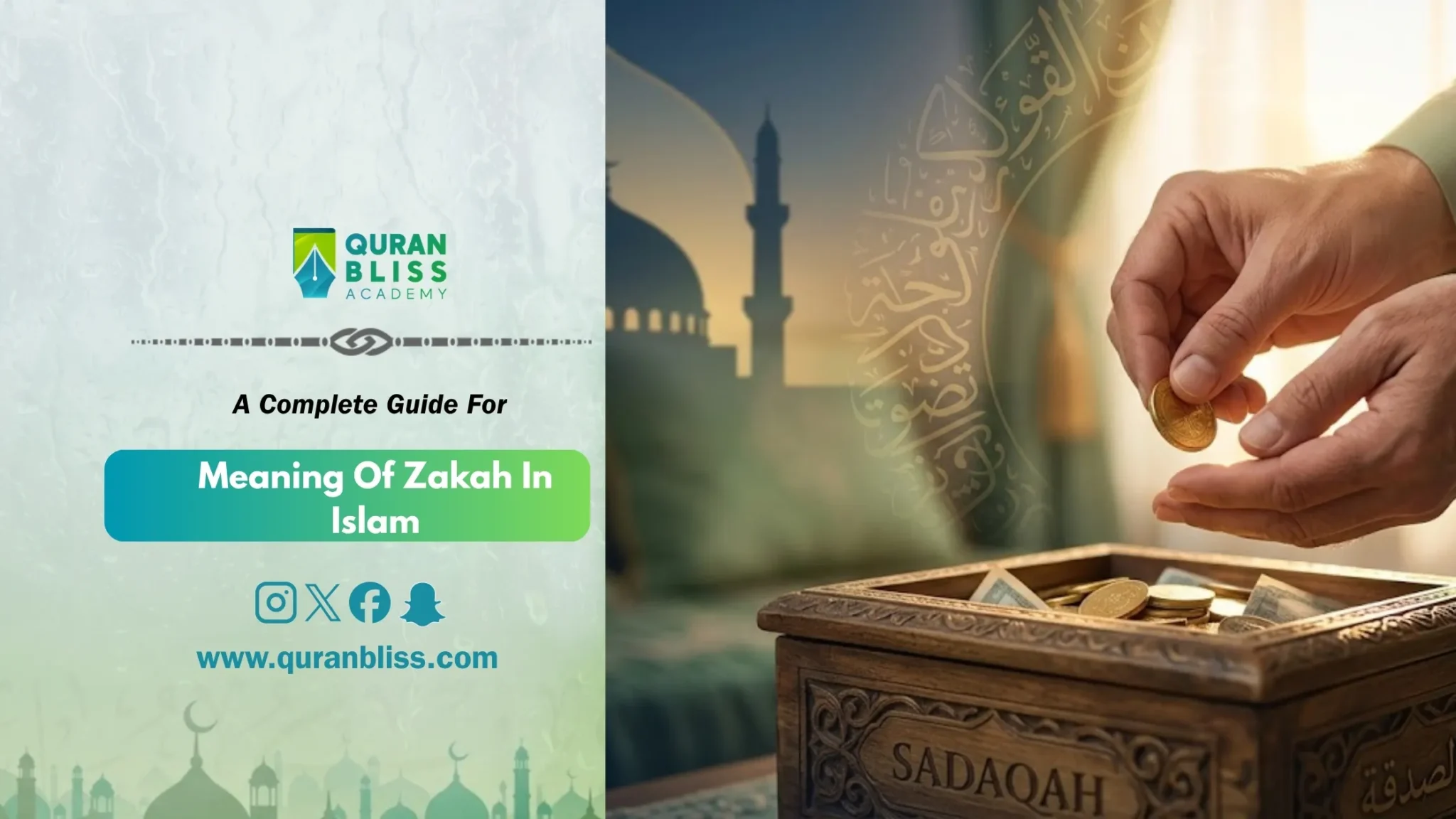
The Meaning of Zakah in Islam: Definition, Types, and Why It Matters
Zakah (زَكَاة) is the Third Pillar of Islam , an obligatory annual act of worship in which Muslims who possess wealth above the Nisab threshold give 2.5% of that wealth to those in need. The word itself means purification and growth in Arabic. Zakah is not optional charity , it is a divine obligation, a right of the poor over the wealth of the rich, and one of the five foundational pillars upon which all of Islamic practice is built.
This guide goes deeper. Here, you’ll find the complete meaning of Zakah in Islam , its linguistic roots, its Shariah definition, its types, who pays it, who receives it, and why it is one of the most spiritually and socially powerful institutions in human history.
What Is the Linguistic Meaning of Zakah?
The Arabic Root: Za-Ka-Wa (ز-ك-و)
The word Zakah (زَكَاة) is derived from the Arabic root Za-Ka-Wa (ز-ك-و) or Za-Ka-Ya (ز-ك-ي), which carries a cluster of related meanings that together paint a complete picture of what this act of worship is meant to accomplish.
Classical Arabic lexicons , including Ibn Manzur’s Lisan al-Arab and Al-Fayruzabadi’s Al-Qamus Al-Muhit , define this root as encompassing four primary meanings:
- Tahara (الطهارة): Purification and cleansing
- Nama’ (النماء): Growth and increase
- Barakah (البركة): Divine blessing
- Madh (المدح): Praise and commendation
Key Meanings , Purity, Growth, Blessing
Each of these meanings illuminates a different dimension of what Zakah does:
- Purification: Zakah purifies the wealth that remains after giving. Just as removing impurities from gold makes it more precious, giving Zakah removes the spiritual contamination from accumulated wealth , which, if hoarded, becomes a source of arrogance, injustice, and sin.
- Growth: Counterintuitively, giving wealth away causes it to grow , not just spiritually, but practically. The Prophet ﷺ said that charity does not diminish wealth. Wealth given in Zakah circulates through the community, generates economic activity, and returns multiplied through Allah’s blessing.
- Blessing: Barakah is the divine quality that makes something inexplicably sufficient, productive, and good. Zakah invites Barakah into every corner of a Muslim’s financial life.
Why the Name Matters Spiritually
Allah chose the name Zakah deliberately. By naming this pillar with a word meaning purification and growth , rather than “tax” or “payment” , the Quran is making a theological statement: the wealthy person who gives Zakah is not doing the poor a favor. They are purifying themselves. The obligation flows in both directions: the poor have a right to the wealth, and the giver receives purification in return.
خُذْ مِنْ أَمْوَالِهِمْ صَدَقَةً تُطَهِّرُهُمْ وَتُزَكِّيهِم بِهَا
“Take from their wealth a charity (Sadaqah) by which you purify them and cause them to increase (Tuzakkihim).”
, Surah At-Tawbah, 9:103
The root word Tuzakkihim in this verse is from the same root as Zakah , confirming that the giving of Zakah is an act of spiritual growth (Tazkiyah) for the giver, not merely a financial transaction.
What Does Zakah Mean in Islam? The Shariah Definition
In Islamic law (Fiqh), Zakah is formally defined as: a specific obligatory portion of wealth that a Muslim who meets the required conditions (Nisab + Hawl) must pay annually to the eight categories of eligible recipients designated by Allah in Surah At-Tawbah, 9:60.
Every word in this definition is precise:
- Specific: The amount is not left to the individual , it is fixed at 2.5% of qualifying wealth
- Obligatory: It is Fard , not recommended, not optional, not a matter of personal generosity
- Portion of wealth: It applies to specific categories of accumulated wealth , not all wealth
- Who meets the conditions: Not every Muslim owes Zakah , only those who cross the Nisab threshold and hold it for a full lunar year
- Eight categories: The recipients are defined by Allah Himself , not by governments, institutions, or personal preference
Zakah as the Third Pillar of Islam
Zakah is not a peripheral practice. It is the Third Pillar of Islam , mentioned alongside prayer (Salah) in the Quran over 80 times.
The pairing is deliberate:
- Salah connects the believer to Allah vertically (servant to Lord)
- while Zakah connects them to creation horizontally (Muslim to community).
- Together, they represent the complete expression of Islamic devotion.
وَأَقِيمُوا الصَّلَاةَ وَآتُوا الزَّكَاةَ وَارْكَعُوا مَعَ الرَّاكِعِينَ
“Establish prayer and give Zakah, and bow with those who bow [in worship].”
, Surah Al-Baqarah, 2:43
Zakah is inseparable from the broader framework of Islamic obligations. To understand where it sits within the complete structure of Islamic practice, explore our detailed guide on defining the 5 Pillars of Islam , where each pillar, including Zakah, is explained with its full spiritual significance.
Who Is Obligated to Pay Zakah?
Zakah is obligatory on every adult Muslim who simultaneously meets the following conditions:
- Muslim: Non-Muslims are not subject to Zakah
- Adult (Baligh): Children are not obligated, though guardians may pay on behalf of a child’s wealth
- Free (Hurr): A historical condition , in the contemporary context, all free persons
- Possessing Nisab: Their total qualifying wealth must equal or exceed the Nisab threshold
- Hawl (one lunar year): That wealth must have remained at or above Nisab for a full lunar year (approximately 354 days)
If any of these conditions is absent, Zakah is not obligatory. A Muslim who is in debt, whose wealth falls below Nisab, or who receives their wealth and spends it before a year passes, owes no Zakah.
Is Zakah a Tax? A Common Misconception , Cleared Up

One of the most common misunderstandings about the meaning of Zakah in Islam is to equate it with a religious tax. This comparison, while convenient, is misleading on multiple levels:
- A tax is imposed by a state. Zakah is imposed by Allah , it is an act of worship (Ibadah), not a civic obligation
- A tax goes to the government. Zakah goes directly to eight specific categories defined in the Quran , not to any state treasury
- A tax is about funding services. Zakah is about purifying the soul, establishing social justice, and fulfilling a divine right
- A tax reduces if you give other taxes. Zakah is due regardless of any other payments , it has its own independent obligation
- Missing a tax is a legal offense. Withholding Zakah is a sin before Allah , with severe spiritual and physical consequences described in hadith
The Prophet ﷺ described Zakah as “a right of the poor within the wealth of the rich” , meaning the poor have a divinely ordained claim on a portion of your wealth. You are not being generous when you pay Zakah. You are returning what was never fully yours.
Types of Zakah in Islam
Understanding the different types of Zakah in Islam helps Muslims fulfill one of the Five Pillars correctly while supporting those in need. From Zakah al-Mal to Zakat al-Fitr, each type has specific rules, conditions, and purposes in Islamic teachings.
Zakat Al-Mal , Obligatory Wealth Zakat
Zakat Al-Mal (زكاة المال , Zakah on Wealth) is what most people mean when they say “Zakah.” It is the annual 2.5% purification of accumulated qualifying wealth , including:
- Gold and silver (in any form , jewelry, coins, bars)
- Cash savings and money in bank accounts
- Stocks, shares, and investment portfolios
- Business inventory and trade goods
- Agricultural produce (at different rates: 5–10% depending on irrigation method)
- Livestock (camels, cattle, sheep , at specific thresholds per animal type)
- Rental income and investment returns (scholars differ on calculation method)
The condition for Zakat Al-Mal is that the wealth type reaches the Nisab threshold and has been held for a full lunar year (Hawl).
Zakat Al-Fitr , End of Ramadan Charity
Zakat Al-Fitr (زكاة الفطر , also called Sadaqat Al-Fitr) is the obligatory charity given at the end of Ramadan, before the Eid al-Fitr prayer. It is distinct from Zakat Al-Mal in its purpose, timing, amount, and conditions.
The Prophet ﷺ established it clearly:
“فَرَضَ رَسُولُ اللَّهِ ﷺ زَكَاةَ الْفِطْرِ طُهْرَةً لِلصَّائِمِ مِنَ اللَّغْوِ وَالرَّفَثِ وَطُعْمَةً لِلْمَسَاكِينِ”
“The Messenger of Allah ﷺ ordained Zakat al-Fitr as a purification of the fasting person from idle talk and obscene speech, and as food for the poor.”
, Abu Dawud (1609), Ibn Majah (1827)
Zakat Al-Fitr is obligatory for every Muslim who can afford it , regardless of whether they possess the Nisab threshold. Even a Muslim with modest means must give it on behalf of themselves and every dependent in their household.
Zakat Al-Fitr is closely tied to the season of Eid al-Adha for many Muslims combining their annual obligations. Our dedicated guide on Zakat for Eid al-Adha explains how to calculate and give Zakah optimally during the blessed days of Dhul Hijjah.
Key Differences Between the Two Types
Feature | Zakat Al-Mal | Zakat Al-Fitr |
Type | Wealth Zakat | Body/Soul Zakat |
Obligation | Fard , for wealth above Nisab | Fard , for every Muslim who has food for the day |
Amount | 2.5% of qualifying wealth | ~2.5 kg of staple food per person (or cash equivalent) |
Timing | Annually , after one lunar year (Hawl) | Before Eid al-Fitr prayer (end of Ramadan) |
Purpose | Purifies accumulated wealth | Purifies the fast from errors; feeds the poor on Eid |
Who pays? | Muslims above Nisab threshold | Every Muslim able to feed themselves on Eid day |
Quran reference | Surah At-Tawbah, 9:103 | Hadith , Sahih Bukhari (1503) |
How Is Zakah Calculated?
Before calculating your Zakah, it is important to understand the concept of Nisab, the minimum amount of wealth a Muslim must own before Zakah becomes obligatory. Knowing the Nisab threshold helps ensure your Zakah calculation is accurate according to Islamic guidelines.
What Is Nisab?
Nisab (نِصَاب) is the minimum threshold of wealth a Muslim must possess , for a full lunar year , before Zakah becomes obligatory. It is derived from the value of either:
- Gold Nisab: 85 grams of gold
- Silver Nisab: 595 grams of silver
Because silver and gold prices fluctuate, the monetary equivalent of Nisab changes. Most contemporary scholars and Zakah institutions publish updated Nisab values in local currencies. The silver Nisab is typically lower than the gold Nisab , and many scholars recommend using the silver Nisab to ensure more people qualify to give (and more poor people receive Zakah).
The 2.5% Rule on Gold, Silver, and Cash
Once your total qualifying wealth exceeds the Nisab and has been held for a full lunar year (Hawl), you pay 2.5% of that total. This rate applies to:
- Cash (in hand, in bank accounts, in wallets)
- Gold and silver held above personal jewelry limits
- Stocks and shares (calculated on market value or underlying assets, depending on the scholar)
- Business inventory and trade goods (at purchase or market value)
Agricultural produce has different rates: 10% on rain-irrigated crops, 5% on artificially irrigated crops. Livestock follows a different schedule based on specific animal counts.
Simple Calculation Example
Example: You have $30,000 in savings. The current Nisab (silver) = $4,500. Your wealth has been above Nisab for 12 lunar months. Zakah due = 2.5% × $30,000 = $750. If you have debts of $10,000, subtract first: ($30,000 – $10,000) = $20,000. Zakah due = 2.5% × $20,000 = $500.
Who Are the 8 Recipients of Zakah?
Allah did not leave the distribution of Zakah to human judgment. He specified , with legal precision , exactly eight categories of people eligible to receive it:
إِنَّمَا الصَّدَقَاتُ لِلْفُقَرَاءِ وَالْمَسَاكِينِ وَالْعَامِلِينَ عَلَيْهَا وَالْمُؤَلَّفَةِ قُلُوبُهُمْ وَفِي الرِّقَابِ وَالْغَارِمِينَ وَفِي سَبِيلِ اللَّهِ وَابْنِ السَّبِيلِ ۖ فَرِيضَةً مِّنَ اللَّهِ
“Zakah expenditures are only for the poor and for the needy, and for those employed for it, and for bringing hearts together, and for freeing captives, and for those in debt, and for the cause of Allah, and for the stranded traveler , an obligation imposed by Allah.”
, Surah At-Tawbah, 9:60
# | Category (Arabic) | Who They Are |
1 | Al-Fuqara (الفقراء) | The poor , those who have almost nothing and cannot meet basic needs |
2 | Al-Masakin (المساكين) | The destitute , even more in need than the poor; the most vulnerable |
3 | Al-‘Amilin (العاملون عليها) | Zakat administrators and collectors who manage its distribution |
4 | Al-Mu’allafat Qulubuhum (المؤلفة قلوبهم) | New Muslims or those whose hearts are being drawn toward Islam |
5 | Ar-Riqab (الرقاب) | Historically: freeing enslaved persons; today: some scholars extend to captives |
6 | Al-Gharimin (الغارمون) | Those overwhelmed by debt they cannot repay through their own means |
7 | Fi Sabilillah (في سبيل الله) | In the cause of Allah , includes scholars, students of Islamic knowledge, defense |
8 | Ibn Al-Sabil (ابن السبيل) | Stranded travelers who have no access to their own funds while away from home |
Note that Zakah cannot be given to: one’s own parents or children (who are your legal dependents), non-Muslim individuals (except in the Al-Mu’allafat Qulubuhum category), or the Prophet’s family (Ahl al-Bayt), as they have a specific prohibition in hadith.
Zakah vs Sadaqah , What’s the Difference?
Muslims often use “Zakah” and “Sadaqah” interchangeably in casual speech, but they are technically distinct in Islamic jurisprudence. Understanding the difference clarifies your obligations and your opportunities:
Feature | Zakat | Sadaqah |
Obligation | Fard (obligatory for those who qualify) | Nafl (voluntary , given freely any time) |
Amount | Fixed: 2.5% of qualifying wealth above Nisab | Any amount , no minimum or maximum |
Timing | Annually (after one full lunar year , Hawl) | Any time , no fixed schedule |
Recipients | 8 specific categories defined by Quran 9:60 | Anyone in need , no restriction |
Condition | Only for Muslims above the Nisab threshold | Any Muslim (or even non-Muslim) can give |
Spiritual role | Purification of wealth , mandatory cleansing | Voluntary charity , unlimited in reward |
What if skipped? | Major sin , wealth becomes impure | No sin , only missed reward |
In short: Zakah is the floor, the minimum obligatory purification of wealth. Sadaqah is everything above the floor, the voluntary generosity that has no ceiling. A Muslim who pays Zakah but gives nothing in Sadaqah has met their obligation. A Muslim who gives generously in Sadaqah but withholds Zakah has committed a major sin.
The Prophet ﷺ encouraged both , and described Sadaqah in the broadest terms: even a smile is Sadaqah; removing harm from a road is Sadaqah; kind words are Sadaqah.
The Spiritual and Social Benefits of Zakah

Purification of Wealth and Soul
The word Zakah means purification for a reason. When a Muslim earns wealth, that wealth accumulates what scholars describe as a kind of spiritual debt , the right of others within it. As long as that right is not fulfilled, the wealth contains an element of impurity. Zakah discharges that right and purifies what remains.
Allah describes those who hoard their wealth and withhold Zakah:
وَالَّذِينَ يَكْنِزُونَ الذَّهَبَ وَالْفِضَّةَ وَلَا يُنفِقُونَهَا فِي سَبِيلِ اللَّهِ فَبَشِّرْهُم بِعَذَابٍ أَلِيمٍ
“And those who hoard gold and silver and do not spend it in the way of Allah , give them tidings of a painful punishment.”
, Surah At-Tawbah, 9:34
2. Strengthening the Muslim Community
Zakah is Islam’s built-in economic justice system. When every qualifying Muslim gives 2.5% of their accumulated wealth annually, the collective flow of resources toward the poor becomes enormous. It systematically prevents the permanent concentration of wealth among an elite, ensures that money circulates throughout the community, and creates a structural safety net for the most vulnerable.
Economic studies of societies where Zakah is properly collected and distributed show significant reductions in extreme poverty, greater community cohesion, and more equitable distribution of resources. This was the Prophet’s ﷺ vision , not a charity drive, but a civilizational institution.
What Happens If Zakah Is Withheld?
The Prophet ﷺ described the fate of those who possess the Nisab but refuse to pay Zakah:
“مَا مِنْ صَاحِبِ ذَهَبٍ وَلَا فِضَّةٍ لَا يُؤَدِّي مِنْهَا حَقَّهَا إِلَّا إِذَا كَانَ يَوْمُ الْقِيَامَةِ صُفِّحَتْ لَهُ صَفَائِحُ مِنْ نَارٍ”
“There is no owner of gold or silver who does not pay what is due from it, but on the Day of Resurrection it will be made into plates of fire.”
, Sahih Muslim (987)
This is not metaphorical , it is a literal warning from the Prophet ﷺ about the physical consequence in the Hereafter of withholding Zakah. The wealth itself becomes the instrument of punishment. This is why classical scholars unanimously classified the intentional withholding of Zakah as a major sin (Kabira).
On the other hand, the Prophet ﷺ described the opposite: wealth given in Zakah grows, not decreases, in the hands of Allah , and returns to the giver multiplied in this world and the next.
Fulfill Your Zakah With Knowledge and Confidence
Understanding the meaning of Zakah in Islam is not just knowledge, it is action. Whether through Zakat Al-Mal or Zakat Al-Fitr, every act of giving fulfills a divine command that purifies wealth, supports the needy, and strengthens your connection with Allah. Zakah is not merely charity, but a core act of worship rooted in responsibility, sincerity, and faith.The true meaning of Zakah goes beyond numbers, it reflects belief that wealth belongs to Allah and must be shared justly. When given with awareness and intention, it transforms from obligation into a powerful pillar of faith. May Allah accept our Zakah and make us among those who give consistently and sincerely. Ameen.
Frequently Asked Questions About the Meaning of Zakah in Islam
Zakah is the obligatory annual act of giving 2.5% of your qualifying wealth to those in need. In Arabic, it means purification and growth. It is the Third Pillar of Islam , commanded by Allah in the Quran , and it purifies both the wealth given and the soul of the giver. It is not optional generosity; it is a divine right of the poor within the wealth of those who have more.
No. Zakah is fundamentally different from a tax. A tax is imposed by a government, goes to state funds, and funds public services. Zakah is imposed by Allah, goes directly to eight specific categories of recipients defined in the Quran, and is an act of worship (Ibadah) , not a civic obligation. Paying a tax does not count as Zakah, and Zakah cannot be replaced by taxes. They are entirely separate obligations.
A Muslim is exempt from Zakah if: their total qualifying wealth is below the Nisab threshold, their wealth has not been held above Nisab for a full lunar year (Hawl), they are in debt that brings their net wealth below Nisab, or they are a child (though guardians may pay on a child’s behalf). Non-Muslims are not subject to Zakah at all.
The word Zakah (زكاة) appears 32 times in the Quran. Additionally, the concept of purifying charity and giving to the poor is referenced in many more verses using related terms. Strikingly, Salah and Zakah are mentioned together , in the same verse , over 28 times, emphasizing their inseparable relationship as the two most foundational acts of Islamic worship after the Shahada.
Zakah is obligatory , a fixed 2.5% of qualifying wealth given annually to eight specific categories. Sadaqah is voluntary , any act of charity, in any amount, at any time, given to anyone in need. Zakah is the minimum obligation; Sadaqah is the unlimited generosity above it. Missing Zakah is a major sin; not giving Sadaqah is simply a missed opportunity for reward. A complete Muslim gives both. What is the meaning of Zakah in simple terms?
Is Zakah the same as a tax?
Who is exempt from paying Zakah?
How many times is Zakah mentioned in the Quran?
What is the difference between Zakat and Sadaqah?


Islamic Studies Course
for Adults
Deepen your understanding of Islam’s teachings.
Learn More
The 5 Pillars of Islam
Understand the fundamental principles of Islamic faith and practice.
Learn More