


Rules For Eid Ul Adha Sacrifice
Did you know that Qurbani rules differ depending on your age, financial status, and even whether you are traveling? Every year, millions of Muslims around the world perform the Eid ul Adha sacrifice — yet many are unsure whether it is truly obligatory for them or for their children, elderly parents, or spouses.
This complete guide covers all the essential rules for Eid ul Adha sacrifice, broken down by age group, animal requirements, slaughter method, and meat distribution. Whether you are performing Qurbani for the first time or simply want to ensure you are following the correct rulings, this article has everything you need.
What Is the Eid ul Adha Sacrifice (Qurbani)?
Qurbani, also spelled Udhiyah in Arabic, is the ritual animal sacrifice performed during Eid ul Adha — the Festival of Sacrifice. It commemorates one of the greatest acts of devotion in Islamic history and holds deep spiritual significance for Muslims worldwide.
Origin & Meaning The Story of Ibrahim (AS)
The origin of Qurbani traces back to the Prophet Ibrahim (Abraham, peace be upon him). Allah commanded Ibrahim to sacrifice his beloved son Ismail (peace be upon him) as a test of faith. As Ibrahim prepared to carry out the command, Allah replaced Ismail with a ram from Paradise, sparing his son’s life and accepting Ibrahim’s sincere devotion.
“وَفَدَيْنَاهُ بِذِبْحٍ عَظِيمٍ”
“And We ransomed him with a great sacrifice.”
(Surah As-Saffat, 37:107)
Muslims perform Qurbani every year on the 10th, 11th, and 12th of Dhul Hijjah to honor this act of submission and to give thanks to Allah.
Is Qurbani Obligatory or Sunnah? (Scholarly Opinions)
Scholars differ on the ruling of Qurbani:
- Hanafi school: Qurbani is Wajib (obligatory) for every qualifying Muslim adult.
- Maliki, Shafi’i, and Hanbali schools: Qurbani is a highly emphasized Sunnah Mu’akkadah — strongly recommended but not strictly obligatory.
Regardless of the scholarly opinion followed, missing Qurbani without a valid reason is considered blameworthy, and performing it earns immense reward.
What Are the Conditions That Make Qurbani Obligatory?
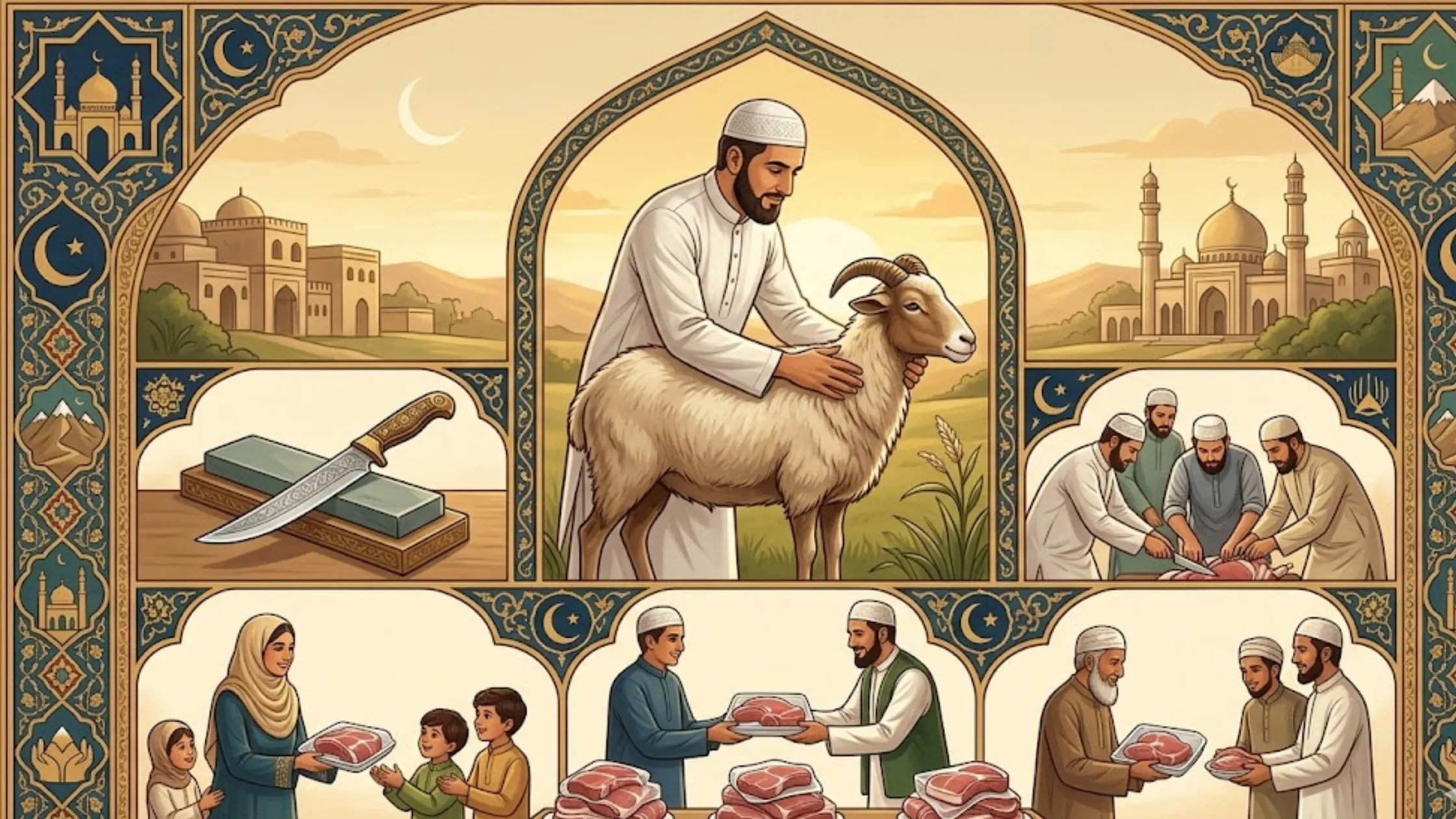
Four main conditions must be met for Qurbani to become obligatory on a person. Understanding these conditions helps clarify who must perform the sacrifice and who is exempt.
Must a Person Be Muslim and of Sound Mind?
Yes. Qurbani is only required of Muslims. A person who is not Muslim or who has lost their mental capacity (such as someone with severe mental illness) is not obligated to perform Qurbani.
Is Reaching Puberty Required for Qurbani?
According to the majority of scholars, Qurbani is not obligatory for children who have not yet reached puberty (Bulugh). The Hanafi opinion, however, states that It is not obligatory on the child, but some scholars recommend the guardian to perform it on their behalf.
What Financial Ability Is Needed (Nisab Explained)?
A person must possess wealth equal to or above the Nisab threshold — the minimum amount of wealth that makes Zakat and Qurbani obligatory. The Nisab is calculated as:
Gold Nisab: Equivalent to 87.48 grams of gold for Qurbani as it results in more people being included and more sacrifice being performed. This wealth must be in excess of one’s basic needs and debts.
Does Being a Resident Affect Qurbani Obligation?
According to the Hanafi school, being a resident (Muqeem) is a condition for Qurbani being Wajib. A traveler (Musafir) — defined as someone traveling a distance of approximately 77 km or more with the intention of staying less than 15 days — is not obligated. The Maliki, Shafi’i, and Hanbali schools generally do not consider residency a condition.
Rules for Eid ul Adha Sacrifice by Age Group
One of the most commonly misunderstood aspects of Qurbani is how the obligation differs across age groups. Here is a clear breakdown:
Children (Before Puberty) Is Qurbani Required?
Qurbani is NOT obligatory for children who have not reached puberty. A child is not yet accountable under Islamic law (Mukallaf), so the rulings of Wajib acts do not apply to them.
However, if a parent or guardian wishes to perform Qurbani on behalf of a child as an act of generosity or to teach them about the practice, this is permissible and praiseworthy.
Teenagers & Youth (At Puberty) When Does It Become Obligatory?
Once a young person reaches puberty (Bulugh) and meets the financial conditions (Nisab), Qurbani becomes obligatory on them as an independent individual — not their parents. Signs of puberty in Islamic law include physical changes or reaching the age of 15 lunar years.
If a teenager is financially dependent and does not possess Nisab in their own name, Qurbani is not obligatory on them personally.
Adults The Primary Obligation
The primary obligation of Qurbani rests on sane, adult Muslims who are residents and possess wealth above the Nisab. Each qualifying adult must perform their own individual Qurbani. A husband performing Qurbani does not fulfill the obligation on behalf of his wife — each person is responsible for themselves (according to the Hanafi school).
Women A Commonly Misunderstood Rule
Qurbani is equally obligatory on women who meet all the conditions (sanity, adulthood, residency, and Nisab). A woman who owns gold, savings, or assets above the Nisab must perform her own Qurbani.
A common misconception is that a husband’s Qurbani covers his wife. This is incorrect in the Hanafi school. Each person must fulfill their own obligation. However, a husband may perform Qurbani on behalf of his wife as a gift, which is a recommended act.
A woman may also perform the slaughter herself or appoint someone else to do it on her behalf.
The Elderly When Are They Exempt?
Age alone does not exempt a person from Qurbani. An elderly person who is mentally sound and possesses Nisab is still required to perform Qurbani. However, they are exempt if:
- They no longer possess Nisab-level wealth
- They are mentally incapacitated
- They are traveling during the days of Eid (Hanafi opinion)
If an elderly person is physically unable to perform the slaughter themselves, they may appoint someone to do it on their behalf.
Travelers Does Travel Remove the Obligation?
According to the Hanafi school, a traveler (Musafir) is exempt from Qurbani during the days of Eid ul Adha. If they return home before the time of Qurbani ends (before sunset on the 12th of Dhul Hijjah), the obligation resumes.
The other three major schools do not consider travel to be a reason for exemption, so those following the Maliki, Shafi’i, or Hanbali schools should still perform Qurbani while traveling if they meet the other conditions.
What Are the Rules for the Sacrificial Animal?
The animal chosen for Qurbani must meet specific criteria related to species, age, and health. Failing to meet these conditions can invalidate the sacrifice.
Which Animals Are Permitted?
Only specific types of animals are acceptable for Qurbani:
- Sheep and goats: One animal = one person’s Qurbani
- Cattle (cows and buffalo): One animal = up to 7 people’s Qurbani
- Camels: One animal = up to 7 people’s Qurbani
Pigs, wild animals, and birds are not permitted for Qurbani under any circumstances.
Minimum Age Per Animal (Table)
Each animal must have reached the minimum age to be eligible for sacrifice:
Animal | Minimum Age | Notes |
Sheep | 6 months (if plump/healthy) or 1 year | A plump 6-month-old sheep is acceptable |
Goat | 1 year (completed) | Must have reached 1 full year |
Cow / Buffalo | 2 years (completed) | Must be at least 2 full years old |
Camel | 5 years (completed) | Must be at least 5 full years old |
Health Conditions — What Disqualifies an Animal?
The following conditions disqualify an animal from Qurbani:
- Blind in one or both eyes
- Severely lame and unable to walk to the slaughter area
- Clearly sick and visibly unwell
- So thin that the bone marrow has dried up
- Missing more than a third of the ear or tail
- Having no teeth at all (extremely old or diseased animal)
Minor defects such as a small cut or a missing horn do not invalidate the Qurbani, though it is better to choose a healthy, full-bodied animal.
How Many People Can Share One Animal?
A goat or sheep counts for one person only. A cow, buffalo, or camel can be shared by up to seven people, provided each person has the sincere intention of seeking closeness to Allah (Taqarrub) — not simply to buy cheap meat. If even one person in the group intends only to purchase meat and not perform an act of worship, the Qurbani of all seven participants may be invalidated.
When Does It Start? (After Eid Prayer)
The time for Qurbani begins after the Eid ul Adha prayer on the 10th of Dhul Hijjah. In areas where the Eid prayer is held, the slaughter may not begin before the prayer concludes. For those in rural areas where no Eid prayer is held, the time begins at sunrise on the 10th of Dhul Hijjah.
“فَصَلِّ لِرَبِّكَ وَانْحَرْ”
“So pray to your Lord and sacrifice.”
(Surah Al-Kawthar, 108:2)
When Does It End? (10th–12th or 13th Dhul Hijjah)
- Hanafi and Maliki schools: Qurbani time ends at sunset on the 12th of Dhul Hijjah (giving 3 days in total).
- Shafi’i and Hanbali schools: Qurbani time extends until sunset on the 13th of Dhul Hijjah (giving 4 days total, including the Tashriq days).
It is most virtuous to perform the sacrifice on the first day — the 10th of Dhul Hijjah — after the Eid prayer.
What If You Miss the Time?
If someone who was obligated to perform Qurbani misses the window entirely without a valid excuse, they must give the equivalent value of the animal in charity as a form of compensation. The obligation does not simply disappear.
Who Can Perform the Slaughter?
The slaughter must be performed by a Muslim, The slaughter must be done by a sane, adult Muslim. They must understand and follow the Islamic method of slaughter.
The Correct Du’a & Takbeer
Before cutting, the person performing the slaughter must:
- Say Bismillah: “بِسْمِ اللَّهِ” — In the name of Allah
- Say Takbeer: “اللَّهُ أَكْبَرُ” — Allah is the Greatest
- Optional du’a: “اللَّهُمَّ تَقَبَّلْ مِنِّي” — O Allah, accept from me
Deliberately omitting Bismillah renders the slaughter invalid and the meat haram. If one forgets to say it, the slaughter is still valid according to most scholars.
How to Treat the Animal Before Slaughter
Islamic guidelines emphasize compassion toward the animal:
- Give it water before slaughter
- Do not sharpen the blade in front of the animal
- Do not slaughter one animal in front of another
- Lay it gently on its left side, facing the Qiblah
- Use a sharp blade to minimize pain
The Prophet Muhammad (peace be upon him) said: “Allah has prescribed excellence in all things. When you slaughter, slaughter well; let each of you sharpen his blade and spare suffering to the animal.” (Sahih Muslim)
Can You Appoint Someone Else?
Yes. It is fully permissible to appoint another person (a Wakeel) to perform the slaughter on your behalf, whether they are physically present or in another country. This is the basis for Qurbani through charities and Islamic organizations operating in different regions. The intention must be made before the slaughter and the appointed person should be a trustworthy Muslim.
Meat Distribution Rules — The Three Thirds
One of the most well-known rules of Qurbani is the division of the meat into three equal parts. This is the recommended practice, though scholars differ on whether it is strictly obligatory or strongly encouraged.
1/3 for Yourself
One third of the Qurbani meat is for the family of the person performing the sacrifice. This is permissible and spiritually rewarding, as the family participates in the blessing of the sacrifice.
1/3 for Family & Friends
Another third may be gifted to relatives, neighbors, and friends — including those who are not in need. This strengthens community bonds and spreads the blessing of Eid.
1/3 for the Poor & Needy
The final third must be given to the poor, the needy, and those who cannot afford to perform Qurbani themselves. This portion is essential and ensures that the spirit of sacrifice reaches those who need it most. Some scholars say it is obligatory to give at least some portion to the poor, even if not exactly one third.
Can You Sell Meat or Skin?
It is strictly forbidden to sell any part of the Qurbani animal including the meat, fat, bones, or skin, as a transaction. The skin may be used personally (for a prayer mat or household items), kept by the slaughterhouse as part of their service fee, or given as charity to the poor. Selling the skin and keeping the money for personal use is not permitted.
What Are the Special Cases and Rulings for Qurbani?
1. Qurbani on Behalf of the Deceased
It is permissible and highly rewarding to perform Qurbani on behalf of a deceased person — whether a parent, spouse, or any other Muslim. The Prophet Muhammad (peace be upon him) performed Qurbani on behalf of his household, including those who had passed away.
If a deceased person left behind a bequest (Wasiyyah) for Qurbani, it becomes obligatory on their estate. If there was no bequest, it is a voluntary act of charity on their behalf.
2. Qurbani Through a Charity (Delegating)
Many Muslims choose to delegate their Qurbani to an Islamic charity that will perform the sacrifice in a poorer country or region. This is valid and permissible, provided the charity is trustworthy, the animal meets all the required conditions, and the slaughter is performed within the correct time window. The intention must be made before the charity carries out the sacrifice.
3. The Hair & Nails Rule (1st–10th Dhul Hijjah)
According to a hadith reported in Sahih Muslim, a person who intends to perform Qurbani should refrain from cutting their hair, nails, or removing any skin from the 1st of Dhul Hijjah until after they have performed the sacrifice. This applies to the person performing Qurbani — not necessarily to their family members. The wisdom behind this mirrors the state of the Hajj pilgrim in ihram.
What If You Cannot Afford It?
If a person genuinely does not possess the Nisab threshold and cannot afford Qurbani, the obligation does not apply. Islam never places an obligation beyond a person’s means. In fact, performing Qurbani by going into debt is not required.
Common Mistakes That Invalidate Qurbani
- Choosing an animal that does not meet the minimum age requirement
- Slaughtering before the Eid prayer on the 10th of Dhul Hijjah
- Using an animal with a major defect (blind, severely lame, extremely sick)
- Omitting Bismillah deliberately before slaughter
- Having a non-Muslim perform the slaughter
- Selling any part of the Qurbani animal (meat, skin, fat, or bones)
- Sharing a cow or camel with more than 7 people
- One of the 7 sharers intending to acquire meat only, not worship
- Delegating to an untrustworthy charity that may not perform the sacrifice correctly
- Cutting hair or nails before the sacrifice if you intended Qurbani from the 1st of Dhul Hijjah
Deepen Your Islamic Knowledge with Quran Bliss Academy
Understanding the rules of Qurbani is just one part of living a fulfilling Islamic life. At Quran Bliss Academy, we help Muslims of all ages — children, teenagers, and adults — build a strong foundation in Quran recitation, Tajweed, Islamic studies, and Arabic language from the comfort of their homes.
Our programs include:
- One-on-one Quran classes with certified, native Arab teachers
- Tajweed courses for beginners through advanced learners
- Islamic studies for children and adults covering Fiqh, Aqeedah, and Seerah
- Arabic language courses designed for non-native speakers
Whether you want to perfect your Quran recitation before Ramadan, help your children understand the meaning of Eid, or deepen your knowledge of Islamic rulings like Qurbani — Quran Bliss Academy has a program tailored for you.
Start Your Free Trial Class Today at Quran Bliss Academy
The rules for Eid ul Adha sacrifice are detailed and vary based on age, financial status, health, and residency. Whether you are a teenager who has just reached puberty, an adult woman managing her own finances, or an elderly person wondering about your obligation — this guide has covered the core rulings that every Muslim should know.
Qurbani is not just a religious ritual. It is an act of devotion, gratitude, and community. Performed correctly, it carries immense reward and symbolizes the very heart of Islam: complete submission to Allah.
May Allah accept your Qurbani and grant you and your family a blessed Eid ul Adha. Ameen.
Frequently Asked Questions (FAQ)
Is Qurbani obligatory for children?
No. Qurbani is not obligatory for children who have not reached puberty. The obligation of Wajib acts in Islam applies only to those who have reached the age of maturity (Bulugh). Parents may perform Qurbani on behalf of their children voluntarily, but it is not a religious requirement.
Can an elderly person skip Qurbani?
An elderly person cannot skip Qurbani simply due to age. As long as they are mentally sound and financially above the Nisab threshold, Qurbani remains obligatory. If they are physically unable to perform the slaughter, they can appoint someone else to do it on their behalf.
What is the minimum age for the animal?
The minimum age varies by species: sheep (6 months if plump, or 1 year), goat (1 year), cow or buffalo (2 years), and camel (5 years). Animals below these ages are not valid for Qurbani.
Can a woman perform Qurbani alone?
Yes. A woman who meets all the conditions of Qurbani (adulthood, sanity, residency, and Nisab) is required to perform her own Qurbani independently of her husband. She may also perform the slaughter herself or appoint another person to do it on her behalf.
Can a husband and wife do one Qurbani?
According to the Hanafi school, a husband performing Qurbani does not fulfill the obligation on behalf of his wife if she independently meets the conditions. Both must perform separate Qurbanis. For a shared cow or camel, they may each take one share of the seven.
What do you sacrifice on Eid ul Adha?
Muslims sacrifice livestock — specifically sheep, goats, cows, buffalo, or camels — on Eid ul Adha. The animal must meet the conditions of age and health described in this guide. The meat is then distributed in three portions: for oneself, for family and friends, and for the poor.
What are the rules of Eid ul Adha?
The key rules of Eid ul Adha include: performing the Eid prayer, performing Qurbani if one meets the conditions, refraining from hair and nails from the 1st of Dhul Hijjah until after the sacrifice, distributing the meat in three portions, and observing the days of Tashriq with dhikr (remembrance of Allah).
Is Eid al-Adha a ritual of sacrifice?
Yes. Eid al-Adha is fundamentally centered on the ritual of sacrifice (Qurbani or Udhiyah). It commemorates the willingness of Prophet Ibrahim (AS) to sacrifice his son in obedience to Allah’s command. The act of Qurbani is the defining practice of Eid al-Adha, distinguishing it from Eid al-Fitr which centers on breaking the fast of Ramadan.
Quran Recitation
with Tajweed
Master accurate Qur’an recitation with clear Tajweed rules.
Learn More