

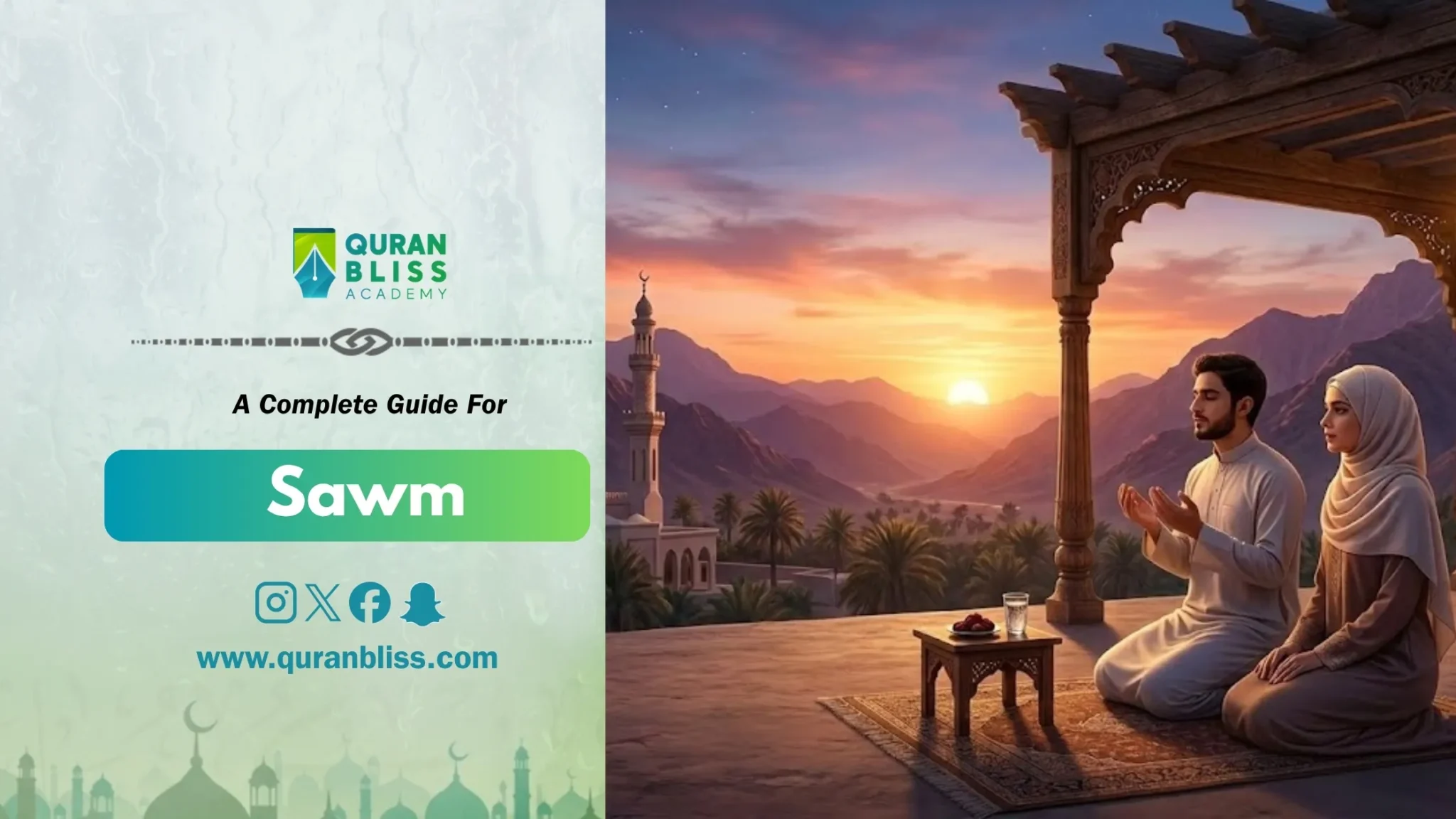
Sawm (Fasting) Understanding the Fourth Pillar of Islam in Daily Life
Sawm (صَوْم) means fasting in Islam. It is the Fourth Pillar of Islam, obligatory for every adult Muslim during the month of Ramadan. A valid fast runs from Fajr (dawn) to Maghrib (sunset) and requires sincere intention (Niyyah). Beyond hunger, Sawm is a comprehensive act of worship that purifies the heart, builds Taqwa (God-consciousness), and strengthens the Muslim Ummah.
The True Meaning of Sawm
Linguistic Meaning
In classical Arabic, the word Sawm (صَوْم) comes from the root ص-و-م, which literally means “to refrain” or “to abstain.” Even in pre-Islamic poetry, it was used to describe a horse standing still, perfectly restrained. This image captures the essence of fasting: the soul holds back from what is permitted, for the sake of something greater.
Islamic (Shari’ah) Meaning
In Islamic law, Sawm is defined as abstaining from food, drink, sexual relations, and all that breaks the fast, from the break of dawn (Fajr) until sunset (Maghrib), with a sincere intention to worship Allah. This formal definition is agreed upon by all four major schools of Islamic jurisprudence.
The Inner Fast: More Than Food
Many scholars, including Imam Al-Ghazali, teach that a complete fast involves three levels:
- The fast of the stomach, refraining from food and drink.
- The fast of the limbs, keeping the eyes, tongue, and hands away from sin.
- The fast of the heart, emptying it of anything other than Allah.
The Prophet (peace be upon him) warned: “Whoever does not give up lying speech (false statements) and acting on those lies and evil actions, Allah does not need his leaving his food and drink.” (Sahih Bukhari, 6057)
Sawm in the Quran and Sunnah

Key Quranic Verses
Allah (SWT) commands Sawm directly in the Quran, leaving no ambiguity about its obligation:
“يَا أَيُّهَا الَّذِينَ آمَنُوا كُتِبَ عَلَيْكُمُ الصِّيَامُ كَمَا كُتِبَ عَلَى الَّذِينَ مِن قَبْلِكُمْ لَعَلَّكُمْ تَتَّقُونَ”
“O you who have believed, decreed upon you is fasting as it was decreed upon those before you, that you may become righteous (attain Taqwa).”
(Surah Al-Baqarah, 2:183)
“شَهْرُ رَمَضَانَ الَّذِي أُنزِلَ فِيهِ الْقُرْآنُ هُدًى لِّلنَّاسِ”
“The month of Ramadan is that in which the Quran was revealed, a guidance for the people.”
(Surah Al-Baqarah, 2:185)
Hadiths on Fasting
The Prophet Muhammad (peace be upon him) left us a wealth of teachings on the spiritual power of Sawm:
“الصِّيَامُ جُنَّةٌ”
“Fasting is a shield,” meaning protection from sins and Hellfire.
(Sahih Bukhari, 1894)
“مَنْ صَامَ رَمَضَانَ إِيمَانًا وَاحْتِسَابًا غُفِرَ لَهُ مَا تَقَدَّمَ مِنْ ذَنْبِهِ”
“Whoever fasts during Ramadan with faith and seeking reward, his previous sins will be forgiven.”
(Sahih Bukhari, 38)
What Makes a Fast Valid?
Niyyah (Intention)
The fast must be accompanied by sincere intention (Niyyah) in the heart before Fajr. The Niyyah does not need to be uttered aloud; it is an internal resolve to fast for the sake of Allah. For obligatory fasts like Ramadan, the intention to fast must be made each night before the fast begins.
Timing: Fajr to Maghrib
The fast begins at true dawn (Fajr Al-Sadiq), not civil twilight, and ends at the setting of the sun (Maghrib). Many Muslims break their fast with the Adhan of Maghrib, following the Sunnah of the Prophet (peace be upon him) who said: “The people will remain upon good as long as they hasten to break the fast.” (Sahih Muslim, 1098)
What Invalidates the Fast
The following actions break the fast and may require Qadha (making up the missed day) or Kaffarah (expiation):
- Eating or drinking intentionally, even a sip of water.
- Sexual intercourse is the most serious violation, requiring Kaffarah.
- Intentional vomiting occurs when one forces oneself to vomit.
- Menstruation or postnatal bleeding automatically breaks the fast; these days must be made up later.
- Apostasy, leaving Islam, invalidates all acts of worship.
Note: Forgetfully eating or drinking does NOT break the fast. The Prophet (peace be upon him) said: “Whoever forgets he is fasting and eats or drinks, let him complete his fast, for it was Allah who fed him and gave him drink.” (Sahih Bukhari, 1933)
Who Must Fast in Ramadan? Important Rules, Exceptions & Islamic Guidelines
Obligatory Conditions
Fasting in Ramadan is Fard (obligatory) upon every Muslim who meets the following conditions:
- Muslim (the fast is not required of non-Muslims)
- Sane (aqil), those who have lost their mental faculties are exempt.
- Reached the age of puberty (baligh)
- Physically capable of fasting
- Resident (not a traveller on a legitimate journey)
Exemptions
Islam is a religion of ease. Allah says: “يُرِيدُ اللَّهُ بِكُمُ الْيُسْرَ وَلَا يُرِيدُ بِكُمُ الْعُسْرَ وَلِتُكْمِلُوا الْعِدَّةَ وَلِتُكَبِّرُوا اللَّهَ عَلَىٰ مَا هَدَاكُمْ“
“Allah intends for you ease, and does not want to make things difficult for you.” (Al-Baqarah, 2:185).
The following groups are exempt:
- Travellers may break the fast and make it up later.
- Sick individuals: those for whom fasting causes harm may break the fast and make up the days.
- Pregnant and nursing women: if fasting causes harm to them or their baby, they may be exempt. Many Muslims also ask, Can a pregnant woman fast in the month of Ramadan? and Islamic rulings generally allow exemption if fasting may affect the mother’s or baby’s health.
- Elderly: those too old and frail to fast may pay Fidya instead.
- Menstruating women must break the fast and make up days after Ramadan.
Kaffarah and Fidya
- Kaffarah is the severe expiation for intentionally breaking the fast through sexual intercourse during Ramadan. It requires: freeing a slave (no longer applicable), OR fasting for 60 consecutive days, OR feeding 60 poor people.
- Fidya is the compensation paid to those permanently unable to fast (the elderly and chronically ill). They must feed one poor person for each day of fasting missed, at a cost of approximately one meal per day.
The Different Types of Sawm in Islam
Understanding the different categories of fasting helps Muslims engage with this worship correctly and earn maximum reward:
Type | Arabic | Status | Example |
Fard | فرض | Obligatory | Ramadan fasting |
Sunnah | سنة | Recommended | Mondays & Thursdays |
Nafl | نفل | Voluntary | Fasting of Dawud (a.s.) |
Makruh / Haram | مكروه / حرام | Disliked / Forbidden | Eid & Tashreeq days |
Fard (Obligatory)
Obligatory fasting includes: fasting during Ramadan, making up missed Ramadan days (Qadha), and fasting as expiation (Kaffarah). These carry a serious religious obligation and must not be neglected without a valid reason.
Sunnah (Recommended)
These are fasts that the Prophet (peace be upon him) regularly observed and encouraged:
- Mondays and Thursdays: The Prophet said: “تُعْرَضُ الأَعْمَالُ يَوْمَ الاثْنَيْنِ وَيَوْمَ الخَمِيسِ، فَأُحِبُّ أَنْ يُعْرَضَ عَمَلِي وَأَنَا صَائِمٌ”
- “Deeds are presented on Monday and Thursday, and I love for my deeds to be presented while I am fasting.” (Tirmidhi, 747)
- The White Days (13th, 14th, and 15th of each Islamic month): the Prophet encouraged fasting on these three days each month.
- Six days of Shawwal: fasting six days after Ramadan equals the reward of fasting an entire year. (Sahih Muslim, 1164)
- Day of Arafah (9th of Dhul Hijjah): for non-pilgrims, this expiates sins of the past and the coming year.
Nafl (Voluntary)
Voluntary fasts may be observed at any time (within permitted days) for extra reward. The fast of Prophet Dawud (a.s.), fasting every other day, is described as the best voluntary fast. To determine the best days to fast in Islam, scholars point to Mondays, Thursdays, and the middle three days of each Islamic month as the most rewarding days.
Those seeking extra reward should also explore fasting for dhul hijjah, a complete guide to the most virtuous days of the year.
Prohibited Fasting Days
Fasting is strictly forbidden (Haram) on:
- Eid Al-Fitr (1st Shawwal): the day Muslims celebrate the end of Ramadan.
- Eid Al-Adha (10th Dhul Hijjah): the day of sacrifice.
- The Days of Tashreeq (11th, 12th, 13th Dhul Hijjah): the Prophet prohibited fasting on these days.
On these days, fasting would go against the spirit of celebration and the command of Allah. Even if a person has a vow or makes up for a missed day, these five days remain impermissible.
The Spiritual Rhythm of Ramadan
Ramadan is divided by scholars into three spiritual stages: the first ten days are for Mercy (Rahmah), the middle ten for Forgiveness (Maghfirah), and the final ten for Liberation from Hellfire (Itq min Al-Nar). Each stage invites the believer to deepen their fast, increase their Quran recitation, and seek Allah with greater urgency.
Ramadan is not merely a month of hunger; it is a comprehensive school for the soul. Tarawih prayers are held every night. The Quran is completed. Sadaqah flows generously. Families break fast together. The Ummah breathes as one.
Laylatul Qadr, The Night of Power
“لَيْلَةُ الْقَدْرِ خَيْرٌ مِّنْ أَلْفِ شَهْرٍ”
“The Night of Decree is better than a thousand months.”
(Surah Al-Qadr, 97:3)
Laylatul Qadr falls in the last ten nights of Ramadan, most likely on an odd night. The Prophet (peace be upon him) would intensify his worship during this period, entering I’tikaf (seclusion in the mosque) and encouraging his family to seek this night. A single night of sincere worship on Laylatul Qadr is worth more than 83 years of continuous worship.
The Wisdom Behind Sawm
The wisdom behind Sawm goes far beyond abstaining from food and drink it is a journey of inner discipline, spiritual clarity, and sincere connection with Allah. Through fasting, the believer learns patience, gratitude, and self-control, transforming daily habits into acts of worship.
Taqwa, God-Consciousness
The Quran explicitly states the purpose of fasting: “…that you may attain Taqwa.” (Al-Baqarah, 2:183).
Taqwa is an awareness of Allah that shapes every decision, every word, every thought. Fasting trains this awareness because the fasting person refrains from even what is lawful, food and drink, out of obedience to Allah. If one can hold back from halal things, it becomes far easier to avoid haram ones.
Discipline and Self-Mastery
Neuroscience today confirms what Islam taught 1,400 years ago:
- Fasting rewires our habits and strengthens impulse control.
- Every hour of restraint during Sawm is a repetition in the spiritual gym.
- The fast builds the mental and moral muscle to say “no” to anger, to desire, to laziness, long after Ramadan ends.
Empathy for the Poor
Hunger is not abstract when you have felt it. Sawm forces the wealthy and comfortable to experience, even briefly, what millions live with daily. This lived experience naturally opens the heart to generosity. Ramadan sees the highest rates of charitable giving (Zakat and Sadaqah) in the Muslim world precisely because fasting makes the suffering of others feel real and urgent.
Ummah Unity
When 1.8 billion Muslims fast on the same day, begin the fast at the same time, and break fast at the same moment, it produces a unique sense of solidarity. The iftar table is one of Islam’s most powerful symbols of community. No matter the country, language, or ethnicity, Muslims are united in this single act of collective worship.
Sawm in Today’s World

In today’s fast-paced and distraction-filled world, Sawm offers a rare opportunity to pause and rebalance body and spirit. It reminds the believer to slow down, refocus, and reconnect with what truly matters beyond the noise of daily life.
Fasting While Working
For Muslims in the modern workplace, fasting while maintaining full professional responsibilities is a common challenge, and a rewarding one. Practical tips from scholars and contemporary Muslims include:
- Eat a nutritious Suhoor (pre-dawn meal) rich in complex carbohydrates and protein.
- Stay hydrated between Iftar and Suhoor.
- Adjust sleep schedules during Ramadan to account for night prayers (Tarawih and Tahajjud).
- Communicate openly with employers about Ramadan schedules where necessary.
Islam acknowledges difficulty. The traveller and the ill person may break their fast; the same principle extends compassionately to extreme hardship cases, subject to proper scholarly guidance.
Fasting in Non-Muslim Countries
- For Muslims in Western countries, Ramadan can sometimes feel isolating due to the absence of public Islamic traditions and community atmosphere.
- Many Muslims experience deeper spiritual commitment while fasting in non-Muslim environments because fasting becomes a personal and intentional act of faith.
- Sawm (fasting) is one of the Five Pillars of Islam and is closely connected to Salah, Shahadah, Zakat, and Hajj.
- Understanding all Five Pillars together helps Muslims appreciate the full spiritual meaning and purpose of fasting in Islam.
Sawm is not deprivation but purification and elevation. Through fasting, Muslims learn self-control, compassion for the poor, and a deeper connection with the Quran and Allah. Every Ramadan, whether your first or fiftieth, is a chance to renew faith and grow stronger and more mindful. May Allah accept our fasts, forgive our shortcomings, and grant us the full rewards of Sawm in this life and the Hereafter. Ameen.
Frequently Asked Questions About Sawm
Yes, but Islam permits you to break the fast while travelling and make up the missed days later. Most scholars define travel as a journey of at least 88 km. If you choose to fast while travelling and it does not harm you, your fast is valid.
This is a matter of scholarly difference. Most contemporary scholars, including the Islamic Fiqh Council, consider inhalers that deliver medication to the lungs (not the stomach) as permissible during fasting for medical necessity. For regular medication that must be swallowed, consult a qualified Islamic scholar about your specific situation.
Fasting on Mondays and Thursdays is an established Sunnah. The Prophet (peace be upon him) said he preferred to be fasting on those days because deeds are presented to Allah on those days. It is among the best days to fast in Islam outside of Ramadan and the Day of Arafah.
Children who have not reached puberty are not obligated to fast. However, many Muslim families gradually introduce fasting to children from around the age of 7–10 as a form of practice and spiritual education, never by force, and never to the point of harm. Once puberty is reached, fasting becomes obligatory.
Yes. A person may break a voluntary (Nafl) fast before sunset without sin, though it is better to complete it. However, if the fast is interrupted without a valid reason, it is recommended to make it up as a matter of good character and respect for the act of worship. Breaking an obligatory fast intentionally is a completely different matter and requires Qadha. Can I fast while travelling?
Does using an inhaler or taking a medication break break my fast?
What is the ruling on fasting on Mondays and Thursdays?
Can children fast in Ramadan?
Is it permissible to break a voluntary fast before sunset?

Islamic Studies Course
for Adults
Deepen your understanding of Islam’s teachings.
Learn More
The 5 Pillars of Islam
Understand the fundamental principles of Islamic faith and practice.
Learn More