


What Is Idgham in Tajweed? The Complete Guide for Beginners
Picture yourself reciting Surah Al-Baqarah, words flowing steadily, until your teacher pauses: The sound isn’t merging correctly here. This common hurdle points to Idgham, a vital Tajweed rule that transforms your recitation once mastered. The Quran Bliss Academy Editorial Team created this comprehensive guide, certified Quran and Islamic Studies educators with more than a decade of experience teaching non-Arab Muslims around the world.
We will walk you through everything regarding what is Idgham in Tajweed. Your journey to a smoother recitation with our certified teachers starts here. Let’s dive into the rules, letters, and practical examples.
Understanding Idgham, More Than Just a Rule
Idgham in Tajweed is the merging of a Noon Sakinah or Tanween into one of six specific Arabic letters, so they become a single blended sound. It occurs across two consecutive words and has two types: Idgham with Ghunnah (nasal sound) and Idgham without Ghunnah.
The Literal Meaning of Idgham in Arabic
For students searching to understand what Idgham is in Tajweed in English, the word itself answers: Idgham (إدغام) comes from the Arabic root دَغَمَ, which means to insert one thing into another.
In the context of Tajweed, this is precisely what happens:
- one letter is absorbed into the letter that follows it, creating a single, stronger, unified sound.
- The first letter does not disappear, it merges, leaving its trace in the intensity of what comes after.
How Idgham Fits Into the Bigger Picture of Tajweed
Tajweed is the complete science of Quranic recitation, covering everything from the precise exit points of letters (Makharij) to the qualities of sound (Sifat), the rules of stretching vowels (Madd), and the four Noon Sakinah and Tanween rules. Idgham is one of those four rules, sitting alongside Izhar, Iqlab, and Ikhfa.
Understanding where Idgham fits helps students see the bigger map:
- every rule serves the goal of preserving the Quran exactly as it was revealed to Prophet Muhammad ﷺ.
- Idgham, in particular, ensures the natural smoothness of Arabic speech is maintained in recitation, no awkward stops, no broken sounds, just a continuous, melodic flow.
The Building Blocks, Noon Sakinah and Tanween
Before Idgham can happen, two foundational sounds must be present. Think of them as the ‘triggers’ that set the rule in motion. Every single case of Idgham in the Quran, across thousands of verses, starts with one of these two elements:
- Noon Sakinah, the silent Noon that can appear in the middle or at the end of a word
- Tanween, the double vowel sound at the end of a noun that carries an implicit Noon sound
These are not just technicalities, they are the most common sounds in the Arabic language, which is why Idgham appears so frequently throughout the Quran. A student who understands these two triggers will never miss an Idgham.
What Is Noon Sakinah?
Noon Sakinah (نْ) is a Noon letter that carries a Sukoon (ْ), the small circle above the letter indicating it has no vowel sound of its own. It is a ‘resting’ Noon. You will find it both inside words (e.g., مِنْكُمْ) and at the end of words (e.g., مَنْ).
When this silent Noon appears at the end of a word and the next word begins with one of the six Idgham letters, the merging rule applies. The Noon does not stop, it flows directly into the letter that follows.
What Is Tanween?
Tanween (التنوين) refers to the double vowel marks written at the end of Arabic nouns: Fathatayn (ـً), Dammatayn (ـٌ), and Kasratayn (ـٍ). These marks produce an ‘n’ sound at the end of the word, essentially an invisible Noon Sakinah that appears only in pronunciation, not in the written letter.
For example, the word كِتَابٌ is pronounced ‘kitaabun’, that final ‘n’ sound is Tanween. When this sound is followed by an Idgham letter at the start of the next word, the same merging process takes place.
Why These Two Are the Starting Point of Idgham
The reason Noon Sakinah and Tanween are the starting point is simple:
- both produce the same ‘n’ sound, and that particular sound has a natural tendency in Arabic to soften, merge, or transform when certain letters follow it.
- Arab linguists and Tajweed scholars identified this tendency over a thousand years ago, codified it, and passed it down, generation to generation, in an unbroken chain of oral transmission all the way to the Prophet ﷺ.
The Six Letters of Idgham (يَرْمَلُون)
The six Idgham letters are not random, they were grouped together by early Tajweed scholars into a single memorable word:
يَرْمَلُون
This word is made up of the six letters: ي (Ya), ر (Ra), م (Meem), ل (Lam), و (Waw), ن (Noon). When a Noon Sakinah or Tanween is followed by any of these six letters, across two separate words, Idgham takes place.
The Easy Mnemonic Every Student Should Know
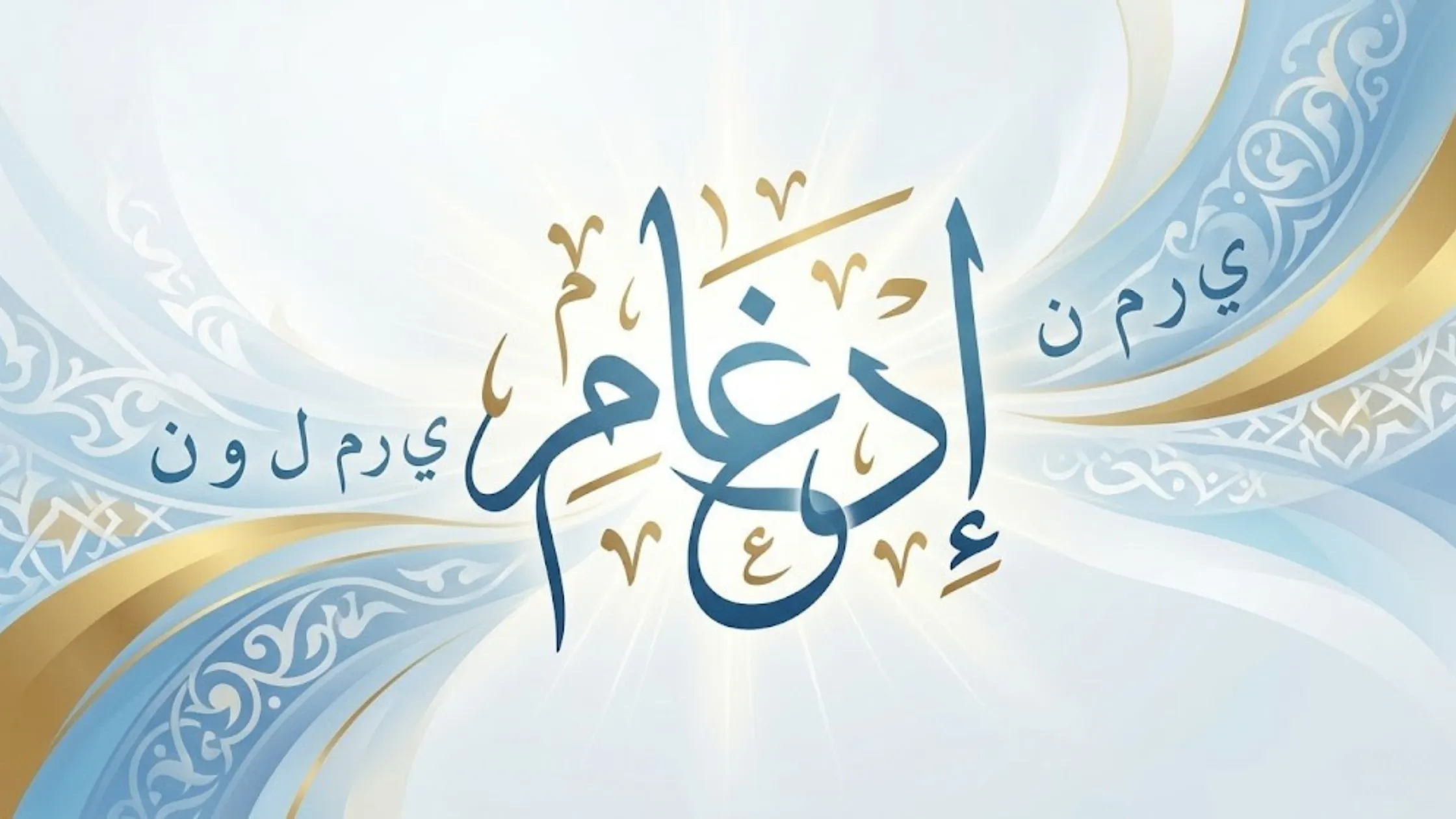
The mnemonic يَرْمَلُون has been used in Tajweed classrooms for centuries. At Quran Bliss Academy, we teach students to read it as one smooth word so it becomes second nature. Some teachers also use the alternative phrase: لر ينمو, both contain the same six letters.
Here is a quick breakdown of all six letters and what they mean for recitation:
- ي (Ya), merges with Ghunnah
- ن (Noon), merges with Ghunnah
- م (Meem), merges with Ghunnah
- و (Waw), merges with Ghunnah
- ل (Lam), merges WITHOUT Ghunnah
- ر (Ra), merges WITHOUT Ghunnah
Where to Find These Letters in the Quran
Understanding what is Idgham in Quran becomes clear when you see how often it appears, the six Idgham letters appear thousands of times throughout the Quran.
The six Idgham letters appear thousands of times throughout the Quran. A student reciting Surah Al-Baqarah alone will encounter dozens of Idgham cases. For example, in the phrase مَنْ يَقُولُ, the Noon Sakinah in مَنْ merges into the ي of يَقُولُ, producing a sound closer to ‘may-yaqool’ with a gentle nasal hum.
This frequent appearance is exactly why mastering Idgham is among the highest priorities in any structured Tajweed curriculum.
The Two Types of Idgham in Tajweed
Before diving into the types, let’s be clear: the best way to understand Idgham is through Idgham examples directly from the Quran — which is exactly what this section provides:
Idgham with Ghunnah (Nasalization) Letters & Examples
Idgham with Ghunnah applies to four letters: ي، ن، م، و. When a Noon Sakinah or Tanween meets any of these four letters, the Noon sound merges into the following letter while producing a Ghunnah, a resonant nasal sound held for approximately two counts (two beats of the finger).
Quran Example:
“مِنْ وَالٍ”
“…from any protector…”
(Surah Ar-Ra’d, 13:11)
Here, the Noon Sakinah in مِنْ merges into the و of وَالٍ with a clear nasal hum. The result sounds like ‘min-waalin’ with a smooth, extended nasal blend.
Another example:
“كِتَابٌ مَرْقُومٌ”
“…a written register…”
(Surah Al-Mutaffifin, 83:9)
The Tanween at the end of كِتَابٌ merges into the م of مَرْقُومٌ, producing a Ghunnah before the Meem.
Idgham without Ghunnah, Letters & Examples
Let’s look at clear Idgham without Ghunnah examples from the Quran to make this type easy to recognize: ل and ر. When these appear after a Noon Sakinah or Tanween, the Noon is completely absorbed, no nasal sound, no humming. The letters blend into one with no trace of nasalization.
This type feels more abrupt to new students because the Noon simply vanishes. With practice, it becomes natural and even feels lighter in the mouth.
Quran Example:
“مِنْ رَبِّكَ”
“…from your Lord…”
(Surah An-Nahl, 16:102)
The ر of رَبِّكَ completely absorbs the Noon Sakinah in مِنْ. There is no nasal hum, the reciter moves directly into the Ra with emphasis (Shaddah).
Another example:
“غَفُورٌ رَحِيمٌ”
“…Most Forgiving, Most Merciful…”
(Surah Al-Baqarah, 2:173)
The Tanween of غَفُورٌ merges silently into the ر of رَحِيمٌ, clean, direct, no nasalization.
Comparison Table With Ghunnah vs. Without Ghunnah
Here is a clear side-by-side comparison to help you remember the difference:
Feature | Idgham with Ghunnah | Idgham without Ghunnah | Key Tip |
Letters | ي، ن، م، و | ل، ر | 4 vs 2 letters |
Nasal Sound (Ghunnah) | Yes, 2 counts | No | Listen for the hum |
Example | مِنْ وَالٍ → min-waalin | مِنْ رَبِّكَ → mir-rabbik | Practice both |
Noon sound | Merges with nasal hum | Completely absorbed | No trace of Noon |
Best for beginners? | Start here | Easier to hear | Learn together |
Examples of Idgham in the Quran The following 10 examples of Idgham in the Quran cover both types and will sharpen your ear for every recitation session:
Arabic Phrase | Reference | Type | |
1 | مَنْ يَقُولُ | Al-Baqarah 2:8 | With Ghunnah (ي) |
2 | مِنْ وَالٍ | Ar-Ra’d 13:11 | With Ghunnah (و) |
3 | كِتَابٌ مَرْقُومٌ | Al-Mutaffifin 83:9 | With Ghunnah (م) |
4 | مَنْ نَشَاءُ | Yusuf 12:56 | With Ghunnah (ن) |
5 | هُدًى وَرَحْمَةٌ | Al-A’raf 7:52 | With Ghunnah (و) |
6 | مِنْ رَبِّكَ | An-Nahl 16:102 | Without Ghunnah (ر) |
7 | غَفُورٌ رَحِيمٌ | Al-Baqarah 2:173 | Without Ghunnah (ر) |
8 | مِنْ لَدُنْهُ | Al-Kahf 18:2 | Without Ghunnah (ل) |
9 | خَيْرٌ لَكُمْ | Al-Baqarah 2:184 | Without Ghunnah (ل) |
10 | قَوْلًا مَيْسُورًا | Al-Isra 17:28 | With Ghunnah (م) |
Idgham Rules, When and How It Applies
Students who search for what is idgham in tajweed rules often know the letters but miss the conditions. Knowing exactly when the rule kicks in, and when it does not, is what separates a student who has memorized Tajweed from one who truly applies it. The rules of Idgham are precise, and once internalized, they become automatic.
The Two-Word Rule (Idgham Only Across Words)
This is the most fundamental rule of Idgham, and it is non-negotiable: Idgham ONLY applies when the Noon Sakinah or Tanween is at the end of one word, and the Idgham letter is at the beginning of the very next word.
In simple terms: the merge happens across a word boundary, never within a single word. If the Noon Sakinah and the Idgham letter are both inside the same word, Idgham does NOT apply.
Correct example of Idgham: مِنْ يَشَاءُ, Noon at end of first word, ي at start of second word → Idgham applies.
The Exception, When Idgham Does NOT Apply (Same Word)
There are four words in the Quran where a Noon Sakinah is followed by an Idgham letter within the same word. In these cases, Tajweed scholars ruled that Idgham does NOT apply, instead, Izhar (clear pronunciation) is used. These four words are:
- دُنْيَا (Dunya), Noon + ي in same word
- بُنْيَان (Bunyan), Noon + ي in same word
- قِنْوَان (Qinwan), Noon + و in same word
- صِنْوَان (Sinwan), Noon + و in same word
In each of these words, the Noon is pronounced clearly and distinctly, with no merging. This exception is important to memorize because these words appear in the Quran, and applying Idgham here would be incorrect recitation.
Common Mistakes Beginners Make with Idgham
In our experience teaching students from over 30 countries at Quran Bliss Academy, Idgham is where many beautiful recitations quietly go wrong. Here are the three most common errors we see:
Applying Idgham Within a Single Word
- This is the most common mistake among beginners, and it almost always happens with the word دُنْيَا (Dunya).
- A student sees Noon Sakinah followed by ي and immediately applies the merge, but this is incorrect.
- As explained above, the four exceptional words require Izhar, not Idgham.
The fix: whenever you encounter a Noon Sakinah followed by an Idgham letter, pause for a split second and ask yourself, are these two letters in the same word, or two different words? That one question will eliminate this error.
Confusing Idgham with Iqlab or Ikhfa
- A common challenge we see among beginners is mixing up the four Noon Sakinah rules.
- Iqlab changes the Noon sound into a Meem when followed by ب.
- Ikhfa hides the Noon partially when followed by 15 specific letters.
- Idgham merges the Noon completely when followed by the six يَرْمَلُون letters.
- The distinction matters because each rule produces a different sound. Applying Ikhfa when Idgham is required, or vice versa, changes the correct pronunciation.
A helpful practice: drill all four rules side by side using the same base word (e.g., مِنْ) with different following letters until the ear automatically recognizes each case.
Forgetting the Ghunnah Duration (2 Counts)
- Students who understand that Idgham with Ghunnah requires a nasal sound sometimes rush through it, producing a Ghunnah that lasts less than one count.
- The correct duration is two counts, approximately two finger-tap beats.
- The Ghunnah in Idgham should be the same length as the Ghunnah in Ikhfa. If it is shorter, the recitation is technically deficient.
At Quran Bliss Academy, we use a finger-tapping exercise in every Tajweed session to help students internalize the correct duration until it becomes natural.
Why Mastering Idgham Transforms Your Recitation

The Prophet Muhammad ﷺ said:
“الْمَاهِرُ بِالْقُرْآنِ مَعَ السَّفَرَةِ الْكِرَامِ الْبَرَرَةِ”
“The one who is proficient in the recitation of the Quran will be with the honorable and obedient scribes (angels).”
Source: Sahih Bukhari, Hadith No. 4937
- This Hadith reminds us that the quality of our recitation matters deeply.
- Idgham is not about following a linguistic rule for its own sake, it is about honoring the speech of Allah with the precision and beauty it deserves.
- Many of our students at Quran Bliss Academy report that the moment Idgham ‘clicks,’ they begin to hear the Quran differently.
- Verses they have recited for years suddenly have a smoothness and rhythm they never noticed before.
- That is the power of learning correctly.
- Beyond the sound, Idgham also deepens your connection to the meaning.
When you glide from مِنْ يَشَاءُ without breaking the flow, you are not just pronouncing Arabic correctly, you are experiencing the same recitation style that has been passed down, mouth to ear, since the time of the Prophet ﷺ. That is an extraordinary inheritance.
Ready to take your Quranic recitation to the next level?
At Quran Bliss Academy, our certified Tajweed teachers guide students step by step, from understanding Idgham all the way to a confident, beautiful recitation. Join thousands of students worldwide and start your journey today. Book your free trial class now.
The journey from knowing a rule to truly applying it takes practice, patience, and the right guidance. If you are ready to move beyond just asking, What Is Idgham in Tajweed? and want to master its practical application, we are here to walk with you every step of the way. At Quran Bliss Academy, we provide certified teachers, a warm learning environment, and a curriculum that honors the Quran as it deserves to be honored.
Start your free trial class today and experience the difference that proper Tajweed makes.
Frequently Asked Questions About Idgham in Tajweed
Idgham is a Tajweed rule that says: when a Noon Sakinah or Tanween is followed by one of six specific Arabic letters, the Noon sound merges into that next letter and they become one blended sound. The six letters are grouped in the word يَرْمَلُون. There are two types, with a nasal hum (Ghunnah) and without it, depending on which letter follows.
The six Idgham letters are ي، ر، م، ل، و، ن, memorized together as the word يَرْمَلُون. Four of them (ي، ن، م، و) trigger Idgham with Ghunnah, while two of them (ل، ر) trigger Idgham without Ghunnah. Whenever a Noon Sakinah or Tanween is followed by any of these six letters across two words, Idgham applies.
Both types involve merging the Noon Sakinah or Tanween into the following letter. The difference is the nasal hum: Idgham with Ghunnah (letters ي، ن، م، و) requires a resonant nasal sound held for two counts during the merge. Idgham without Ghunnah (letters ل، ر) involves a complete, clean absorption, the Noon disappears entirely with no nasal sound, and the reciter moves directly into the next letter.
No, Idgham only applies across two separate words. When the Noon Sakinah and the Idgham letter appear within the same word, the rule changes to Izhar (clear pronunciation). There are exactly four such words in the Quran where this exception applies: دُنْيَا، بُنْيَان، قِنْوَان، and صِنْوَان. In all four, the Noon is pronounced clearly without any merging.
The Ghunnah in Idgham with Ghunnah should last for two counts, approximately two beats of the finger. This is the same standard duration used for Ghunnah in other Tajweed rules like Ikhfa. A Ghunnah shorter than two counts is technically incomplete. Practicing with a metronome or finger-tapping alongside a qualified teacher is the best way to internalize the correct duration. What is Idgham in Tajweed in simple words?
What are the 6 letters of Idgham?
What is the difference between Idgham with and without Ghunnah?
Does Idgham apply within a single word?
How long should the Ghunnah sound last in Idgham?


Quran Recitation
with Tajweed
Master accurate Qur’an recitation with clear Tajweed rules.
Learn More