

What Is Iqlab in Tajweed? Rules, Letters, Pronunciation & Quran Examples (2026 Beginner’s Guide)
Every Muslim who recites the Quran with sincerity eventually reaches a point where mispronunciations feel like a barrier. You recite confidently until you realize some sound transitions lack flow. One of the most overlooked rules is what is Iqlab in Tajweed; a precise adjustment that makes the difference between perfect recitation and subtle error. This guide was crafted by the Quran Bliss Academy Editorial Team certified educators with over a decade of experience to help you master these nuances. Understanding Iqlab will immediately improve the clarity, rhythm, and spiritual quality of your recitation.
What Is Iqlab in Tajweed?
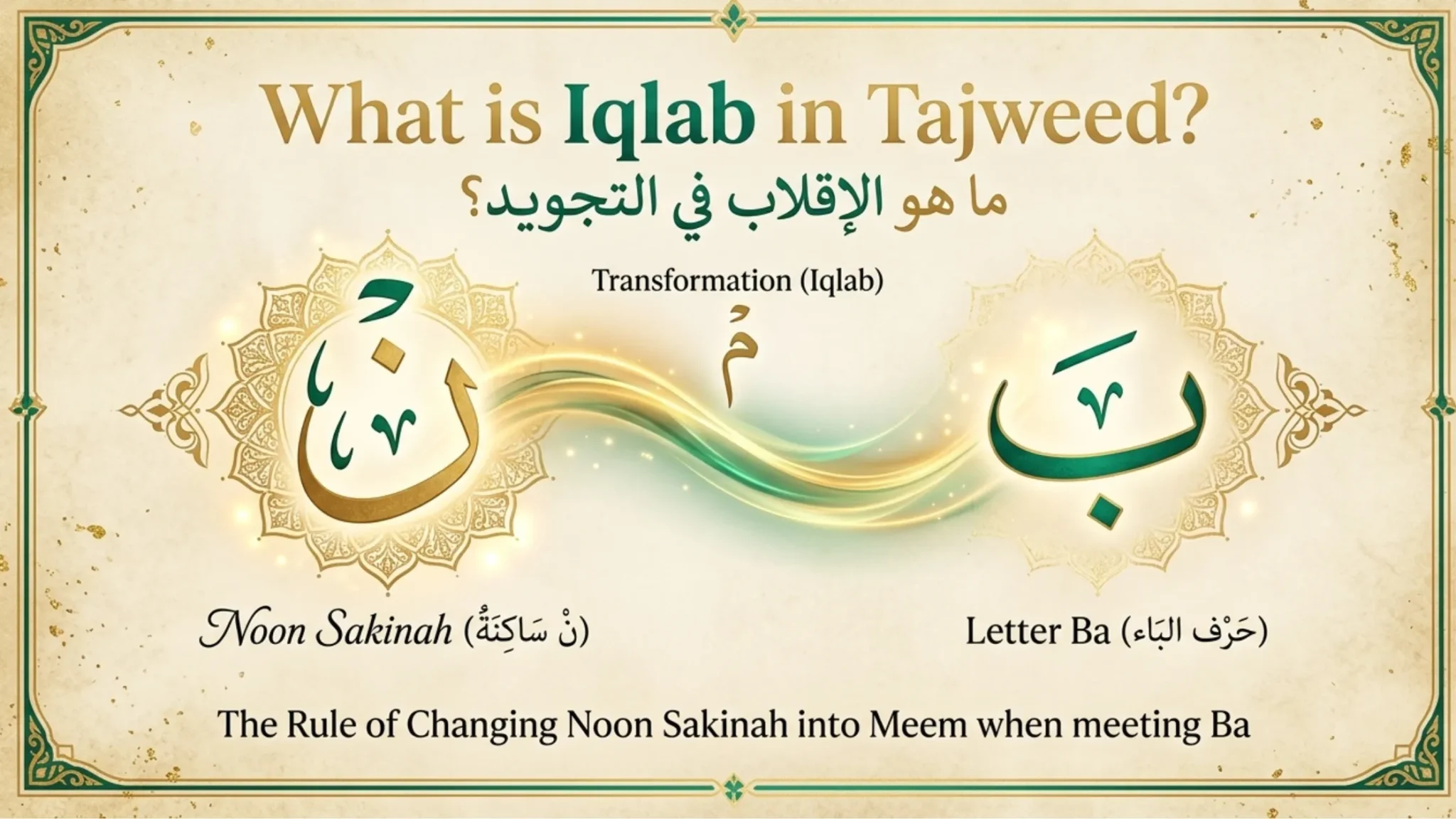
Iqlab is a tajweed rule that occurs when a nun sakinah or tanween is followed by the letter baa (ب). In this case, the nun sound changes into a hidden meem (م) with ghunnah (nasal sound) for smooth and correct recitation.
For example: كَلَّا لَئِن لَّمْ يَنتَهِ لَنَسْفَعًا بِالنَّاصِيَةِ — the nun sound is converted into a nasalized meem before baa.
Mastering Iqlab helps avoid mispronunciation and is essential in quran tajweed lessons.
What Does Iqlab Mean?
Arabic terminology in Tajweed is not just technical labeling; each word carries a precise description of what happens phonetically. What is Iqlab in Tajweed? It is derived from the Arabic root meaning “to turn” or “to flip,” describing the transformation of a Nun Sakinah or Tanween sound into a Meem (م) sound when followed by the letter Baa (ب).
This process is not merely a partial change; it is a complete conversion characterized by several key features:
- Total Transformation: The original Nun sound disappears entirely and is replaced by a hidden Meem.
- The Bridge of Ghunnah: A smooth, nasal resonance is maintained during the transition, bridging the two sounds.
- Seamless Flow: The word Iqlab perfectly encapsulates this “flip,” creating a natural, melodious connection in your recitation.
What Is the Condition for Iqlab? The Single Rule You Must Know
Students who study Quran Tajweed lessons often memorise long lists of letters for other rules, so it comes as a pleasant surprise that Iqlab has only one condition. For Iqlab to apply, two things must be present together: a Nun Sakinah or Tanween, followed immediately, whether within the same word or across two consecutive words, by the letter Baa (ب).
The condition is therefore threefold:
- Presence of Nun Sakinah (نْ) or Tanween (ـً / ـٍ / ـٌ)
- The very next letter must be Baa (ب), and only Baa
- No vowel separates the two; they must be adjacent in the flow of recitation
This precision is what makes Iqlab unique among the four rules governing Nun Sakinah. While Idgham requires six letters, Ikhfaa requires fifteen, and Idhar requires six letters of the throat, Iqlab letters number exactly one: the letter Baa (ب). If any other letter follows the Nun, a different rule applies
How Does Iqlab Work? The Three Actions That Complete the Rule

For those learning Quran recitation online, it helps to understand Iqlab not as a single act but as a sequence of three phonetic actions that must all occur together. Skipping any one of them results in incorrect recitation. The three actions are:
Conversion of Nun into Hidden Meem
The Nun Sakinah or Tanween is fully converted into a Meem (م) sound. The lips gently come together as if preparing to say “meem,” but the sound is not fully voiced, it remains hidden (مخفاة). The Nun disappears from pronunciation entirely.
Merging the Hidden Meem with Baa Using Ikhfaa
The hidden Meem is gently merged into the following Baa (ب) using a technique similar to Ikhfaa, a partial concealment. This creates a smooth, connected transition between the two sounds without a full, distinct Meem being heard independently.
Maintaining Ghunnah for Two Counts
Throughout this transition, a clear Ghunnah (nasal sound) is sustained for approximately two beats. This nasalisation is the defining characteristic of Iqlab in Tajweed and distinguishes it from Idhar, where the Nun is pronounced clearly with no Ghunnah.
Identifying Iqlab in the Mushaf
In the Uthmani script of the Mushaf, scholars included specific visual markers to help the reciter apply Tajweed rules intuitively.
- The Iqlab Marker: A small, vertical Meem (م) is placed directly above the Nun Sakinah (نْ) or the Tanween (ـً / ـٍ / ـٌ).
- Significance: This Meem is not part of the original word structure; it serves as a visual “alert” that the Nun or Tanween has been converted into a hidden Meem due to the following letter being a Baa (ب).
- Visual Distinction: Unlike other rules (like Idgham or Ikhfaa), which have their own specific signs (such as the absence of a diacritic or skewed Tanween), the small Meem is the exclusive marker for Iqlab. Seeing this symbol acts as an immediate prompt to gently close your lips and prepare the nasal resonance (Ghunnah).
How to Pronounce Iqlab Correctly?
Many students who learn quran online through self-study make the same pronunciation error: they either say the Nun too clearly (missing the conversion) or they say a fully audible Meem (overdoing the conversion). Correct Iqlab requires a balanced, subtle technique. Here is how to apply it step by step:
- Recognise the Iqlab sign: In the Uthmani Mushaf, a small Meem (م) is placed above the Nun Sakinah or Tanween whenever Iqlab applies. This visual marker is your signal.
- Bring the lips together gently: As you approach the Baa, lightly close your lips as you would for Meem. Do not press firmly, this is a hidden sound.
- Let the nasal resonance vibrate: Direct airflow through your nasal passage and allow the Ghunnah to vibrate clearly for two counts.
- Release into Baa smoothly: Without lifting your lips abruptly, transition naturally into the Baa (ب). The listener should sense a smooth flow, not a break.
Practising this with a qualified teacher through the best online quran classes accelerates the learning curve significantly, ensuring you move beyond basic reading to true mastery
The Rule of Iqlab and Ghunnah
To fully grasp what is Iqlab in Tajweed, it is essential to understand why Ghunnah (nasal sound) is an inseparable part of the rule. Because the Arabic phonetic system associates both the Meem and Nun with nasalisation, the conversion of a Nun into a hidden Meem before a Baa necessitates that the nasal channel remains open.
This structural integration ensures the sound remains authentic to the oral tradition of the Quran. Consider these key reasons why Ghunnah is critical to the rule of Iqlab:
- Structural Integrity: Ghunnah is not an optional embellishment; it is a fundamental requirement that makes the transition between the Meem and Baa phonetically possible.
- Preventing Distortion: Without Ghunnah, the sound becomes clipped or unnatural, which scholars classify as a recitation error that can undermine the sanctity of the verse.
- Preserving Tradition: The inclusion of Ghunnah aligns your recitation with the unbroken chain of transmission (Sanad) maintained for over 1,400 years.
Ultimately, the benefits of reading quran with tajweed extend far beyond technical accuracy; they include a deeper connection with the meaning of each verse and a more meditative, reverent experience.
How Iqlab Noon Sakinah Works in Three Essential Forms
Among the different Iqlab rules, learners must understand that this rule does not occur in just one setting. Depending on whether the Nun Sakinah or Tanween appears inside a single word or at the end of one word before another, the visual pattern changes, but the phonetic rule remains identical. Here are the three essential forms:
Type | How It Occurs | Quranic Example | Transliteration |
Within one word | Nun Sakinah appears before Baa in the same word | أَنْبِئْهُمْ | Anbi’hum |
Across two words (Nun) | Nun Sakinah ends the first word, Baa starts the second | مِنْ بَيْنِهِمْ | Min baynihim |
Across two words (Tanween) | Tanween ends the first word, Baa starts the second | عَلِيمٌ بِذَاتِ الصُّدُورِ | ‘Aleemun bi-dhatis-sudoor |
In all three forms, the visual indicator in the Uthmani Mushaf, the small Meem (م), appears above the Nun or Tanween. This makes identifying Iqlab examples in the Quran straightforward, even for students who are still building their Tajweed knowledge.
10 examples of iqlab in quran
The best way to internalise any Tajweed rule is through repeated exposure to its examples in the Quran. Below are ten verified Iqlab examples from the Quran that appear across well-known surahs, covering all three types of Iqlab:
Example 1: Nun Sakinah within a word
“أَنْبِئْهُمْ” “”Inform them”” (Surah Al-Baqarah, 2:33)
The Nun Sakinah (نْ) in Anbi’hum is immediately followed by Baa, making this a classic Iqlab within a single word.
Example 2
“وَأَمَّا مَنْ بَخِلَ وَاسْتَغْنَى” “”As for him who was stingy and thought himself self-sufficient”” (Surah Al-Layl, 92:8)
The Nun Sakinah at the end of مَنْ is followed by Baa at the start of بَخِلَ, triggering Iqlab.
Example 3
“أَنْ بُورِكَ مَن فِي النَّارِ” “”That blessed is whoever is at the fire”” (Surah An-Naml, 27:8)
One of the most frequently cited Iqlab examples in quran tajweed lessons, the Nun Sakinah before Baa is clearly marked in the Mushaf.
Example 4
“فَكَانَتْ هَبَاءً مُنْبَثًّا” “”And the mountains will be like fluffed wool”” (Surah Al-Waqi’ah, 56:6)
The Nun Sakinah in مُنْبَثًّا is followed by Baa, an Iqlab within a single word with a powerful Ghunnah.
Example 5
“وَالصَّاحِبِ بِالْجَنبِ” “”The companion at your side”” (Surah An-Nisa, 4:36)
This is one of the well-known examples of Iqlab with Tanween, used frequently in Tajweed teaching.
Example 6
“سَمِيعٌ بَصِيرٌ” “”All-Hearing, All-Seeing”” (Surah Al-Isra, 17:1)
The Tanween on سَمِيعٌ transforms into a hidden Meem before بَصِيرٌ, a beautiful Iqlab example with Tanween encountered throughout the Quran.
Example 7
“مِنْ بَعْدِ” “”After”” (Various surahs)
This combination appears dozens of times in the Quran, مِنْ followed by بَعْدِ, making it one of the most frequently practised Iqlab examples for beginners.
Common Pronunciation Mistakes in Iqlab and How to Correct Them
Even students who have spent months studying with an arabic quran teacher online can fall into habitual errors when applying to Iqlab. Identifying these patterns early prevents them from becoming permanent. Here are the most common mistakes and their corrections:
- Pronouncing the Nun: You must fully transform the Nun into a hidden Meem. If you still hear a Nun, you have missed the conversion.
- Over-articulating the Meem: The Meem in Iqlab is concealed, not declared. Keep your lips lightly together; the sound should be felt as nasal resonance, not heard as a distinct letter.
- Dropping the Ghunnah: Rushing through the transition removes the rule’s foundation. Always sustain the Ghunnah for two full counts.
- Confusing Iqlab with Ikhfaa: Remember the trigger: if the letter following Nun Sakinah is Baa, it is always Iqlab never Ikhfaa.
How Can I Apply Iqlab? A Practical Approach for Learners
Knowing the rule intellectually is only the first step. Applying Iqlab in Tajweed consistently during actual recitation requires structured practice. Here is a practical framework that students at Quran Bliss Academy follow:
- Start with recognition: Go through a Juz and highlight every instance where Nun Sakinah or Tanween is followed by Baa. Use a different colour for each type.
- Slow recitation: Read identified Iqlab positions at half your normal pace, consciously performing each of the three actions.
- Listen and repeat: Use recordings of certified Quranic reciters and pause at every Iqlab example to absorb the correct sound pattern.
- Live correction: Work with an Arabic Quran teacher online who can identify and correct errors in real time, something no app or recording can replicate.
- Graduated speed: Once each position feels natural at slow speed, gradually increase pace until the rule applies automatically at your normal recitation speed.
Students who follow quran tajweed lessons with a structured curriculum, rather than learning rules in isolation, tend to internalise Iqlab far more quickly because they see it applied in the context of full surahs rather than isolated examples.
The Importance of Precise Tajweed in Quranic Recitation
Some learners wonder whether the fine details of Tajweed including Iqlab are truly necessary or whether a general approximation of the sounds is sufficient. This is a common question, and it deserves a thorough answer.
Preserving the Sacred Oral Tradition
The Quran was revealed in a precise Arabic dialect and transmitted orally with meticulous attention to every sound, pause, and phonetic nuance. The Prophet Muhammad ﷺ received the Quran from Jibreel (AS) and recited it back exactly a tradition preserved through chains of memorization for over fourteen centuries.
The Responsibility of the Reciter
When we address the common concern,is reading quran without tajweed wrong, scholars distinguish between deliberate negligence and honest ignorance. Knowing that one has the ability to learn but choosing not to is considered blameworthy.
The Spiritual and Practical Impact
The benefits of Tajweed extend beyond technical accuracy. They include a deeper connection with the meaning of each verse and the fulfillment of the Quranic command: “وَرَتِّلِ الْقُرْآنَ تَرْتِيلًا” (“And recite the Quran with measured recitation” Surah Al-Muzzammil, 73:4).
Recognizing the importance of recitation of holy quran with precision helps every Muslim appreciate why these details were preserved so carefully for over fourteen centuries.
Iqlab and the Path to Ijazah: Taking Your Tajweed to the Next Level
Students often ask how to get ijazah in tajweed, and the answer lies in demonstrating total mastery of every rule governing Nun Sakinah and Tanween, including the rigorous application of Iqlab.
Pursuing an Ijazah is one of the most honored achievements in Islamic scholarship, offering several unique benefits:
- Verified Chains of Transmission: Connect your recitation directly to the Prophet Muhammad ﷺ through a verified, authentic chain of teachers.
- Rigorous Mentorship: Our structured program at Quran Bliss Academy provides the same level of expert oversight and correction as traditional, face-to-face learning.
- Global Accessibility: Whether you are in London, Manchester, or beyond, you can pursue this prestigious certification from the comfort of your home.
- Comprehensive Mastery: Beyond just Iqlab, you will refine every phonetic principle, ensuring your recitation is as accurate as it is spiritually profound.
Common Challenges for Kids and Adults Learning Tajweed Online

While online learning is highly effective, students often face distinct challenges depending on their age group:
Challenges for Children
- Attention Span: Maintaining focus during digital sessions can be difficult.
- Abstract Concepts: Children often struggle with theoretical rules (like “Nun Sakinah”); they learn best through repetition, mimicry, and gamified interaction rather than heavy explanation.
Challenges for Adults
- Habitual Errors: The most significant hurdle is unlearning years of incorrect habitual recitation.
- Time Constraints: Balancing professional and personal responsibilities makes consistent daily practice difficult.
- Performance Anxiety: Many adults feel self-conscious about making mistakes; however, a one-to-one environment with a patient, certified teacher is the most effective way to build confidence and overcome this hurdle.
How to Create a Daily Tajweed Practice Routine
To see measurable progress, Tajweed must transition from a “lesson” to a daily habit. Here is a recommended 30-minute daily routine:
- Warm-up Review (5 minutes): Quickly review the specific rule you are currently studying (e.g., Iqlab). Read two or three verses containing that rule to refresh your memory.
- Focused Application (15 minutes): Read one page of the Quran, focusing exclusively on the rule you are practicing. Don’t worry about perfection in other areas; just ensure you apply the Iqlab correctly whenever it appears.
- Active Listening (5 minutes): Listen to a renowned reciter (such as Sheikh Al-Husary) reading the same verses. Pay close attention to how they manage the timing of the Ghunnah and the transitions.
- Self-Recording (5 minutes): Record yourself reading the passage, then listen back and compare your performance with the Sheikh’s recording. This is the single most effective way to identify and correct your own errors.
Begin Your Tajweed Journey with Quran Bliss Academy
If you are wondering whether your pronunciation, especially rules like Iqlab, is truly correct, now is the perfect time to find out. At Quran Bliss Academy, we provide personalized, one-to-one Tajweed lessons designed to transform your recitation from your very first session.
- Expert Mentorship: Learn from certified teachers specialized in guiding students through complex phonetic nuances.
- Flexible & Structured: Whether your goal is improving daily prayers, memorization, or earning an Ijazah, our curriculum adapts to your pace.
- Global Access: Experience the rigor of traditional face-to-face learning from the comfort of your own home.
- Proven Progress: Join thousands of students who have gained confidence and precision in their Quranic recitation.
Conclusion
Iqlab is an elegant rule that brings flow and beauty to your recitation. With only one triggering letter and a clear three-step process, mastering what is Iqlab in Tajweed is easily achievable for any sincere student. At Quran Bliss Academy, we invite you to take the next step. Book your free trial class today, and let our certified teachers guide your recitation from where you are now to the excellence you strive to reach.
Frequently Asked Questions:
An example is: سَمِيعٌ بَصِيرٌ (Samee‘un Baseer) Here, the tanween in سميعٌ (Samee‘un) is pronounced as a hidden meem before the letter baa in (baa in Baseer) بصير.
Iqlab is the Tajweed rule where a Nun Sakinah or Tanween is transformed into a hidden Meem sound when followed by the letter Baa. This transition is naturally accompanied by a nasal resonance known as Ghunnah, held for two beats.
Iqlab is unique because it is governed by only one letter: the Baa (ب). Whenever Nun Sakinah or Tanween precedes this specific letter, the rule of Iqlab must be applied.
In Ikhfaa, the Nun sound is partially concealed before fifteen different letters. In contrast, Iqlab completely replaces the Nun with a hidden Meem and exclusively applies only when the next letter is a Baa.
Scholars view tarteel as a divine command, meaning intentionally ignoring Tajweed rules is discouraged. However, beginners are excused while learning, and the effort to master these rules is a deeply rewarding act of reverence.
Yes, online learning is highly effective with a structured program. Quran Bliss Academy offers live sessions with certified scholars who provide the same real-time feedback and expert correction found in traditional learning circles. What is an example of Iqlab Tanween?
What is Iqlab in simple terms?
How many letters trigger Iqlab?
What is the difference between Iqlab and Ikhfaa?
Is reading the Quran without Tajweed wrong?
Can I learn Iqlab and Tajweed online?


Quran Recitation
with Tajweed
Master accurate Qur’an recitation with clear Tajweed rules.
Learn More