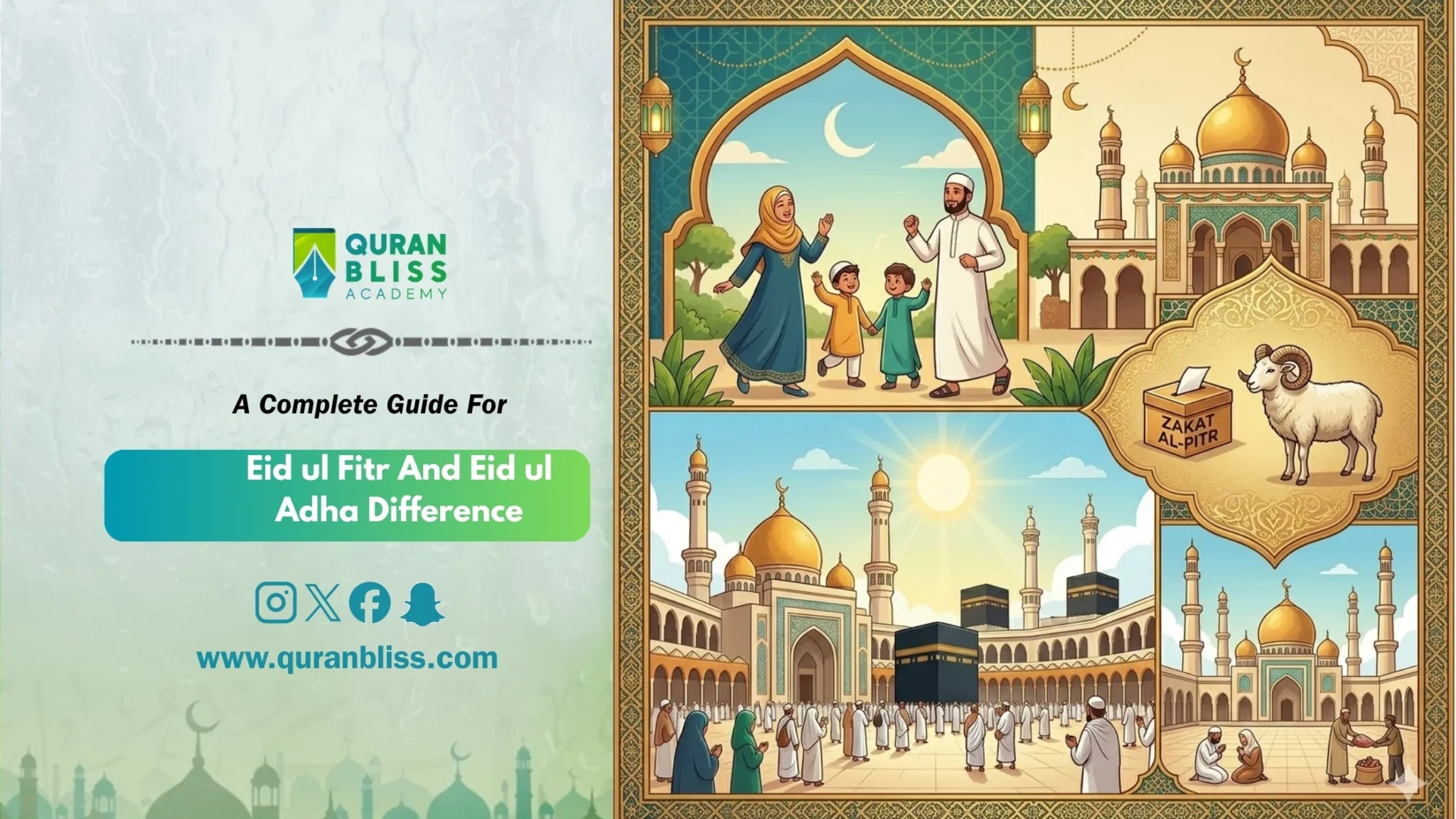
Eid ul Fitr and Eid ul Adha Difference
If you’ve ever wondered about the difference between Eid al-Fitr and Eid al-Adha , why they happen, what they mean, and how they’re observed , you’re in the right place.
These two celebrations are the most important festivals in Islam. They share the same joyful spirit, yet they carry very different spiritual meanings, histories, and traditions. This guide breaks it all down clearly, so you’ll never confuse the two again.
Feature | Eid ul Fitr | Eid ul Adha |
Meaning | Festival of Breaking the Fast | Festival of Sacrifice |
Islamic Month | 1st of Shawwal (10th month) | 10th of Dhul Hijjah (12th month) |
What It Marks | End of Ramadan | End of Hajj / Ibrahim’s sacrifice |
Key Practice | Zakat al-Fitr (charity) | Qurbani (animal sacrifice) |
Common Name | Small Eid / Sweet Eid | Big Eid / Bakra Eid / Qurbani Eid |
Duration | 1–3 days | 3–4 days |
What Does “Eid” Mean?
The word “Eid” (عيد) comes from Arabic and means “celebration,” “feast,” or “recurring happiness.” The word carries the idea of something joyful that returns, making it a perfect name for these annual Islamic holidays.
Islam has exactly two Eids, both established during the time of Prophet Muhammad (PBUH). According to a well-known hadith:
عَنْ أَنَسٍ قَالَ: قَدِمَ رَسُولُ اللَّهِ ﷺ الْمَدِينَةَ وَلَهُمْ يَوْمَانِ يَلْعَبُونَ فِيهِمَا…
“Anas (RA) reported: The Messenger of Allah (PBUH) arrived in Madinah when its people had two days of celebration. He said: ‘What are these two days?’ They said: ‘We used to celebrate them in the days of ignorance.’ He replied: ‘Allah has replaced them for you with something better: the Day of Adha and the Day of Fitr.'”
Source: Sunan Abu Dawood, Hadith 1134 , Graded Sahih
This hadith shows that the eid ul fitr and eid ul adha difference is not just cultural , it is rooted in divine guidance. Both celebrations were given to Muslims as a spiritual gift and a replacement for the pre-Islamic festivals of that era.
Eid ul Fitr: The Festival of Breaking the Fast
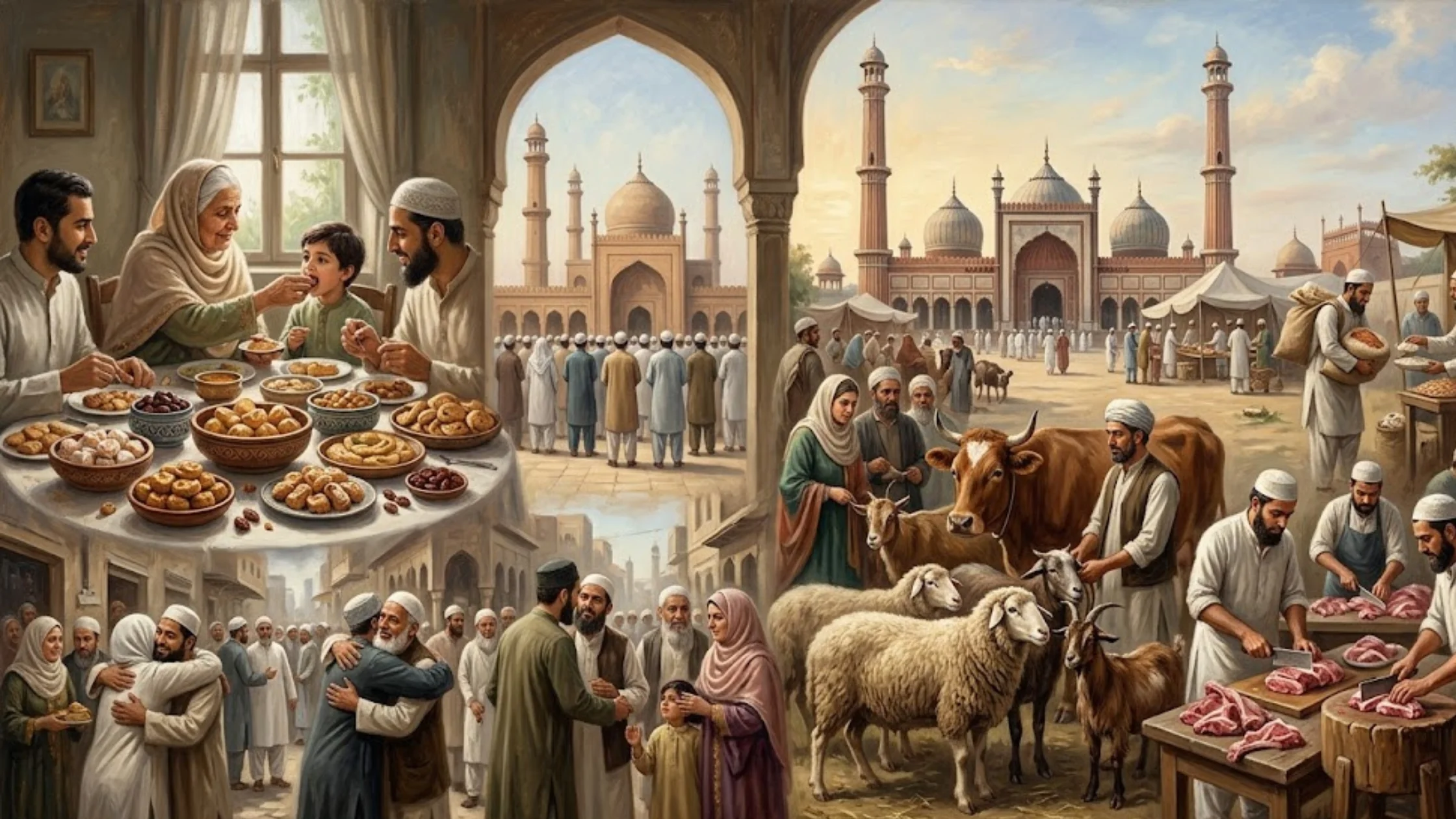
Eid ul Fitr is the first of the two Eids on the Islamic calendar and is one of the most eagerly awaited days of the year for Muslims worldwide. It is a day of pure joy, gratitude, and community.
When Is Eid ul Fitr?
Eid ul Fitr falls on the 1st of Shawwal, the tenth month in the Islamic lunar calendar. Since the Islamic calendar follows the moon’s cycles, the date shifts approximately 10–11 days earlier each year on the Gregorian calendar.
The beginning of Eid is announced by the sighting of the crescent moon at the end of Ramadan. This means the exact date can vary by a day between different countries depending on local moon sightings.
Why Do Muslims Celebrate Eid ul Fitr?
The primary reason is gratitude. Muslims spend the entire month of Ramadan fasting from dawn to sunset, increasing their prayers, reading the Quran, and giving in charity. Eid ul Fitr is Allah’s reward , a day of feasting and celebration after 30 days of discipline and devotion.
Allah says in the Quran:
وَلِتُكْمِلُوا الْعِدَّةَ وَلِتُكَبِّرُوا اللَّهَ عَلَىٰ مَا هَدَاكُمْ وَلَعَلَّكُمْ تَشْكُرُونَ
“…and so that you complete the prescribed period, and that you glorify Allah for having guided you, so that you may be grateful.”
(Surah Al-Baqarah, 2:185)
This verse is often recited in the context of completing Ramadan , reminding Muslims that the purpose of Eid is thankfulness (shukr) to Allah.
How Is Eid ul Fitr Celebrated?
The day of Eid ul Fitr follows a beautiful, structured routine:
- Ghusl (ritual bath) and wearing new or best clothes
- Eating a small meal (preferably dates) before heading to prayer , unlike every day of Ramadan
- Eid Salah , a special congregational prayer with two rak’ahs and extra takbeers
- Exchanging ‘Eid Mubarak’ greetings with family, friends, and neighbors
- Visiting relatives, feasting on traditional foods, and giving gifts or Eidiyah to children
The atmosphere is festive and warm , streets are busy, homes are filled with laughter, and the spirit of generosity is everywhere.
Zakat al-Fitr , The Charity of Eid
Zakat al-Fitr (also called Sadaqat al-Fitr) is a mandatory charity that every Muslim must pay before the Eid prayer. It is typically given in the form of staple food (rice, wheat, or its cash equivalent) , enough to feed one person.
Its purpose is beautiful: to ensure that even the poor can celebrate Eid with dignity and a full meal. It must be paid before the Eid prayer to be valid.
Note: Many people ask whether zakat for Eid al-Adha is also required. The answer is no , Zakat al-Fitr is specific to Eid ul Fitr. However, on Eid ul Adha, the obligation of Qurbani (described below) takes its place as the key act of giving.
The Prophet Muhammad (PBUH) said:
فَرَضَ رَسُولُ اللَّهِ ﷺ زَكَاةَ الْفِطْرِ طُهْرَةً لِلصَّائِمِ مِنَ اللَّغْوِ وَالرَّفَثِ، وَطُعْمَةً لِلْمَسَاكِينِ
“The Messenger of Allah (PBUH) obligated Zakat al-Fitr as a purification for the fasting person from idle talk and obscene speech, and as food for the poor.”
Source: Sunan Abu Dawood, Hadith 1609 , Graded Sahih
Eid ul Adha: The Festival of Sacrifice
Eid ul Adha is widely known as the ‘Big Eid’ (Eid al-Kabir) and is considered the greater of the two celebrations in terms of religious significance. It is a time for deep reflection, sacrifice, and spiritual submission.
When Is Eid ul Adha?
Eid ul Adha begins on the 10th of Dhul Hijjah , the twelfth and final month of the Islamic lunar calendar. It coincides with the completion of the Hajj pilgrimage in Makkah.
Many Muslims ask: when is Eid al-Adha 2026? Based on the Islamic lunar calendar, Eid ul Adha 2026 is expected to fall around May 26–27, 2026, though the confirmed date depends on the official moon sighting in each country.
When comparing Eid ul Fitr to Eid ul Adha in terms of timing, Eid ul Adha comes approximately 70 days after Eid ul Fitr. It lasts for 3–4 days, making it the longer of the two Eids.
The Significance of the 10 Days of Dhul Hijjah
Before Eid ul Adha begins, Muslims are encouraged to honor the importance of the 10 days of Dhul Hijjah. These are considered the most blessed days of the entire year , even more virtuous than the days of Ramadan, according to several scholars.
The Prophet Muhammad (PBUH) said:
مَا مِنْ أَيَّامٍ الْعَمَلُ الصَّالِحُ فِيهَا أَحَبُّ إِلَى اللَّهِ مِنْ هَذِهِ الْأَيَّامِ
“There are no days on which righteous deeds are more beloved to Allah than these ten days.”
Source: Sahih Bukhari, Hadith 969
During these 10 days, Muslims are encouraged to increase their dhikr, fast (especially on the Day of Arafah), give charity, and engage in fasting for Dhul Hijjah. While fasting all 10 days is a recommended act, the most emphasized fast is that of the 9th of Dhul Hijjah , the Day of Arafah.
The Day of Arafah , The Most Blessed Day Before Eid
The day before Eid ul Adha is known as the Day of Arafah (9th of Dhul Hijjah) , a day of enormous blessing on which Muslims who are not performing Hajj are encouraged to fast. This is one of the most emphasized voluntary fasts in all of Islam.
Day of Arafah 2026 is expected to fall on May 25–26, 2026 (depending on moon sighting). Fasting on this day expiates sins of the past year and the coming year, according to the Prophet’s (PBUH) authentic narration.
The Prophet Muhammad (PBUH) said:
صِيَامُ يَوْمِ عَرَفَةَ أَحْتَسِبُ عَلَى اللَّهِ أَنْ يُكَفِّرَ السَّنَةَ الَّتِي قَبْلَهُ وَالسَّنَةَ الَّتِي بَعْدَهُ
“Fasting on the Day of Arafah , I hope that Allah will expiate thereby the sins of the year before it and the year after it.”
Source: Sahih Muslim, Hadith 1162
The Story of Prophet Ibrahim (AS)
The heart of Eid ul Adha is the story of Prophet Ibrahim (AS) and his son Ismail (AS). After years of being without a child, Ibrahim was tested by Allah in one of the most profound ways imaginable.
In a dream , which for prophets carries the weight of divine revelation , Ibrahim was commanded to sacrifice his beloved son, Ismail. Both father and son accepted this command with full submission to Allah.
Just as Ibrahim raised the knife, Allah intervened and replaced Ismail with a ram to be sacrificed instead. It was a test of ultimate obedience , and both passed.
Allah honored this moment in the Quran:
فَلَمَّا أَسْلَمَا وَتَلَّهُ لِلْجَبِينِ ۚ وَنَادَيْنَاهُ أَن يَا إِبْرَاهِيمُ ۞ قَدْ صَدَّقْتَ الرُّؤْيَا ۚ إِنَّا كَذَٰلِكَ نَجْزِي الْمُحْسِنِينَ
“And when they had both submitted [to Allah’s will] and he had laid him down on his forehead, We called out to him: ‘O Ibrahim! You have fulfilled the vision.’ Indeed, this is how we reward the good-doers.”
(Surah As-Saffat, 37:103–105)
This story , the cornerstone of the difference between Eid al-Fitr and Eid al-Adha , teaches Muslims that true faith means trusting Allah completely, even when the test is beyond what we can bear. The legacy of Prophet Ibrahim is at the heart of why Eid ul Adha is sometimes called the ‘greater Eid.’
How Is Eid ul Adha Celebrated?
The celebration of Eid ul Adha follows a pattern similar to Eid ul Fitr, but with some key additions:
- Eid Salah , congregational prayer performed in the morning
- Wearing clean clothes and exchanging greetings of ‘Eid Mubarak’
- Performing Qurbani (animal sacrifice) , the defining practice of Eid ul Adha
- Distributing Qurbani meat in three parts: family, neighbors/friends, and those in need
- Gathering with family and enjoying large feasts centered around the sacrificed meat
- Giving charity and gifts (Eidiyah) to children
One key difference: on Eid ul Adha, it is Sunnah to NOT eat before the Eid prayer , and to eat from the Qurbani meat afterward. This is the opposite of Eid ul Fitr, where eating before the prayer is encouraged.
Qurbani , The Sacred Sacrifice and Its Rules
Qurbani (also written as Udhiyah) is the ritual slaughter of a livestock animal , typically a sheep, goat, cow, or camel , performed after the Eid ul Adha prayer.
Understanding the rules for Eid ul Adha sacrifice is important for every Muslim who wishes to fulfill this obligation correctly:
- Who must perform it: Every adult Muslim who owns the Nisab amount (the minimum wealth that makes Zakat obligatory) is required to offer Qurbani
- Timing: Qurbani is valid from after the Eid prayer on the 10th of Dhul Hijjah until sunset on the 13th (12th for some scholars)
- Distribution: The meat is divided into thirds , one-third for the family, one-third for friends and neighbors, one-third for the poor
- Animals: Goat and sheep count for one person; cattle and camels count for up to seven people
The Prophet Muhammad (PBUH) said about Qurbani:
مَا عَمِلَ ابْنُ آدَمَ يَوْمَ النَّحْرِ عَمَلًا أَحَبَّ إِلَى اللَّهِ مِنْ إِهْرَاقِ الدَّمِ
“There is no deed that a person can do on the Day of Sacrifice that is more beloved to Allah than shedding the blood [of a sacrifice].”
Source: Sunan Ibn Majah, Hadith 3126 , Graded Hasan
Eid ul Fitr vs Eid ul Adha: Full Side-by-Side Comparison
Here is a detailed look at the difference between Eid al Fitr and Eid al Adha across every major aspect:
Aspect | Eid ul Fitr | Eid ul Adha |
Full Name | Eid ul Fitr (عيد الفطر) | Eid ul Adha (عيد الأضحى) |
Translation | Festival of Breaking the Fast | Festival of Sacrifice |
Islamic Month | 1st Shawwal (Month 10) | 10th Dhul Hijjah (Month 12) |
Reason for Celebration | End of Ramadan fasting | Prophet Ibrahim’s sacrifice & end of Hajj |
Duration | 1–3 days | 3–4 days (longer) |
Key Religious Act | Zakat al-Fitr (charity before prayer) | Qurbani (animal sacrifice after prayer) |
Eating Before Prayer | Sunnah to eat (dates preferred) | Sunnah to NOT eat before prayer |
Connection to Pilgrimage | No direct link to Hajj | Directly linked to Hajj season |
Popular Names | Small Eid, Sweet Eid, Meethi Eid | Big Eid, Bakra Eid, Qurbani Eid |
Greeting Used | Eid Mubarak / Eid Saeed | Eid Mubarak / Eid Saeed |
Story Behind It | Gratitude for completing Ramadan | Obedience and sacrifice of Prophet Ibrahim |
Fasting Before It | Ramadan (29–30 days) | Day of Arafah fast (optional, 1 day) |
Which Eid Is More Important?
This is a common question when people explore the difference between Eid ul Fitr and Eid ul Adha. The answer depends on perspective:
From a religious significance standpoint: Most Islamic scholars consider Eid ul Adha to be the greater Eid because of its direct connection to Hajj , one of the Five Pillars of Islam , and its commemoration of Prophet Ibrahim’s supreme act of submission. It is called ‘Al-Eid al-Kabir’ (The Great Eid) for this reason.
From a celebratory standpoint: Many Muslims feel that Eid ul Fitr is more festive in practice. After 30 days of fasting and spiritual effort, the emotional release of Eid ul Fitr is immense. Families reunite, sweets are everywhere, and children receive gifts.
The truth is: both Eids are profound gifts from Allah. One teaches gratitude for endurance and devotion; the other teaches sacrifice and submission. They represent two pillars of the Islamic spirit , and together, they make the Muslim year complete.
Now you have a clear picture of the eid ul fitr and eid ul adha difference. Both are precious celebrations in Islam , one born from the discipline of Ramadan, the other from the legacy of sacrifice left by Prophet Ibrahim.
Whether you want to know when Eid al-Adha 2026 falls, understand the importance of the 10 days of Dhul Hijjah, fast on the Day of Arafah, or learn the rules for Eid ul Adha sacrifice , this guide covers it all. Understanding both Eids deepens your appreciation for the richness of Islamic tradition.
Whether you’re a Muslim wanting to explain these holidays to others, or a non-Muslim curious to learn , the two Eids offer a window into the values Islam holds most dear: gratitude, generosity, obedience, and love for Allah.
FAQ About Eid ul Fitr and Eid ul Adha Difference:
What is the difference between Eid ul Fitr and Eid ul Adha?
Eid ul Fitr marks the end of Ramadan and celebrates gratitude to Allah for completing a month of fasting. Eid ul Adha commemorates Prophet Ibrahim’s willingness to sacrifice his son for Allah, and coincides with the Hajj pilgrimage. The key difference is in their occasion, timing, and central ritual , Zakat al-Fitr for Eid ul Fitr vs. Qurbani for Eid ul Adha.
When is Eid al-Adha 2026?
Eid al-Adha 2026 is expected to fall around May 26–27, 2026, subject to moon sighting confirmation. The Day of Arafah 2026 would accordingly fall on May 25–26, 2026. Dates may vary by one day between countries based on their official moon sighting committees.
What is the importance of the 10 days of Dhul Hijjah?
The first 10 days of Dhul Hijjah are the most blessed days of the year in Islam. Muslims are encouraged to increase worship, fasting (especially on the Day of Arafah), dhikr, and charity during these days. Fasting for Dhul Hijjah , even for some of these days , carries immense reward.
What are the rules for Eid ul Adha sacrifice (Qurbani)?
Every adult Muslim who owns the Nisab amount must offer Qurbani. The sacrifice is performed after the Eid prayer and can be done until sunset on the 13th of Dhul Hijjah. The meat is divided into three equal parts: one for the family, one for friends and neighbors, and one for the poor.
Is zakat required for Eid al-Adha?
Zakat al-Fitr is specific to Eid ul Fitr , it is not required for Eid al-Adha. However, the Qurbani sacrifice serves a similar charitable function on Eid ul Adha, as one-third of the meat must be given to those in need. Regular annual Zakat (2.5% of savings) is a separate obligation throughout the year.
Which Eid is called 'Big Eid'?
Eid ul Adha is commonly referred to as ‘Big Eid’ (Eid al-Kabir or Bada Eid). This is because of its connection to Hajj and the story of Prophet Ibrahim, giving it greater religious weight in Islamic scholarship. However, in some regions and cultures, Eid ul Fitr is celebrated more elaborately.
How many days is each Eid?
Eid ul Fitr officially lasts 1 to 3 days, with the main celebrations on the first day. Eid ul Adha lasts 3 to 4 days (the 10th through the 13th of Dhul Hijjah), as the Qurbani can be performed on any of these days.
Can non-Muslims celebrate Eid?
Yes , non-Muslims are warmly welcome to join in Eid celebrations as guests, enjoy the food, and share in the festive spirit. While the religious practices (prayer, fasting, Qurbani) are specifically Islamic, the community celebrations are open and inclusive.
What do you say on each Eid?
The most common greeting on both Eids is Eid Mubarak (عيد مبارك) , meaning Blessed Eid. You can also say Eid Saeed (عيد سعيد) , meaning Happy Eid. For more specificity, say Eid ul Fitr Mubarak or Eid ul Adha Mubarak.
Quran Recitation
with Tajweed
Master accurate Qur’an recitation with clear Tajweed rules.
Learn More