
How do you do Hajj? This complete guide walks you through every step, from spiritual preparation to the farewell Tawaf, so you can begin this blessed journey with clarity and confidence.
Every year, over 2 million Muslims answer one of the most powerful calls in the world (Hajj). It is a journey that transcends borders, erases social differences, and connects every pilgrim to a 1,400-year-old tradition of faith and submission. For first-time pilgrims, understanding each step clearly makes all the difference.
What Is Hajj and Why Is It Obligatory?
Hajj is the annual Islamic pilgrimage to the holy city of Makkah in Saudi Arabia. It is not optional for those who are able, it is a divine command that every capable Muslim must fulfill at least once in their lifetime.
Hajj as the 5th Pillar of Islam
Islam is built on five foundational acts of worship. If you want to fully understand and define the 5 pillars of islam, they are: the Declaration of Faith (Shahada), Prayer (Salah), Fasting (Sawm), Obligatory Charity (Zakat), and Pilgrimage (Hajj). Hajj is the fifth and final pillar, the culmination of a Muslim’s outward acts of worship.
The Quranic Command
Allah commanded Hajj directly in the Quran, making it one of the clearest obligations in Islamic law:
وَلِلَّهِ عَلَى النَّاسِ حِجُّ الْبَيْتِ مَنِ اسْتَطَاعَ إِلَيْهِ سَبِيلًا ۚ وَمَن كَفَرَ فَإِنَّ اللَّهَ غَنِيٌّ عَنِ الْعَالَمِينَ
“And [due] to Allah from the people is a pilgrimage to the House, for whoever is able to find thereto a way. But whoever disbelieves, then indeed, Allah is free from need of the worlds.”
(Surah Al-Imran, 3:97)
Who Must Perform Hajj?, The Conditions of Istita’ah
Hajj is obligatory only when a Muslim meets the conditions of Istita’ah (ability). These conditions are:
- Being Muslim
- Being of sound mind (aqil)
- Being an adult (baligh)
- Being physically able to undertake the journey
- Having the financial means to travel and cover expenses
- For women: having a Mahram (male guardian) accompany her, though some scholarly opinions allow exceptions for organized group travel
If any of these conditions are not met, Hajj is not yet obligatory on that person.
The 3 Types of Hajja and Which One Should You Choose?
Before you begin preparing, you must decide which type of Hajj you will perform. Each has different rituals and requirements. Here is a clear comparison:
Type | Description | Who It’s For | Sacrifice Required? |
Hajj al-Tamattu’ | Perform Umrah first, exit Ihram, then re-enter Ihram for Hajj on 8th Dhul Hijjah | Most international pilgrims, highly recommended | Yes (mandatory) |
Hajj al-Ifrad | Perform Hajj only, without combining Umrah | Pilgrims residing in or near Makkah | No (optional) |
Hajj al-Qiran | Combine Umrah and Hajj in one unbroken state of Ihram | Advanced pilgrims with strong physical endurance | Yes (mandatory) |
Hajj al-Tamattu’
This is the most popular and recommended type for pilgrims traveling from outside Saudi Arabia. The pilgrim performs a full Umrah first, exits Ihram temporarily, and then re-enters Ihram specifically for Hajj on the 8th of Dhul Hijjah. Rules for eid ul adha sacrifice (Qurbani) are required.
Hajj al-Ifrad
The pilgrim makes the intention for Hajj only and remains in Ihram throughout. No Umrah is combined. This type is mainly practiced by those living in Makkah or its surroundings, as they are not considered ‘travelers’ in the same sense.
Hajj al-Qiran
The pilgrim enters Ihram for both Umrah and Hajj simultaneously and remains in that state throughout. This is considered the most demanding type, as the Ihram restrictions apply for the entire duration. A sacrifice is also obligatory.
What to Prepare Before Hajj?
Preparation for Hajj begins weeks, even months before you arrive in Makkah. It is both a spiritual and practical process.
What Is Spiritual Preparation Before Hajj?
The Prophet Muhammad ﷺ taught us that the journey to Hajj is a journey of the heart first. Before you travel, you should:
- Make sincere Tawbah (repentance) and seek forgiveness from anyone you have wronged
- Settle all outstanding debts, or make arrangements for them
- Write or update your will (wasiyyah), as traveling for Hajj is a major undertaking
- Increase your salah, dhikr, and Quran recitation in the weeks before departure
- Learn the basic rituals of Hajj, ignorance of the rites is one of the main causes of errors
Complete Hajj Packing Guide
On the practical side, ensure you have:
- Valid passport and Hajj visa (apply through your country’s official Hajj mission)
- Ihram garments for men (two unstitched white cloths), carry at least two sets
- Comfortable sandals that can be worn with Ihram
- Unscented soap, deodorant, and toiletries (scented products are forbidden in Ihram)
- A small backpack for daily use at the holy sites
- Medications for heat, blisters, and stomach issues
- A printed or downloaded copy of du’a and supplications
For Women: Mahram Requirement & Clothing Rules
Women must travel with a Mahram (husband or a male relative she cannot marry). Her Ihram clothing is not a specific garment but rather modest, loose-fitting attire that covers her entire body. She must not cover her face with a Niqab while in Ihram, though she may use a face shield to avoid eye contact with non-Mahram men.
2026 Hajj Dates (8–13 Dhul Hijjah)
Hajj 1447H falls in late May 2026. The official Dhul Hijjah 2026 dates for Hajj are expected to be approximately May 25–30, 2026 (subject to moon sighting). The key dates are:
- 8th Dhul Hijjah, Travel to Mina
- 9th Dhul Hijjah, Day of Arafat 2026 (the most important day of Hajj)
- 10th Dhul Hijjah, Eid al-Adha: Rami, Qurbani, Halq
- 11th–12th Dhul Hijjah, Ayyam al-Tashreeq in Mina
- 13th Dhul Hijjah, Final day in Mina (optional), Tawaf al-Wida before departure
Niyyah & Entering the State of Ihram
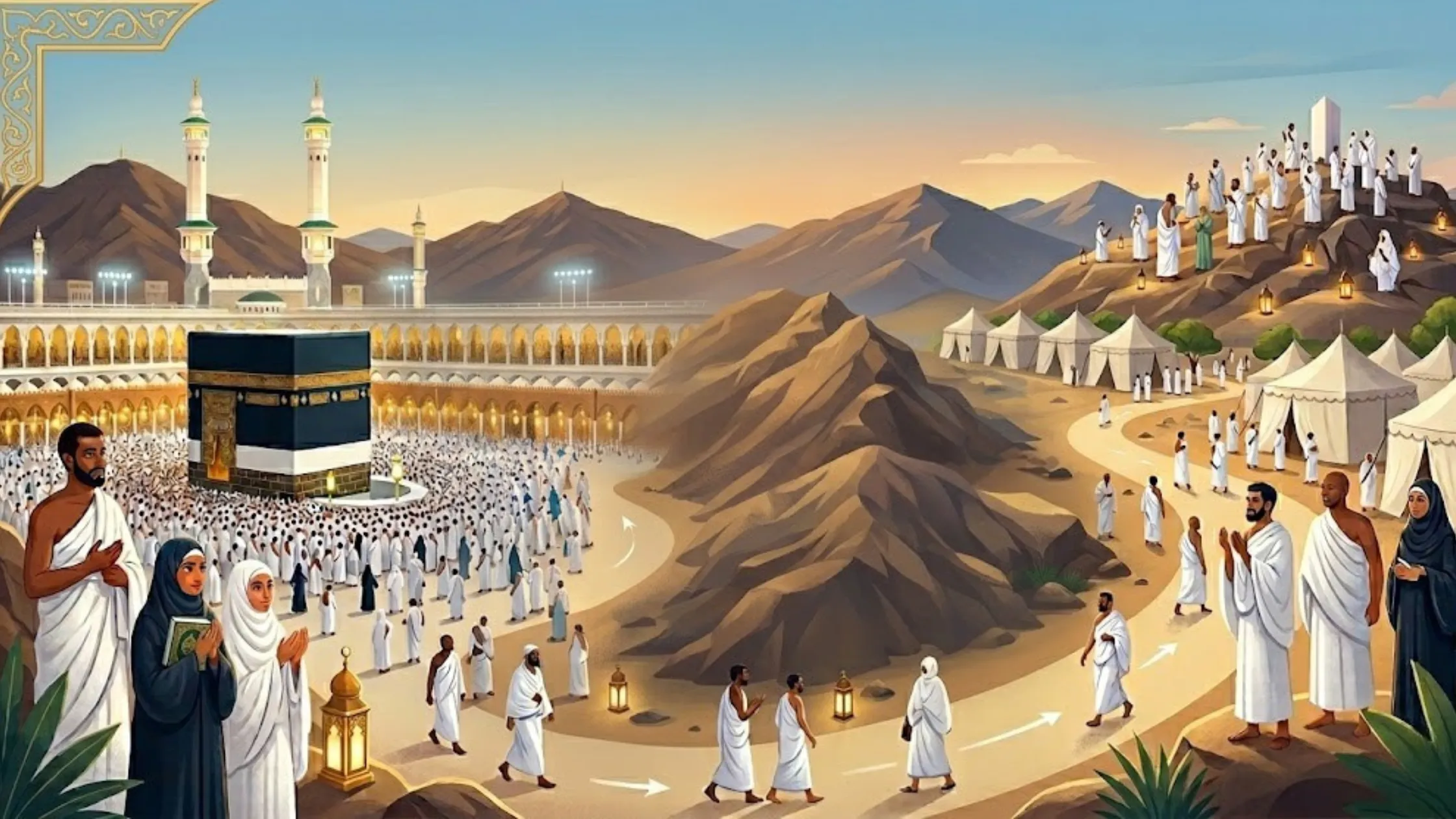
What Is Ihram and What Does It Symbolize?
Ihram is the sacred state of spiritual purity that every pilgrim must enter before performing Hajj or Umrah. The word comes from the Arabic root meaning ‘to prohibit’, because once you enter Ihram, certain acts become forbidden. It symbolizes equality before Allah: rich and poor, king and servant, all dressed identically, standing as one.
The Miqat Where to Enter Ihram
The Miqat refers to the designated boundary points around Makkah. A pilgrim must enter the state of Ihram before crossing these boundaries. The five main Miqat points are:
- Dhul Hulayfah (Abyar Ali), for those traveling from Madinah
- Al-Juhfah, for those from Syria, Morocco, and nearby regions
- Qarn al-Manazil (Al-Sayl), for those from Najd and the Gulf
- Yalamlam, for pilgrims from Yemen, India, Pakistan, and East Africa
- Dhat Irq, for pilgrims from Iraq and surrounding areas
Ihram Clothing for Men vs Women
Men: Two unstitched white cloths, one wrapped around the waist (Izar) and one draped over the shoulder (Rida’). No sewn garments, no head coverings, open sandals only.
Women: Modest, loose-fitting Islamic attire covering the entire body. No specific color required. The face and hands must remain uncovered while in Ihram.
Prohibitions During Ihram
Once you enter Ihram, the following become forbidden until you exit:
- Using perfume or scented products
- Cutting hair or nails
- Engaging in marital relations
- Hunting or harming animals
- Men wearing sewn or stitched clothing or covering their heads
- Arguing, using vulgar language, or engaging in sinful behavior
Reciting the Talbiyah
Once in Ihram, begin reciting the Talbiyah aloud, this is the pilgrim’s declaration of answering Allah’s call:
لَبَّيْكَ اللَّهُمَّ لَبَّيْكَ، لَبَّيْكَ لَا شَرِيكَ لَكَ لَبَّيْكَ، إِنَّ الْحَمْدَ وَالنِّعْمَةَ لَكَ وَالْمُلْكَ، لَا شَرِيكَ لَكَ
“Here I am, O Allah, here I am. Here I am, You have no partner, here I am. Verily all praise, grace, and sovereignty belong to You. You have no partner.”
(Talbiyah, recited continuously from Ihram until the first stoning on 10th Dhul Hijjah)
Why Do Muslims Perform Tawaf 7 Times Around the Ka’bah?
Upon arriving at Masjid al-Haram, pilgrims performing Hajj al-Tamattu’ or Hajj al-Qiran begin with Tawaf al-Qudum (the Arrival Tawaf). This means circling the Ka’bah seven times in a counterclockwise direction, beginning and ending at the Black Stone (Hajar al-Aswad).
- Start each circuit at the Black Stone, saying ‘Bismillah, Allahu Akbar’
- Men should walk briskly (ramal) during the first three circuits if possible
- Make du’a freely in any language throughout the Tawaf
- There are no fixed supplications, your heartfelt words are most powerful
Prayer at Maqam Ibrahim
After completing the seven circuits, offer two Rak’ahs of prayer near Maqam Ibrahim (the Station of Ibrahim). Allah commanded this in the Quran:
وَاتَّخِذُوا مِن مَّقَامِ إِبْرَاهِيمَ مُصَلًّى
“And take the Station of Ibrahim as a place of prayer.”
(Surah Al-Baqarah, 2:125)
Sa’i Between Safa and Marwa The Story Behind the Ritual
After Tawaf, pilgrims perform Sa’i, walking seven times between the hills of Safa and Marwa. This ritual commemorates the desperate search of Hajar (Hagar), the wife of Prophet Ibrahim (AS), for water for her infant son Ismail (AS). Her unwavering faith was answered with the miracle of Zamzam.
- Begin at Safa and end at Marwa (one trip = one length, so 7 lengths total)
- Men should jog lightly between the green markers inside the Sa’i corridor
- Make du’a at both Safa and Marwa, facing the Ka’bah
Drinking Zamzam Water
After Sa’i, drink from the blessed Zamzam water, the same water that gushed for Hajar and Ismail thousands of years ago. The Prophet ﷺ said Zamzam water is for whatever purpose it is drunk for, so make a sincere intention as you drink.
Day 1 of Hajj: Mina (8th Dhul Hijjah)
Travelling to Mina, The City of Tents
On the 8th of Dhul Hijjah, during the sacred and blessed days that highlight the importance of 10 days of Dhul Hijjah, pilgrims travel to Mina, a valley about 5–6 km from Makkah that transforms into the world’s largest temporary city during Hajj. Massive air-conditioned tents accommodate millions of pilgrims, organized by country and group.
Spending the Night in Prayer and Dhikr
Pilgrims are required to spend this day and night in Mina. The Sunnah is to pray all five daily prayers here, shortening the four-Rak’ah prayers to two (Qasr) while still praying at their proper times (no combining on this day). This night is an opportunity to prepare mentally and spiritually for the most important day of Hajj.
Spiritual Significance of This Day
The day in Mina is a pause, a threshold before the pinnacle of Hajj. Use this time to recite Talbiyah often, read Quran, make du’a, and reflect on why you are here. The distraction of phones and socializing can diminish what is meant to be a day of spiritual focus.
The Most Important Day: Arafat (9th Dhul Hijjah)
Wuquf, Standing on the Plains of Arafat
The 9th of Dhul Hijjah is known as Yawm Arafah, the Day of Arafat, and it is the absolute heart of Hajj. The Prophet ﷺ declared it plainly:
الْحَجُّ عَرَفَةُ
“Hajj is Arafat.”
, Sunan al-Tirmidhi, 889, Sahih
If a pilgrim misses the Wuquf at Arafat, standing from noon until sunset on this day, the Hajj is invalid. This is the single most critical obligation of the entire pilgrimage.
The Khutbah at Masjid al-Namirah
After arriving at Arafat, pilgrims attend the Hajj Khutbah (sermon) delivered at Masjid al-Namirah. This mirrors the Prophet’s ﷺ Farewell Sermon delivered at this very location in 632 CE, a reminder of the equality of all Muslims, the sanctity of life, and the responsibilities of the faith.
Combined Dhuhr & Asr Prayer
At Masjid al-Namirah, Dhuhr and Asr prayers are combined and shortened (Jam’ wa Qasr) at the time of Dhuhr. This frees pilgrims to devote the entire afternoon to supplication.
Du’a & Seeking Forgiveness, The Core of Hajj
The afternoon at Arafat, from noon to sunset, is the most precious window for du’a in the entire Islamic year. Stand, raise your hands, and pour your heart out to Allah. Weep if you can. Ask for forgiveness, for your family, for the Muslim Ummah, for everything that matters to you. The Prophet ﷺ said the best du’a is the du’a of Arafat.
خَيْرُ الدُّعَاءِ دُعَاءُ يَوْمِ عَرَفَةَ
“The best du’a is the du’a of the Day of Arafat.”
, Sunan al-Tirmidhi, 3585, Hasan
Do not leave Arafat until after sunset. Leaving early is one of the gravest mistakes a pilgrim can make and may invalidate the Hajj.
What Happens During the Night in Muzdalifah?
Combined Maghrib & Isha Prayer
After sunset, pilgrims move from Arafat to Muzdalifah, a small valley approximately 9 km away. Here, Maghrib and Isha prayers are combined and shortened at the time of Isha. This is obligatory: pilgrims must spend at least part of this night in Muzdalifah.
Sleeping Under the Open Sky
Muzdalifah is an open plain with no tents. Pilgrims sleep under the stars, a profound leveling experience. This is intentional: no status, no comfort, just the night sky and the remembrance of Allah. Many pilgrims find this night among the most spiritually powerful of Hajj.
Collecting Pebbles for Rami, How Many and What Size
Before leaving Muzdalifah at dawn, collect pebbles for the Rami (stoning) ritual. Here is what you need:
- 7 pebbles for the first day of stoning (10th Dhul Hijjah, only the large Jamrah)
- 21 pebbles per day for the Ayyam al-Tashreeq (11th, 12th, and optionally 13th)
- Total if staying 2 days in Mina: 49 pebbles. If staying 3 days: 70 pebbles.
- Size: roughly chickpea-sized, not too large, not too small
- They do not need to come specifically from Muzdalifah, they can be collected anywhere in the vicinity
Day of Eid: Rami, Qurbani & Halq (10th Dhul Hijjah)
Rami al-Jamarat, Stoning the Largest Pillar
On the morning of the 10th of Dhul Hijjah (Eid al-Adha), pilgrims travel back to Mina to stone the Jamarat, three large pillars (now walls) representing the spots where Shaytan (Satan) attempted to dissuade Prophet Ibrahim (AS) from obeying Allah’s command.
On this first day, only the largest pillar (Jamrah al-Aqabah) is stoned, using all 7 pebbles. Say ‘Allahu Akbar’ with each throw. Stop reciting the Talbiyah after this stoning.
Qurbani, The Animal Sacrifice & Its Meaning
After Rami, pilgrims offer a Qurbani (animal sacrifice). This commemorates the supreme test of Prophet Ibrahim (AS), who was commanded to sacrifice his son Ismail (AS), and Allah replaced Ismail with a ram at the moment of sacrifice. Many pilgrims purchase a Qurbani voucher in Makkah, which is carried out on their behalf by licensed slaughterhouses.
Halq or Taqsir, Shaving or Trimming Hair
After Qurbani, men should shave their heads completely (Halq) or trim their hair short (Taqsir). Shaving is considered superior in reward. Women cut only a fingertip’s length from their hair.
Exiting Partial Ihram
After Rami, Qurbani, and Halq, in that order, pilgrims exit the state of Ihram partially. Most Ihram restrictions are now lifted, except for marital relations. You may now wear regular clothes.
Tawaf al-Ifadah & Sa’i (Return to Makkah)
Performing the Obligatory Tawaf al-Ifadah
Pilgrims return to Masjid al-Haram in Makkah to perform Tawaf al-Ifadah, the Tawaf of ‘pouring forth.’ This is one of the three obligatory pillars (Faraidh) of Hajj; if it is omitted, the Hajj is not valid. It is performed exactly like Tawaf al-Qudum: seven counterclockwise circuits around the Ka’bah.
Sa’i Again (If Not Done After Tawaf al-Qudum)
Pilgrims performing Hajj al-Tamattu’ who did not perform Sa’i after the Arrival Tawaf must perform it now. Pilgrims performing Hajj al-Ifrad or al-Qiran who already performed Sa’i after Tawaf al-Qudum do not need to repeat it.
Full Exit from Ihram
After Tawaf al-Ifadah and Sa’i, all Ihram restrictions are fully lifted, including marital relations. The Hajj is now in its final stages.
The Days of Tashreeq: Back in Mina (11th–13th Dhul Hijjah)
Stoning All 3 Jamarat in Order
On the 11th and 12th of Dhul Hijjah (and the 13th if you stay), pilgrims return to Mina and stone all three Jamarat, the small (Sughra), medium (Wusta), and large (Aqabah), in that order. Use 7 pebbles for each pillar, saying ‘Allahu Akbar’ with every throw. The time for stoning begins after Dhuhr and extends until before Fajr.
Staying the Night in Mina
It is obligatory (wajib) to spend the nights of the Ayyam al-Tashreeq in Mina. Pilgrims who do not spend these nights there must offer a compensatory sacrifice (Dam). These nights in Mina are for reflection, dhikr, Quran, and prayer, a final opportunity to milk the blessed days of Hajj for every drop of spiritual reward.
Leaving on the 12th vs Staying the 13th
Pilgrims who wish to leave early may depart Mina on the 12th of Dhul Hijjah before sunset, this is known as Nafr Awwal (the early departure). However, those who remain in Mina until sunset on the 12th must stay for the 13th and perform the stoning again. Staying the 13th (Nafr Thani) earns greater reward.
Why Is Tawaf al-Wida Obligatory Before Leaving Makkah?
The last act of every pilgrim before leaving Makkah must be Tawaf al-Wida, the Farewell Tawaf. The Prophet ﷺ made this obligatory:
لَا يَنْفِرَنَّ أَحَدٌ حَتَّى يَكُونَ آخِرُ عَهْدِهِ بِالْبَيْتِ
“No one should depart until the last thing he does is the Tawaf of the House.”
, Sahih Muslim, 1327
Menstruating women are exempt from this Tawaf and may leave without performing it.
How to Perform Tawaf al-Wida Step by Step?
Tawaf al-Wida is performed like any regular Tawaf, consisting of seven counterclockwise circuits around the Ka’bah. Unlike other types of Tawaf, there is no Sa’i afterward. After completing the seven rounds, pilgrims may pray two Rak’ahs near Maqam Ibrahim if possible and drink Zamzam water before leaving Makkah.
- Perform seven counterclockwise circuits around the Ka’bah
- No Sa’i is required after Tawaf al-Wida
- Pray two Rak’ahs near Maqam Ibrahim if possible
- Drink Zamzam water before departure
How to Spend Your Final Moments Before Leaving Makkah?
For many pilgrims, this is the hardest moment of Hajj. As you complete your final circuit and walk toward the door of Masjid al-Haram, turn back to look at the Ka’bah one last time. Many pilgrims weep, unsure if they will ever return. Make du’a that Allah accepts your Hajj, forgives your sins, and brings you back.
Common Hajj Mistakes to Avoid
Many pilgrims, especially first-timers, make avoidable mistakes that can reduce or invalidate parts of their Hajj. Here are the most critical ones:
- Leaving Arafat Before Sunset: This is the most serious error. Wuquf at Arafat must last from noon until after sunset. Leaving even minutes early can invalidate the Hajj entirely. Stay until the call to depart is given after the Maghrib adhan.
- Not Making Niyyah Correctly at Miqat: Some pilgrims cross the Miqat boundary in regular clothes, forgetting to enter Ihram. This requires either returning to the Miqat or paying a Dam (penalty sacrifice). Know your Miqat boundary before you travel.
- Rushing Rami Without Knowing the Order: On the 10th of Dhul Hijjah, only the large Jamrah (Aqabah) is stoned. On the 11th–13th, all three are stoned in order: small, medium, large. Reversing this order is an error that requires Dam.
- Neglecting Spiritual Focus for Logistics: Hajj can become an exhausting logistical exercise if pilgrims spend all their energy managing transport, accommodation, and food. Preparation before travel is the solution, so you can arrive focused on worship, not survival.
Not Spending the Night in Mina During Ayyam al-Tashreeq: Some pilgrims return to Makkah each night for comfort. Spending these nights in Mina is wajib, missing them without a valid excuse requires Dam.
What Happens After Hajj? Life as a Hajji
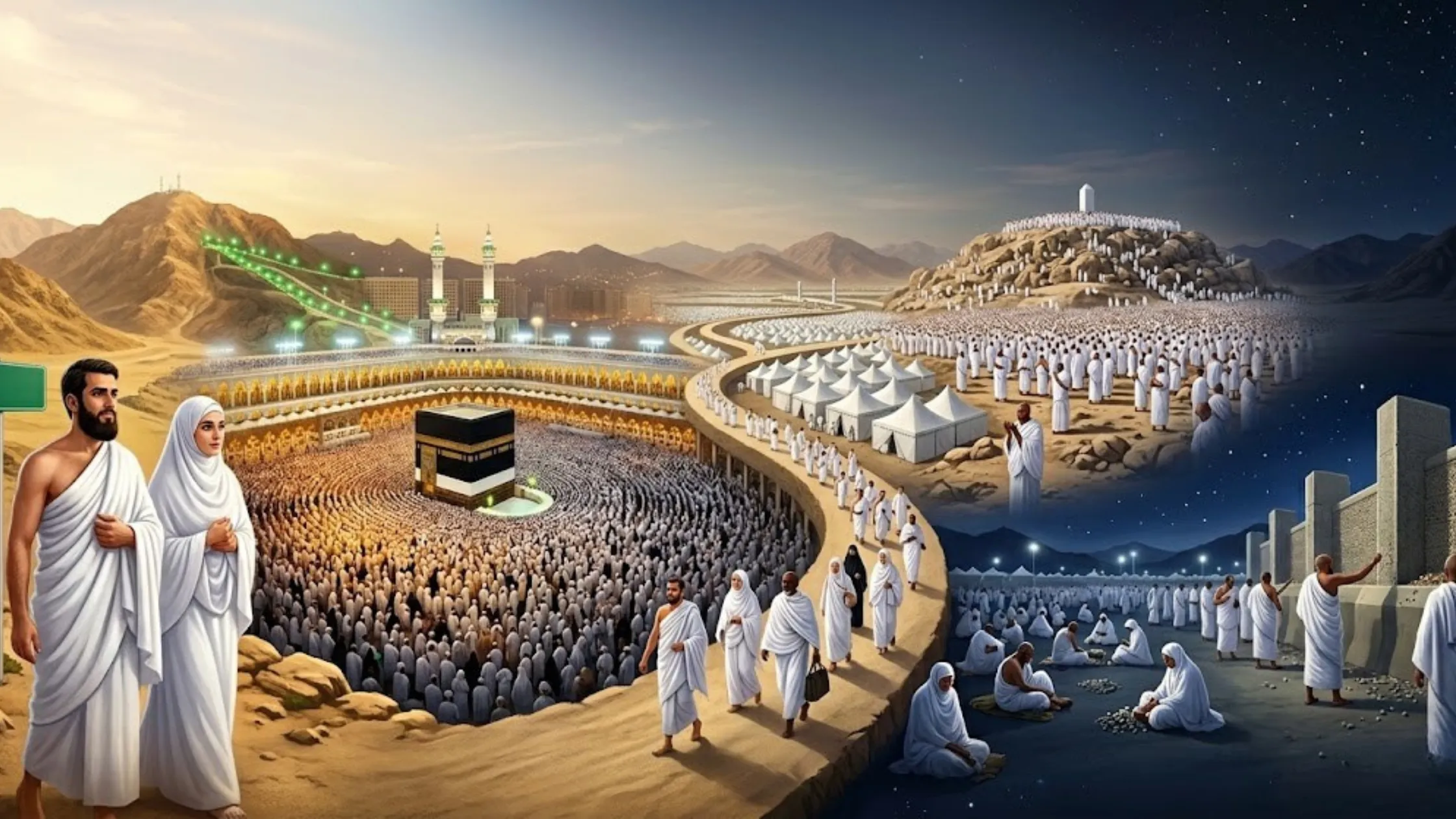
Returning from Hajj Pure: The Reward of Sins Being Erased
The Prophet Muhammad ﷺ described the reward of a Mabrur (accepted) Hajj in the clearest terms:
مَنْ حَجَّ فَلَمْ يَرْفُثْ وَلَمْ يَفْسُقْ رَجَعَ كَيَوْمِ وَلَدَتْهُ أُمُّهُ
“Whoever performs Hajj and does not speak lewdly or commit sin will return as the day his mother bore him.”
, Sahih al-Bukhari, 1521
This is not a metaphor, it is a complete spiritual reset. Every sin, great and small, is forgiven for the pilgrim who performs Hajj with sincerity and correctness.
What Is the Connection Between Hajj and Visiting Madinah?
Visiting Madinah, the city of the Prophet ﷺ, is not a ritual of Hajj and is not obligatory. However, it is among the most beloved acts a Muslim can do. Many pilgrims visit before or after Hajj to pray in Masjid al-Nabawi and send salutations upon the Prophet ﷺ at his grave. The spiritual atmosphere of Madinah is a gift that should not be missed if you are already in the Hijaz.
Maintaining Faith and Spiritual Growth After Hajj
The true test of Hajj comes after you return home. A Mabrur Hajj is not just about the rituals performed, it is about the person you become afterward. Scholars say the sign of an accepted Hajj is that the pilgrim returns having abandoned their sins and improved their character. Guard your salah, maintain family ties, continue your dhikr, and let the transformation of Hajj be permanent.
Ready to Deepen Your Connection with Islam?
If Hajj has sparked a desire to learn more, to understand the Quran, master Arabic, or deepen your knowledge of Islamic rituals, QuranBliss Academy is here to guide you. At QuranBliss, qualified teachers offer personalized online lessons in Quran recitation, Tajweed, Islamic studies, and Arabic language for learners of all levels worldwide. Whether you are preparing for Hajj, raising Muslim children, or simply seeking a closer relationship with the words of Allah, QuranBliss makes it accessible, structured, and transformative. Visit
Quran Bliss Academy to start your journey today.
Hajj is not just a journey to a place, it is a journey to your Lord. From the moment you enter Ihram to the moment you bid farewell to the Ka’bah, every step is an act of worship, every moment is an opportunity for forgiveness. Knowing how to do Hajj correctly is the first step toward performing it with confidence, focus, and full spiritual presence. May Allah accept the Hajj of every pilgrim who undertakes this sacred journey. Ameen.
Frequently Asked Questions (FAQ)
How many days does Hajj take?
Hajj officially spans 5 days, from the 8th to the 12th of Dhul Hijjah (or the 13th for those who choose to stay). However, most pilgrims spend 2–4 weeks in Saudi Arabia overall, including travel, acclimatization, and Umrah before Hajj begins.
What are the 5 pillars of Hajj?
The core obligatory acts (Faraidh) of Hajj are: (1) entering Ihram with the correct Niyyah, (2) standing at Arafat (Wuquf), (3) performing Tawaf al-Ifadah, (4) Sa’i between Safa and Marwa, and (5) shaving or trimming the hair (Halq/Taqsir). Missing any of these invalidates the Hajj or requires a compensatory sacrifice.
Can a woman do Hajj without a Mahram?
The classical scholarly position requires a woman to travel with a Mahram (husband or unmarriageable male relative). However, some contemporary scholars, particularly in the Maliki school, permit women over a certain age to travel in a trustworthy group without a Mahram. Saudi Arabia has also permitted organized group travel for women in recent years. Consult a qualified scholar for a ruling specific to your situation.
What is the difference between Hajj and Umrah?
Hajj is the major pilgrimage, performed only during specific days of Dhul Hijjah, and is obligatory once in a lifetime for every able Muslim. Umrah is the minor pilgrimage, which can be performed at any time of year, and is Sunnah (recommended) but not obligatory. Hajj includes additional rituals such as Wuquf at Arafat, the stoning of the Jamarat, and Qurbani, none of which are part of Umrah.
How much does Hajj cost?
The cost of Hajj varies widely depending on your country, the type of package, and the year. For pilgrims from Western countries (US, UK, Canada, Australia), packages typically range from $7,000 to $15,000 USD per person, covering visa, flights, accommodation in Makkah and Madinah, transport between holy sites, and meals. Government-regulated packages in Muslim-majority countries may be significantly less expensive. Always book through an accredited and licensed Hajj operator.


Islamic Studies Course
for Adults
Deepen your understanding of Islam’s teachings.
Learn More
The 5 Pillars of Islam
Understand the fundamental principles of Islamic faith and practice.
Learn More