
- Published:
What Are the 5 Differences Between Hajj and Umrah? A Clear Guide
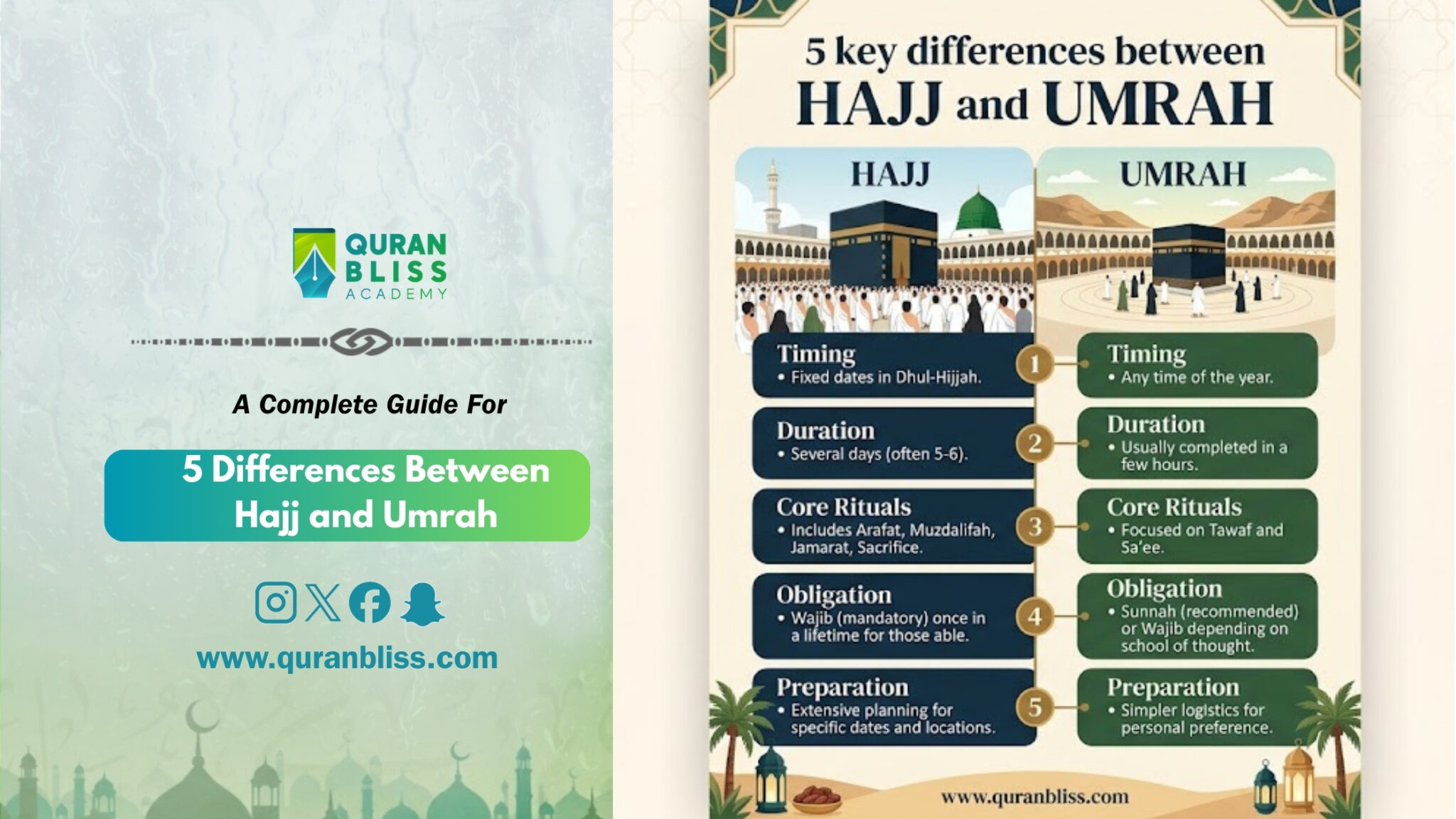
Both Hajj and Umrah bring Muslims to the same sacred destination , the Kaaba in Makkah. Both involve Ihram, Tawaf, and Sa’i. So why are they treated so differently in Islam? And which one actually applies to you?
This guide breaks down the 5 differences between Hajj and Umrah clearly and completely , with Quran and Hadith evidence, a full ritual comparison, and practical guidance for every Muslim. Whether you’re planning your first pilgrimage or simply want to understand the hajj and umrah difference once and for all, you’re in the right place.
Explore This Article
ToggleWhat Is Hajj?
Hajj (حَجّ) is the fifth and final Pillar of Islam , the obligatory pilgrimage to Makkah that every capable adult Muslim must perform at least once in their lifetime. It takes place during the first two weeks of Dhul Hijjah, the twelfth and final month of the Islamic lunar calendar, with the core rituals concentrated between the 8th and 13th.
Allah commands it in the Quran:
وَلِلَّهِ عَلَى النَّاسِ حِجُّ الْبَيْتِ مَنِ اسْتَطَاعَ إِلَيْهِ سَبِيلًا
“And [due] to Allah from the people is a pilgrimage to the House , for whoever is able to find thereto a way.”
, Surah Al-Imran, 3:97
What do you do during Hajj? The pilgrimage includes: entering Ihram at the Miqat, Tawaf around the Kaaba, Sa’i between Safa and Marwah, the essential standing at Arafat (Wuquf), an overnight stay in Muzdalifah, days in Mina, the symbolic stoning of the devil (Rami al-Jamarat), animal sacrifice on Eid al-Adha, and finally cutting the hair to exit Ihram. It is the most comprehensive act of worship in Islam , physically demanding, spiritually profound, and unique in the world.
To fully understand the significance of this pilgrimage season, read our detailed guide on the importance of the 10 days of Dhul Hijjah , the holiest days of the Islamic year that frame the entire Hajj experience.
What Is Umrah?
Umrah (عُمْرَة) is the Lesser Pilgrimage , a voluntary act of worship that Muslims perform by visiting Masjid al-Haram in Makkah. Unlike Hajj, Umrah is not obligatory, but it is a highly recommended Sunnah that carries immense reward.
What do you do in Umrah? Umrah consists of four rituals: entering Ihram (the sacred state) at the Miqat, performing Tawaf (circling the Kaaba 7 times), walking Sa’i between the hills of Safa and Marwah (7 laps), and completing Halq or Taqsir (shaving or cutting the hair). The entire pilgrimage can be completed in as little as 3–6 hours, making it accessible to Muslims throughout the year.
Umrah is sometimes called the “small Hajj” , but as we’ll see, the 5 differences between them are significant.
Want a complete walkthrough? Our step-by-step guide on how do you do Umrah covers every ritual in detail , with Arabic du’as, common mistakes to avoid, and practical tips for first-timers.
What Are the 5 Differences Between Hajj and Umrah?
At first glance, Hajj and Umrah may appear similar , both begin with Ihram, both involve Tawaf around the Kaaba, and both conclude with the cutting of hair. But the similarities end there. The differences between them are not just about the number of rituals , they touch on obligation, timing, spiritual weight, physical commitment, and divine reward.
Here are the 5 differences between Hajj and Umrah, explained clearly with evidence from the Quran and authentic Hadith:
Obligation: Pillar of Islam vs Sunnah
This is the most fundamental difference between Hajj and Umrah, and it shapes everything else.
Hajj , Fard (Obligatory): Hajj is the Fifth Pillar of Islam. It is a religious obligation (Fard ‘Ayn) for every adult Muslim who possesses the physical health, financial means, and a safe route to Makkah. Performing it is not a choice , it is a divine command.
Umrah , Sunnah Mu’akkadah (Strongly Recommended): Umrah is a highly recommended but voluntary act of worship. The majority of scholars classify it as Sunnah Mu’akkadah , meaning the Prophet ﷺ consistently performed it and encouraged it, but failing to perform it does not make one sinful.
The clearest evidence comes from the Hadith of Jibril , the definitive narration that defines the Five Pillars of Islam:
“بُنِيَ الْإِسْلَامُ عَلَى خَمْسٍ: شَهَادَةِ أَنْ لَا إِلَهَ إِلَّا اللَّهُ وَأَنَّ مُحَمَّدًا رَسُولُ اللَّهِ، وَإِقَامِ الصَّلَاةِ، وَإِيتَاءِ الزَّكَاةِ، وَصَوْمِ رَمَضَانَ، وَحَجِّ الْبَيْتِ”
“Islam is built upon five [pillars]: Testifying that there is no god but Allah and that Muhammad is His messenger, establishing prayer, paying Zakat, fasting Ramadan, and performing Hajj to the House.”
, Sahih Bukhari (8), Sahih Muslim (16)
Timing, Fixed Dates vs Any Time of Year
- Hajj , Fixed to Dhul Hijjah: Hajj can only be performed during the designated sacred days , from the 8th to the 13th of Dhul Hijjah. These dates are non-negotiable. Arriving one day late means missing Hajj entirely for that year. The rituals of Arafat (9th), the return to Muzdalifah (night of 9th–10th), the days of Mina, and the sacrifice on Eid al-Adha (10th) are all locked into this specific window.
- Umrah , Any Time of Year: Umrah may be performed on any day of the Islamic calendar, with the exception of the days of Hajj itself (8th–13th Dhul Hijjah), when some scholars discourage it to avoid confusion with Hajj rituals. Beyond that window, Umrah is open year-round , in Muharram, Rajab, Sha’ban, and of course, Ramadan.
الْحَجُّ أَشْهُرٌ مَّعْلُومَاتٌ
“Hajj is [during] well-known months.”
, Surah Al-Baqarah, 2:197
Planning to time your Umrah around the sacred month of sacrifice? Our complete guide on when Eid al-Adha 2026 will be and what to expect during Dhul Hijjah will help you plan your pilgrimage at exactly the right time.
Rituals: Simple vs Comprehensive
Shared Rituals , What Hajj and Umrah Have in Common
Both pilgrimages share four fundamental rituals that form the backbone of Islamic pilgrimage:
- Ihram: Entering the sacred state at the Miqat , wearing the two white sheets (men) or modest clothing (women), making Niyyah, and reciting the Talbiyah
- Tawaf: Circling the Kaaba seven times counter-clockwise, beginning and ending at the Black Stone (Hajar al-Aswad)
- Sa’i: Walking seven laps between the hills of Safa and Marwah, commemorating Hajar’s search for water
- Halq / Taqsir: Shaving (men, preferred) or trimming the hair to exit the state of Ihram
Hajj-Only Rituals , What Makes Hajj Unique
These rituals exist exclusively in Hajj and have no equivalent in Umrah:
- Wuquf at Arafat (9th Dhul Hijjah): Standing on the plain of Arafat from midday to sunset , the single most essential ritual of Hajj. The Prophet ﷺ said: “Hajj IS Arafat.” (Abu Dawud, Tirmidhi). Missing this moment means missing Hajj entirely.
- Muzdalifah (Night of 9th–10th): Spending the night under the open sky, collecting pebbles for the stoning
- Mina (Days of Tashreeq): Staying in Mina on the 8th before Arafat and returning for the 11th–13th after the sacrifice
- Rami al-Jamarat: The symbolic stoning of the devil at three pillars in Mina , performed on the 10th, 11th, 12th, and optionally 13th of Dhul Hijjah
- Animal Sacrifice (Qurbani/Udhiyah): Slaughtering an animal on Eid al-Adha (10th Dhul Hijjah) to commemorate Ibrahim’s ﷺ sacrifice
- Tawaf al-Ifadah: A second Tawaf performed after returning from Mina , a pillar (Rukn) of Hajj
- Tawaf al-Wada’: The farewell Tawaf performed just before departing Makkah
Here is a complete side-by-side ritual comparison:
Ritual | Umrah | Hajj | Notes |
Ihram (Sacred state) | ✅ | ✅ | Both begin here |
Tawaf (Circling the Kaaba) | ✅ | ✅ | 7 counter-clockwise rounds |
Sa’i (Safa & Marwah walk) | ✅ | ✅ | 7 laps, honors Hajar ﷺ |
Halq / Taqsir (Hair) | ✅ | ✅ | Marks end of Ihram |
Wuquf at Arafat | ❌ | ✅ | “Hajj IS Arafat” , Hadith |
Mina (1st day) | ❌ | ✅ | 8th Dhul Hijjah |
Muzdalifah (overnight) | ❌ | ✅ | Night of 9th Dhul Hijjah |
Rami al-Jamarat | ❌ | ✅ | Stoning the devil , 10th–13th |
Animal Sacrifice (Qurbani) | ❌ | ✅ | 10th Dhul Hijjah |
Tawaf al-Ifadah | ❌ | ✅ | After returning from Mina |
Tawaf al-Wada’ | ❌ | ✅ | Farewell Tawaf before departure |
For a complete, step-by-step breakdown of all Hajj rituals in sequence, visit our dedicated guide on how do you do Hajj , including what to say, what to do, and what to avoid at each stage.
Duration: Hours vs Days
- Umrah , Completed in 3–6 Hours: From the moment you enter Ihram to the final cut of hair, Umrah can be completed in as little as three hours for an experienced pilgrim , or up to a full day if you take your time with du’a, prayer, and spiritual reflection. This accessibility is one of Umrah’s greatest gifts: it fits within a single day of a busy life.
- Hajj , 5–6 Full Days of Continuous Worship: Hajj is a marathon of devotion. From the 8th of Dhul Hijjah (entering Mina) to the final Tawaf al-Wada’ on the 12th or 13th, a pilgrim is continuously engaged in worship , sleeping under the stars in Muzdalifah, walking miles in the desert heat, standing for hours on the plain of Arafat. It is one of the most physically and spiritually demanding experiences a human being can undertake.
The difference in duration reflects the difference in scope. Umrah is a sprint of devotion. Hajj is an endurance journey , a complete immersion in worship that tests body, soul, and spirit simultaneously.
Spiritual Reward: Different Levels
Both pilgrimages carry extraordinary spiritual reward , but they are not equal in magnitude. The Prophet ﷺ described each one clearly:
The Reward of Hajj , A Clean Slate
“مَنْ حَجَّ فَلَمْ يَرْفُثْ وَلَمْ يَفْسُقْ رَجَعَ كَيَوْمِ وَلَدَتْهُ أُمُّهُ”
“Whoever performs Hajj and does not commit any obscenity or wrongdoing will return [free of sins] as on the day his mother gave birth to him.”
, Sahih Bukhari (1521)
“الْحَجُّ الْمَبْرُورُ لَيْسَ لَهُ جَزَاءٌ إِلَّا الْجَنَّةُ”
“An accepted Hajj has no reward except Paradise.”
, Sahih Bukhari (1773)
An accepted Hajj wipes away every sin that came before it , a complete spiritual reset. No other act of worship in Islam carries this total expiation. It is described as returning to the purity of a newborn child.
The Reward of Umrah , Ongoing Expiation
“الْعُمْرَةُ إِلَى الْعُمْرَةِ كَفَّارَةٌ لِمَا بَيْنَهُمَا، وَالْحَجُّ الْمَبْرُورُ لَيْسَ لَهُ جَزَاءٌ إِلَّا الْجَنَّةُ”
“From one Umrah to the next is an expiation for whatever comes between them, and an accepted Hajj has no reward except Paradise.”
, Sahih Bukhari (1773), Sahih Muslim (1349)
Umrah atones for sins committed between the previous Umrah and this one. Every time a Muslim performs Umrah, they receive another spiritual cleansing. The more Umrahs performed, the more continuous the expiation , making it a powerful tool for ongoing spiritual maintenance throughout one’s life.
Is Hajj More Difficult Than Umrah?
Yes , unambiguously. Hajj is far more demanding than Umrah on every level:
- Physically: Hajj involves 5–6 days of outdoor rituals , standing for hours at Arafat, sleeping in Muzdalifah under the open sky, walking between Mina and Makkah multiple times, and navigating enormous crowds of millions
- Logistically: Hajj requires advance booking of Hajj packages (often a year or more in advance), coordination with authorized tour operators, and compliance with Saudi permit systems
- Emotionally: The sheer scale of Hajj , millions of pilgrims, days away from modern comfort, the weight of performing this once-in-a-lifetime obligation , makes it an emotionally intense experience
- Spiritually: The day of Arafat is described as the greatest day of worship in Islam. The act of standing before Allah on that plain, in complete submission, is incomparable
Umrah, by contrast, can be done at any time, completed in hours, with far less crowd density (except during Ramadan), and with significantly less physical and logistical demand. It is the gentler path , still profoundly meaningful, but accessible to far more Muslims.
How to Explain the Difference Between Hajj and Umrah to Your Child
Explaining the hajj and umrah difference to a child doesn’t require complicated theology. Here’s a simple, child-friendly approach:
- For Hajj: “This is the BIG trip to Allah’s House that every Muslim must do once in their life when they grow up , if they are healthy and have enough money. It happens only once a year during a very special month, and millions of Muslims go together at the same time!”
- For Umrah: “This is a shorter visit to Allah’s House that we can do anytime. We don’t have to go, but Allah loves it when we do! It’s like visiting someone you love , whenever you have the chance.”
Question | Hajj | Umrah |
What is it? | The BIG pilgrimage , once in a lifetime | The little pilgrimage , anytime |
When? | Only in Dhul Hijjah (like an annual holiday) | Any time of year! |
How long? | 5–6 whole days | A few hours |
What do you do? | Lots: walk, stand, pray, shave, sacrifice | Walk around the Kaaba, walk between hills, cut hair |
Do you HAVE to go? | Yes, if you’re able , it’s a pillar of Islam | No, but it’s wonderful if you can! |
Reward? | All your old sins are wiped clean! | Sins between your last Umrah are forgiven |
Complete Comparison Between Hajj vs Umrah at a Glance
Here is a comprehensive 10-point comparison of the hajj and umrah difference , a quick reference you can save and share:
Feature | Hajj | Umrah |
Obligation | Fard , 5th Pillar of Islam | Sunnah Mu’akkadah (highly recommended) |
Timing | 8th–13th Dhul Hijjah ONLY | Any time of year (except Hajj days) |
Duration | 5–6 full days | 3–6 hours (up to 1–2 days) |
Rituals | Ihram, Tawaf, Sa’i, Arafat, Muzdalifah, Mina, Rami, Sacrifice, Halq | Ihram, Tawaf, Sa’i, Halq/Taqsir only |
Wuquf at Arafat | ✅ Required , heart of Hajj | ❌ Not included |
Jamarat (Stoning) | ✅ Required | ❌ Not included |
Animal Sacrifice | ✅ Required on Eid al-Adha | ❌ Not required |
Crowd Level | Millions simultaneously | Varies , busiest in Ramadan |
Spiritual Reward | Wipes away ALL past sins → Paradise | Expiation of sins between 2 Umrahs |
Physical Demand | Very high , multi-day, outdoor rituals | Moderate , completed in hours |
Compulsion on ability | Yes , obligatory once | No , voluntary always |
Can Umrah Replace Hajj in Islam?
No. This is one of the most important clarifications in Islamic jurisprudence. Umrah cannot replace Hajj under any circumstances.
Hajj is a Pillar of Islam , an obligation whose omission (for those who are able) is a major sin. Performing Umrah ten times, twenty times, or even every month of the year does not fulfil the obligation of Hajj. They are categorically different acts of worship.
The only thing that can substitute for Hajj is genuine inability , whether financial, physical, or due to unsafe conditions. In that case, the obligation is lifted until the ability exists. But Umrah, however frequently performed, is never a substitute.
وَأَتِمُّوا الْحَجَّ وَالْعُمْرَةَ لِلَّهِ
“And complete the Hajj and Umrah for Allah.”
, Surah Al-Baqarah, 2:196
Allah mentions both in the same verse , as two distinct, separate obligations to be fulfilled for His sake.
Should You Start with Hajj or Umrah?
For the vast majority of Muslims, the practical answer is: start with Umrah.
Here’s why:
- Umrah is accessible now: You don’t need a permit lottery, years of waiting, or the full Hajj package cost. If you have the means and the desire, you can go this year.
- Umrah prepares you for Hajj: Performing Umrah first gives you familiarity with the Haram, the Tawaf, the Sa’i, and the spiritual environment of Makkah , making Hajj far less overwhelming when you eventually go.
- Umrah does not delay Hajj obligation: If you are financially and physically able to perform Hajj, doing Umrah while waiting does not exempt you. Hajj remains obligatory as soon as the conditions are met.
- Combine both when possible: Many pilgrims performing Hajj al-Tamattu’ (the most common Hajj type) actually perform Umrah first upon arrival, exit Ihram, and then re-enter Ihram for Hajj , performing both in the same trip.
If Hajj is your next goal, explore our complete guide on how do you do Hajj , a step-by-step walkthrough of every ritual from Ihram to Tawaf al-Wada’, with practical tips for first-time Hajj pilgrims.
Also consider the financial dimension of this blessed season: learn about Zakat for Eid al-Adha and how you can multiply your reward during Dhul Hijjah by combining pilgrimage with charity.
The 5 differences between Hajj and Umrah reflect two unique spiritual journeys. Hajj is a once-in-a-lifetime obligation with the reward of Paradise, while Umrah is a voluntary act of worship filled with mercy and repeated opportunities for closeness to Allah. Understanding the hajj and umrah difference helps Muslims prepare for their spiritual journey with clarity and purpose. May Allah grant every Muslim the chance to perform both and accept them. Ameen.
Frequently Asked Questions:
Can Umrah replace Hajj?
No. Umrah and Hajj are two separate acts of worship with distinct obligations, rituals, and rewards. Performing Umrah , even repeatedly , does not fulfil the obligation of Hajj for a Muslim who is physically and financially able. Hajj remains obligatory until performed or until the ability to do so is permanently lost.
How many times can you do Umrah?
There is no limit on the number of times a Muslim may perform Umrah. The Prophet ﷺ himself performed Umrah multiple times during his life. Many Muslims perform Umrah annually , especially during Ramadan , to renew their faith and receive ongoing expiation of sins. Each Umrah offers fresh spiritual reward.
Is Hajj compulsory if I already did Umrah?
Yes. Performing Umrah does not exempt you from the obligation of Hajj. They are independent acts of worship. If you are physically able, financially capable, and have a safe route to Makkah, Hajj is obligatory for you once in your lifetime , regardless of how many Umrahs you have performed.
Does Umrah in Ramadan equal Hajj?
In terms of reward, yes , the Prophet ﷺ said that Umrah in Ramadan is equivalent to Hajj in reward (Sahih Bukhari 1782). However, this equivalence in divine reward does not mean it replaces the obligation of Hajj. A Muslim who has not yet performed Hajj but performs Umrah in Ramadan receives the reward of Hajj , but still remains obligated to perform actual Hajj when able.


Islamic Studies Course
for Adults
Deepen your understanding of Islam’s teachings.
Learn More
The 5 Pillars of Islam
Understand the fundamental principles of Islamic faith and practice.
Learn More