

Alhamdulillah: Meaning, Importance & How Muslims Use This Powerful Phrase
Alhamdulillah (الحمد لله) is an Arabic phrase meaning “All praise and thanks belong to Allah.” It is one of the most important expressions in Islam, used by Muslims in daily prayers, after sneezing, in moments of joy, and even in times of hardship. The phrase appears at the very beginning of Surah Al-Fatiha (Quran 1:2) and is considered one of the greatest forms of dhikr (remembrance of Allah)
In this guide, you will discover the meaning of alhamdulillah, its roots in Arabic, its place in the Quran and Sunnah, and how to embody it in your daily life genuinely.
What Does Alhamdulillah Mean in Arabic?
Before you can truly feel the weight of this phrase, you need to understand what its Arabic roots actually say.
Word-by-Word Breakdown (Al + Hamd + Lillah)
The alhamdulillah definition becomes far richer when broken down into its three components:
- Al (ال) — The definite article, meaning “the.” It makes the praise total and absolute.
- Hamd (حمد) — Often translated as “praise,” but it carries a deeper sense: grateful praise given willingly and from the heart. It is different from simple flattery (madh) or forced acknowledgment.
- Lillāh (لله) — Meaning “belongs to Allah” or “is for Allah.” The letter ل (lam) here denotes complete belonging.
Put together, the phrase means: “All praise — complete, pure, and grateful — belongs to Allah alone.” This is not a casual compliment; it is a declaration of absolute gratitude and devotion.
How to Write It in Arabic (الحمد لله)?
The correct alhamdulillah spelling in Arabic script is: الحمد لله. It consists of four words written right to left: Al (ال) + Hamd (حمد) + Li (لـ) + Allah (الله).
In English transliteration, the most accurate form is: Al-ḥamdu lillāh. The “H” in Hamd is pronounced from the throat, not the lips — a sound unique to Arabic.
How to Pronounce It Correctly
The correct alhamdulillah pronunciation guide:
- Al — Like “al” in algebra
- Ham — “H” is a soft guttural sound (ح), different from the English H
- Du — Short “oo” sound
- Lil — “lil” as in lilt
- Lah — “lah” with a heavy “l” (لله)
A common mispronunciation is “hamdullah” — dropping the “al” entirely. While widely understood, it loses the grammatical completeness of the full phrase. To learn proper Arabic pronunciation, understanding the meaning of tajweed in Islam is an excellent starting point.
Alhamdulillah in the Quran and Sunnah
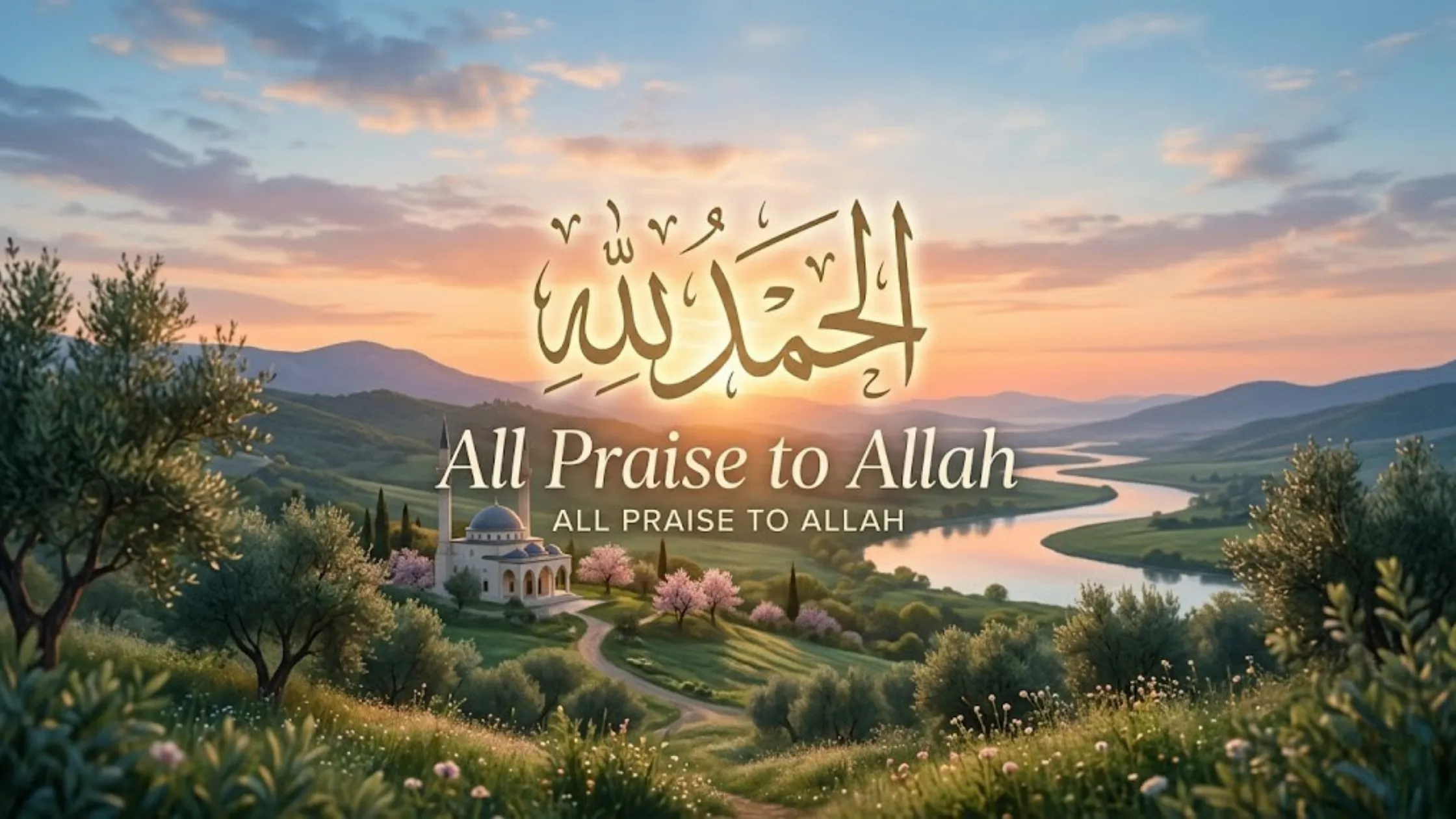
This phrase is not merely a cultural saying, its roots run deep into the foundational texts of Islam.
The Opening of Al-Fatiha (1:2)
The very second verse of the Quran — the opening chapter recited in every unit of prayer — begins with alhamdulillah:
الْحَمْدُ لِلَّهِ رَبِّ الْعَالَمِينَ
“All praise is due to Allah, Lord of all the worlds.”
(Surah Al-Fatiha, 1:2)
By placing it at the very opening of His Book, Allah established that gratitude and praise are the foundation of the believer’s relationship with Him. Every Muslim recites this at least 17 times per day in their obligatory prayers.
“It Fills the Scales” — Key Hadith References
The Prophet Muhammad ﷺ explicitly elevated alhamdulillah among all forms of dhikr in Islam:
الطُّهُورُ شَطْرُ الإِيمَانِ، وَالْحَمْدُ لِلَّهِ تَمْلأُ الْمِيزَانَ
“Cleanliness is half of faith, and ‘Alhamdulillah’ fills the Scale (of good deeds).”
(Sahih Muslim, 223)
In another narration:
مَا أَنْعَمَ اللَّهُ عَلَى عَبْدٍ نِعْمَةً فَقَالَ الْحَمْدُ لِلَّهِ إِلَّا كَانَ الَّذِي أَعْطَى أَفْضَلَ مِمَّا أَخَذَ
“Whenever Allah bestows a blessing upon a servant, and he says ‘Alhamdulillah,’ what he gave (in thanks) is better than what he received.”
(Ibn Majah, graded Hasan)
Why is it called the Best Dhikr?
Scholars explain that alhamdulillah is considered the best dua because it does not ask — it acknowledges. It transforms the worshipper from a petitioner into a grateful servant, which is the highest spiritual station.
In a famous hadith, the Prophet ﷺ said:
أَفْضَلُ الذِّكْرِ لَا إِلَهَ إِلَّا اللَّهُ، وَأَفْضَلُ الدُّعَاءِ الْحَمْدُ لِلَّهِ
“The best dhikr is ‘La ilaha illallah,’ and the best supplication is ‘Alhamdulillah.'”
(Sunan Ibn Majah, 3800 — graded Hasan)
When Do Muslims Say Alhamdulillah?
Understanding alhamdulillah for everything means recognizing it as a response to all of life — not just its highs.
After Sneezing
The Prophet ﷺ instructed believers to say alhamdulillah after sneezing, and for those around them to respond with “yarhamukallah” (may Allah have mercy on you). Sneezing expels harmful air from the body — hence the gratitude.
إِذَا عَطَسَ أَحَدُكُمْ فَلْيَقُلِ الْحَمْدُ لِلَّهِ
“When one of you sneezes, let him say ‘Alhamdulillah.'”
(Sahih Bukhari, 6224)
After Eating and Drinking
Gratitude for sustenance is central to Islamic ethics. After meals, Muslims are encouraged to say:
الْحَمْدُ لِلَّهِ الَّذِي أَطْعَمَنَا وَسَقَانَا وَجَعَلَنَا مُسْلِمِينَ
“All praise to Allah who fed us and gave us drink, and made us Muslims.”
(Sunan Abu Dawud, 3850)
In Times of Joy and Gratitude
When something good happens, a birth, a job offer, passing an exam, recovering from illness, the Muslim’s first response is alhamdulillah. It is an acknowledgment that the blessing came from Allah, not by personal merit alone. This is where alhamdulillah and mashallah are often confused: MashaAllah is used to express admiration for others; alhamdulillah is used to express your own gratitude directly to Allah.
In Times of Hardship and Loss
Perhaps the most powerful use of alhamdulillah is in difficulty. The Prophet ﷺ would say it even when receiving news of loss. This reflects a profound theological truth: God’s wisdom encompasses what we cannot see. Saying alhamdulillah in pain is not denial, it is trust.
إِنَّ لِلَّهِ مَا أَخَذَ وَلَهُ مَا أَعْطَى
“Indeed, to Allah belongs what He took, and to Him belongs what He gave.”
(Sahih Bukhari, 1284)
Alhamdulillah for Everything The Deeper Meaning
The phrase alhamdulillah for everything is more than a phrase — it is a complete worldview.
Gratitude in Ease vs. Gratitude in Pain
Many people can say alhamdulillah when life is good. The true test of faith is whether you say it in illness, loss, or failure. Islamic scholars describe two levels of gratitude: shukr al-naama (gratitude for blessings) and shukr al-balaa (gratitude in trials).
The latter earns a greater reward because it requires deeper trust in Allah’s plan.
The Prophet ﷺ said: “How wonderful is the affair of the believer! If good comes to him, he praises Allah, and that is good for him. If harm comes to him, he bears it with patience, and that is good for him.” (Muslim, 2999)
How It Trains the Mind and Heart?
Modern psychology increasingly validates what Islam taught 1,400 years ago:
- gratitude rewires the brain for well-being.
- Gratitude journaling, positive psychology, and mindfulness practices all echo the prophetic tradition of consistent thankfulness.
- Saying alhamdulillah trains attention on blessings rather than deficits—a powerful mental reframe.
This is directly connected to understanding the deeper importance of reciting the holy Quran, as Quranic recitation itself is an act of gratitude and remembrance.
The Connection to Shukr (شكر)
While hamd (حمد) and shukr (شكر) are both translated as “gratitude,” Arabic scholars distinguish them:
- hamd is praise given even without a personal benefit — you praise Allah simply because He is worthy.
- Shukr is gratitude specifically for a favor received. Alhamdulillah encompasses both, making it the most complete expression of thankfulness in Arabic.
How Many Times Do We Say Alhamdulillah Each Day?
The number may surprise you — and reveal how central this phrase is to Muslim spiritual life.
In the 5 Daily Prayers (Salah)
Surah Al-Fatiha is obligatory in every raka’ah (unit) of prayer. With the minimum obligatory prayers:
- Fajr: 2 raka’at → 2 recitations
- Dhuhr: 4 raka’at → 4 recitations
- Asr: 4 raka’at → 4 recitations
- Maghrib: 3 raka’at → 3 recitations
- Isha: 4 raka’at → 4 recitations
That is a minimum of 17 recitations of Al-Fatiha daily, each containing alhamdulillah. Add sunnah prayers, and it easily exceeds 30+.
Understanding how to perform this correctly is part of mastering the Five Pillars of Islam Online Course, which covers salah in detail.
In Everyday Life Outside Prayer
Beyond formal prayer, the following daily adhkar (remembrances) all include alhamdulillah:
- Morning and evening athkar: 33 times each in some narrations
- After every sneeze throughout the day
- After finishing a meal
- Upon waking from sleep (“Alhamdulillah al-lathi ahyana ba’da ma amatana”)
- After completing any significant task
A devout Muslim may say alhamdulillah 100+ times per day when including all the prophetic supplications. This is the living practice of Islamic phrases and meanings in real life.
What is the Difference Between Alhamdulillah and Other Dhikr?
A key source of confusion is knowing when to say which phrase. Here is a clear comparison — note that alhamdulillah vs inshallah is a separate distinction: inshallah (“if Allah wills”) relates to future intentions. In contrast, alhamdulillah relates to gratitude for what already is.
| Phrase | Meaning in English | When to Say It | Spiritual Function |
| Alhamdulillah (الحمد لله) | All praise be to Allah. | Gratitude, after good or bad events | Gratitude (Hamd) |
| SubhanAllah (سبحان الله) | Glory be to Allah. | Amazement, seeing nature or miracles | Glorification (Tasbih) |
| Allahu Akbar (الله أكبر) | Allah is the Greatest. | Salah, moments of awe | Magnification (Takbir) |
| MashaAllah (ما شاء الله) | What Allah has willed. | Admiring something or someone | Acknowledging Allah’s will |
| Astaghfirullah (أستغفر الله) | I seek forgiveness from Allah. | After a sin, moments of regret | Seeking forgiveness (Istighfar) |
How to Teach Your Children to Say Alhamdulillah?
Children who grow up with alhamdulillah on their lips carry a spiritual foundation that protects them throughout life.
Age-Appropriate Tips
Teaching alhamdulillah is about association, not memorization:
- Ages 2–4: After every meal, every gift, every fun experience — pause and say alhamdulillah together. Let them echo it.
- Ages 5–7: Explain in simple terms: “We say alhamdulillah to thank Allah for giving us this.” Connect it to their concept of thanking people.
- Ages 8–12: Introduce the Arabic meaning. Explain hamd vs. shukr. Share the hadith about it filling the scales.
- Teens: Discuss alhamdulillah in hardship — why we say it even when things are difficult. This deepens faith during the challenging teenage years.
This foundational work supports everything they will later learn, from defining the 5 pillars of Islam to the deeper spiritual sciences.
Making It a Daily Habit at Home
- Create a “gratitude corner” where the family shares three things they are grateful for each night, ending with a collective alhamdulillah.
- Use visual reminders — a whiteboard or sticky note on the fridge that says الحمد لله
- Model it yourself. Children absorb what they observe more than what they are told.
- Celebrate when children remember to say it on their own — positive reinforcement works.
Common Mistakes When Saying Alhamdulillah
Knowing what to avoid is just as important as knowing what to do.
Saying It Without Presence of Heart
The greatest mistake is reciting alhamdulillah as a reflex — a meaningless filler between sentences. Islamic scholars call this ghaflah (heedlessness). The Prophet ﷺ warned against lips that move while the heart is absent. Pause, even for a second, and mean what you say.
Only Saying It in Good Times
If alhamdulillah only appears when life is easy, it reflects a transactional relationship with God — “I praise You when You give me what I want.” True alhamdulillah, as the Quran teaches, is said in all states. Allah says in the Quran that He tests His servants with both ease and hardship to see who truly remains grateful.
Mispronunciation (Hamdullah vs. Alhamdulillah)
Saying “hamdullah” is a colloquial shortening that, while understood culturally, drops the “Al” — the definite article that makes the praise total and absolute. This is the difference between saying “praise to God” versus “ALL praise to God.”
Similarly, pronouncing the ح (Ha) as a regular English “H” changes the word entirely. Proper pronunciation of Arabic letters is part of the Islamic tradition of tajweed. Exploring the meaning of tajweed in Islam helps correct such errors at their root.
Begin Your Journey with Arabic and the Quran
Alhamdulillah is just one phrase, but understanding it fully requires a relationship with Arabic and the Quran. If you have been inspired to go deeper, explore structured learning resources that take you step by step through Arabic grammar, Quranic vocabulary, and the spiritual sciences of Islam.
Whether you are a complete beginner or a parent raising Muslim children, dedicated courses in Arabic and Quran education help you move from surface understanding to lived faith. Start your learning journey today and discover the meaning behind the words you already love.
Alhamdulillah is not just a phrase — it is a posture toward life. Its alhamdulillah meaning — all praise belongs to Allah — contains within it an entire theology of gratitude, surrender, and trust. Rooted in the Quran, elevated by the Prophet ﷺ, and practiced by over a billion Muslims every single day, it remains one of the most powerful expressions in human language.
Whether you say it 17 times in prayer or a hundred times throughout your day, let each repetition be a conscious act of the heart. Because in the end, alhamdulillah said with meaning fills not just the scales of deeds — it fills the soul.
Frequently Asked Questions
The difference between alhamdulillah and hamdulillah is the definite article al. Alhamdulillah means all praise belongs to Allah, complete and total. Hamdulillah, or hamdullah as it is often said, is a grammatically incomplete shortening that omits this totality. While both are understood, the full form is the Quranic and prophetic one.
There is no fixed Islamic response to alhamdulillah, as there is for sneezing. Common responses in Arabic culture include saying alhamdulillah back, or wa nahnu bi khayr, meaning and we are well, or simply smiling and repeating alhamdulillah together. After a sneeze, the reply is yarhamukallah, meaning may Allah have mercy on you.
The phrase الحمد لله appears 23 times in the Quran across multiple surahs. Notable instances include Surah Al-Fatiha 1:2, Surah Al-An’am 6:1, Surah Al-Kahf 18:1, and Surah Saba 34:1. The concept of hamd, meaning praise, appears far more frequently throughout the text.
The phrase is an Arabic expression of gratitude to Allah, the Arabic word for God. Non-Muslims who learn about Islam or Arabic sometimes use it in respectful contexts. Islamic scholars generally view the phrase as sacred, so using it sincerely in acknowledgment of God is considered respectful, while using it casually without understanding is discouraged.
Alhamdulillah translates most accurately as all praise and gratitude belong to Allah. The phrase alhamdulillah, meaning in English, is often simplified to ‘praise God’ or ‘thank God.’ However, the Arabic is richer — it implies total, voluntary, heartfelt praise that belongs to none but Allah. What is the difference between alhamdulillah and hamdulillah?
What do you say when someone says, alhamdulillah?
How many times is alhamdulillah mentioned in the Quran?
Is it okay to say alhamdulillah if you are not Muslim?
What does alhamdulillah mean in English?


Islamic Studies Course
for Adults
Deepen your understanding of Islam’s teachings.
Learn More
The 5 Pillars of Islam
Understand the fundamental principles of Islamic faith and practice.
Learn More