

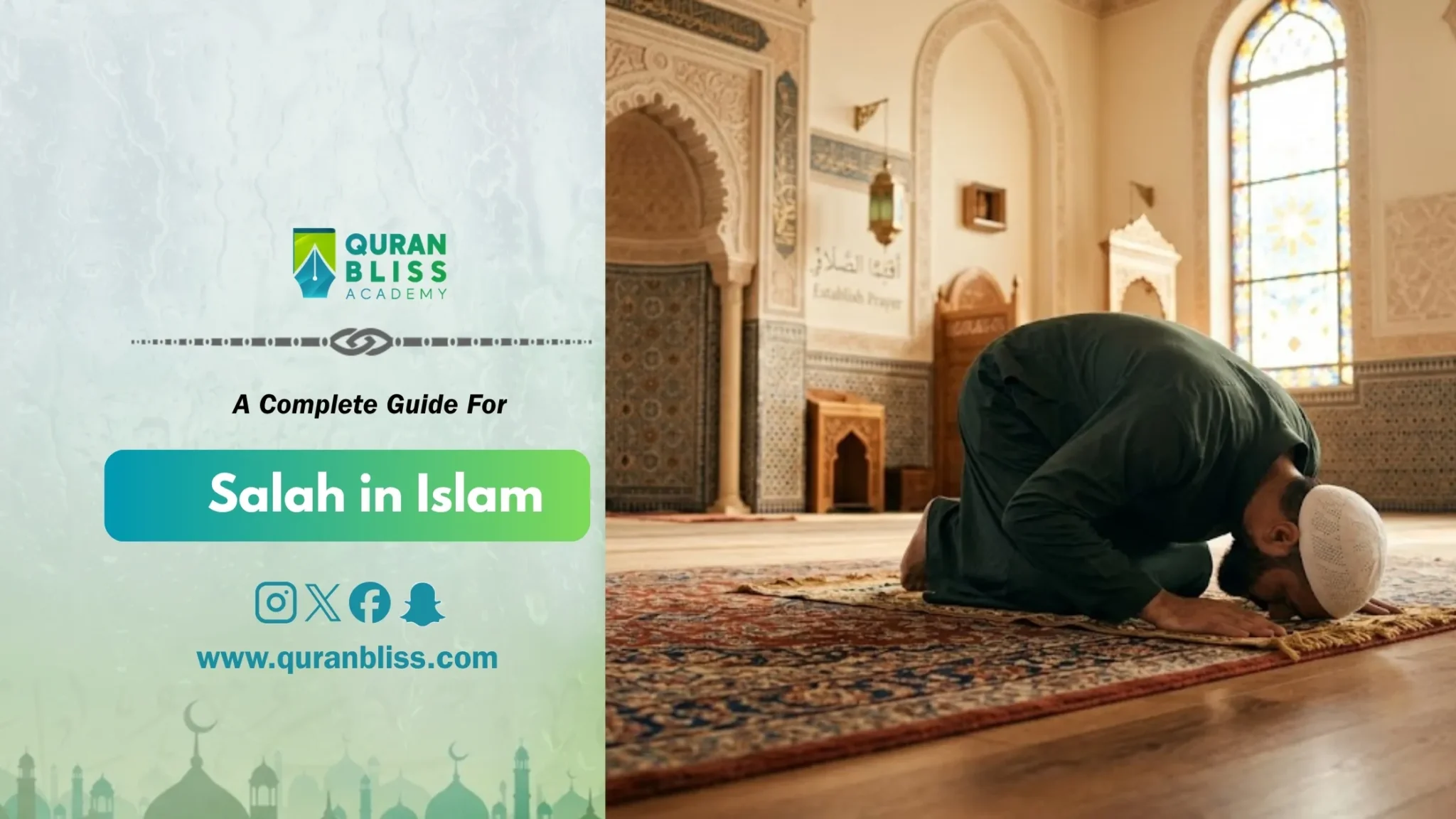
What Is Salah in Islam? Everything You Need to Know About Islamic Prayer
Salah (also spelled salat) is the ritual Islamic prayer performed five times daily. It is the second of the Five Pillars of Islam and is obligatory for every adult Muslim.
In this guide, you will find everything you need to understand salah, its meaning, significance, steps, types, benefits, and the most common mistakes beginners make.
What Does Salah in Islam Mean?
Before understanding how to pray, it helps to understand what the word itself carries, because in Arabic, a word’s root tells you its soul.
Linguistic Meaning (Arabic Root)
Some scholars suggest a connection to the word silah (صلة), though this remains a matter of scholarly discussion, which carries meanings related to connection, closeness, and supplication. Scholars also note it derives from silah (صلة), meaning bond or link, reflecting the idea that prayer is the direct bond between a servant and their Creator.
In English, it is most commonly translated as prayer, though the word worship or devotion captures it more fully, since salah involves prescribed movements, recitations, and a state of mindful presence.
Salah in the Quran, How Many Times Is It Mentioned?
Salah is one of the most frequently referenced acts of worship in the Quran. The word and its derivatives appear approximately 99 times across various surahs, making it the single most repeated practical instruction in the entire book.
This frequency is not coincidental. It signals that salah is the backbone of Islamic practice, the act that holds everything else together.
Why Is Salah Important in Islam?
Among all acts of worship in Islam, salah holds a uniquely central position. It is not simply one pillar among five, it is described in prophetic tradition as the dividing line between belief and disbelief.
Salah as the 2nd Pillar of Islam
The Five Pillars of Islam form the foundation of a Muslim’s faith and practice. Salah is the second pillar, following the Shahada (declaration of faith). To fully
understand where salah fits, it helps to define the 5 pillars of islam, salah sits immediately after believing, making it the first action that flows from faith.
Unlike fasting or pilgrimage, which occur once a year, salah is daily, a constant rhythm woven into every waking day of a Muslim’s life.
The Story of How Salah Was Prescribed (Isra & Mi’raj)
Salah is unique among Islamic obligations because it was not revealed through the Angel Jibreel delivering a message. It was prescribed directly, during the miraculous Night Journey (Isra) and Ascension (Mi’raj), when the Prophet Muhammad ﷺ was taken from Makkah to Jerusalem and then raised through the heavens.
Allah initially prescribed 50 daily prayers. On the Prophet’s descent, at the advice of Prophet Musa (peace be upon him), he returned to Allah multiple times to request a reduction, until the number was set at five, yet carrying the reward of fifty.
This story is significant: it is the only act of worship negotiated in the presence of Allah Himself, which reflects how central salah is to the Islamic spiritual framework.
Key Quran Verses About Salah
The Quran consistently links salah with success, mindfulness, and nearness to Allah. Here are two of the most cited verses:
Arabic: “وَأَقِيمُوا الصَّلَاةَ وَآتُوا الزَّكَاةَ وَارْكَعُوا مَعَ الرَّاكِعِينَ”
English: “And establish prayer and give zakah and bow with those who bow [in worship and obedience].”
Reference: (Surah Al-Baqarah, 2:43)Arabic: “…إِنَّ الصَّلَاةَ تَنْهَىٰ عَنِ الْفَحْشَاءِ وَالْمُنكَرِ ۗ وَلَذِكْرُ اللَّهِ أَكْبَرُ”
English: “Indeed, prayer prohibits immorality and wrongdoing.”
Reference: (Surah Al-Ankabut, 29:45)
Daily Salah Guide: Names, Prayer Times, and Rak’ah Count
Each of the five daily prayers has a specific name, a defined time window, and a set number of units (rak’at). Here is everything you need at a glance.
Fajr, Dhuhr, Asr, Maghrib, Isha, Overview Table
Prayer | Arabic Name | Rak’ah | Time Window |
Fajr | الفجر | 2 | Pre-dawn until sunrise |
Dhuhr | الظهر | 4 | Midday until mid-afternoon |
Asr | العصر | 4 | Mid-afternoon until sunset |
Maghrib | المغرب | 3 | Just after sunset |
Isha | العشاء | 4 | Nightfall until midnight |
Each prayer must be performed within its designated time window. Praying outside this window without a valid excuse is considered a serious matter in Islamic jurisprudence.
How Prayer Times Are Determined
Islamic prayer times are not fixed to the clock, they are tied to the position of the sun. This means they shift slightly every day and vary by geographic location.
- Fajr begins at dawn (when light first appears on the horizon) and ends at sunrise.
- Dhuhr begins when the sun passes its zenith (highest point) and begins to decline.
- Asr is calculated based on shadow length relative to an object’s height (juristic schools differ on the exact calculation).
- Maghrib begins immediately after sunset.
- Isha begins when the red twilight disappears from the sky.
Most Muslims today use verified prayer time apps or tables based on their city’s coordinates, as manual sun-tracking is impractical in modern life.
How to Perform Salah Step by Step
Performing salah correctly requires preparation before you even begin. Rushing into the prayer without the proper prerequisites is one of the most common beginner mistakes.
Prerequisites (Wudu, Niyyah, Qibla, Clean Clothes)
Before starting salah, four conditions must be met:
- Wudu (Ritual Purification): You must perform ablution, washing the hands, mouth, nose, face, arms, head, and feet in a specific sequence. This purification is required before every prayer unless it has been broken.
- Niyyah (Intention): You must form an intention in your heart for which specific prayer you are about to perform. It does not need to be spoken aloud.
- Facing the Qibla: You must face the direction of the Kaaba in Makkah, Saudi Arabia. Compass apps and mosque markings make this straightforward worldwide.
- Clean Clothes and Space: Your clothes and the surface you pray on must be free of physical impurities.
The Steps of One Rak’ah
One rak’ah consists of the following sequence:
- Takbiratul Ihram: Raise both hands to shoulder level and say “Allahu Akbar” (Allah is the Greatest) to begin the prayer.
- Qiyam (Standing): Recite Surah Al-Fatihah, followed by any other portion of the Quran.
- Ruku (Bowing): Bow forward with hands on knees, back flat, and say “Subhana Rabbiyal Adheem” (Glory be to my Lord, the Great) three times.
- I’tidal (Rising from Ruku): Stand upright and say “Sami’Allahu liman hamidah” (Allah hears those who praise Him).
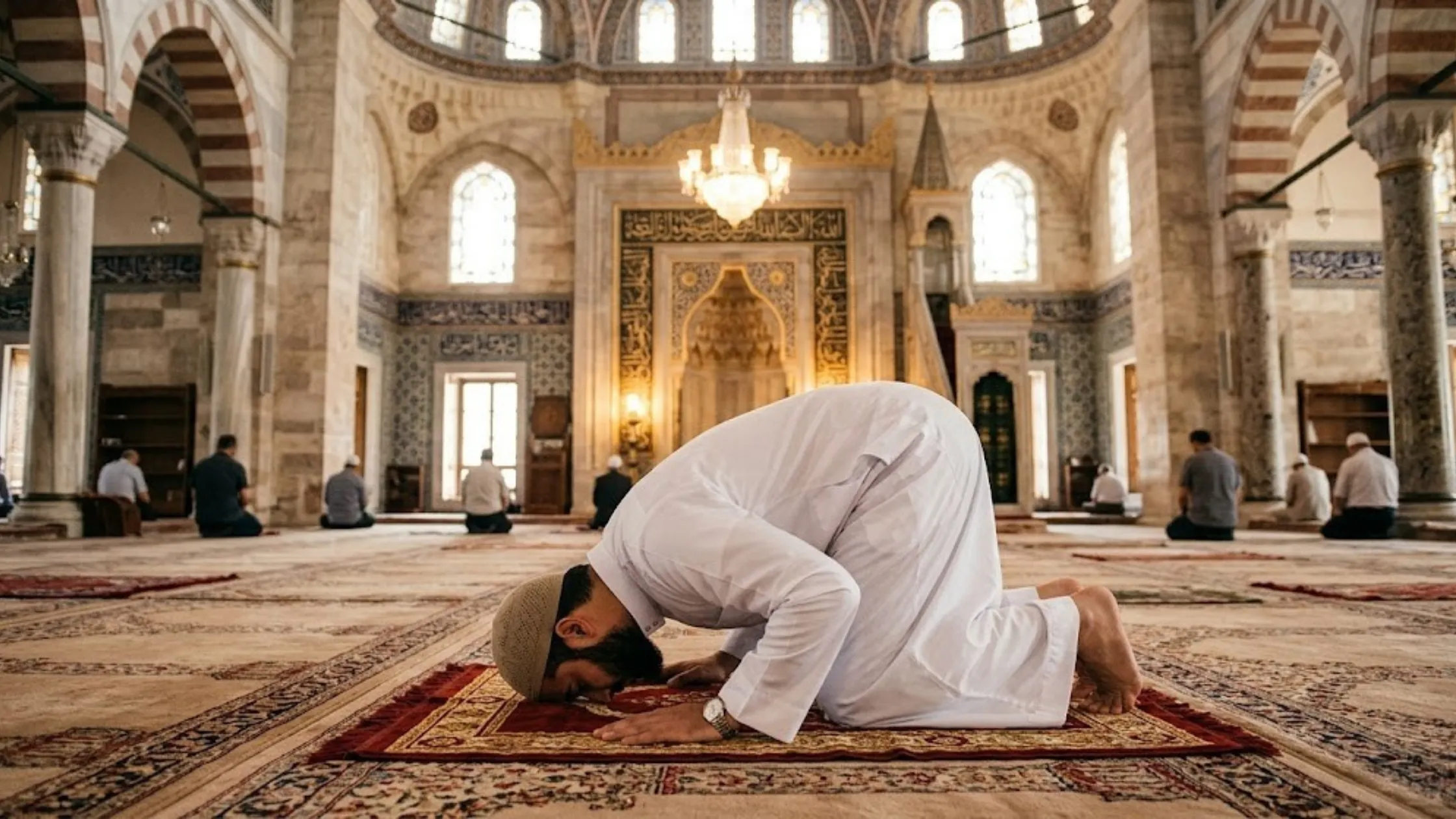
- Sujud (Prostration): Prostrate with forehead, nose, both palms, knees, and toes touching the ground. Say “Subhana Rabbiyal A’la” (Glory be to my Lord, the Most High) three times.
- Julus (Sitting between Prostrations): Sit briefly and say “Rabb ighfir li” (My Lord, forgive me).
- Second Sujud: Repeat the prostration as in step 5.
Completing 2, 3, or 4 Rak’at
After the first rak’ah, you rise and repeat the process. At specific rak’at intervals, you pause for a sitting position (tashahhud) where you recite the Tashahhud and Salawat (blessings upon the Prophet).
- After the 2nd rak’ah in all prayers: sit for the first tashahhud.
- In 2-rak’ah prayers (Fajr): this sitting is also the final one. End with tasleem (turning head right and left saying “Assalamu Alaikum wa Rahmatullah”).
- In 3 or 4-rak’ah prayers: rise after the first tashahhud and complete the remaining rak’at, then sit for the final tashahhud before tasleem.
Types of Salah in Islam
Not every salah carries the same level of obligation. Understanding the categories helps you prioritize correctly and build a richer prayer life beyond the five obligatory prayers.
Fard (Obligatory) vs Sunnah vs Nafl
- Fard (Obligatory): The five daily prayers, Fajr, Dhuhr, Asr, Maghrib, and Isha. Missing these without valid reason is a sin in Islamic jurisprudence.
- Sunnah Mu’akkadah (Confirmed Sunnah): Prayers the Prophet ﷺ performed consistently and rarely missed. Examples include 2 rak’at before Fajr, 2 after Maghrib, and 2 after Isha. These are strongly encouraged.
- Sunnah Ghair Mu’akkadah (Non-Confirmed Sunnah): Prayers the Prophet ﷺ performed occasionally. Missing them carries no blame, but performing them is rewarded.
- Nafl (Voluntary): Extra prayers performed beyond what is required or recommended. These multiply reward and draw the worshipper closer to Allah.
Special Prayers (Jumuah, Eid, Janazah, Tarawih)
- Jumuah (Friday Prayer): Replaces Dhuhr on Fridays for men. It includes a khutbah (sermon) and is obligatory for adult males in a congregation.
- Eid Prayers: Performed on the mornings of Eid al-Fitr and Eid al-Adha. They involve additional takbirs (repetitions of “Allahu Akbar”) and are considered wajib (required) by many scholars.
- Salat al-Janazah (Funeral Prayer): A collective obligation (fard kifayah) performed for a deceased Muslim. It does not include ruku or sujud, it is entirely performed standing.
- Tarawih: Voluntary night prayers during Ramadan, typically 8 or 20 rak’at, performed in congregation after Isha.
Common Mistakes Beginners Make in Salah
Many people who are new to salah, or who have prayed for years without proper instruction, unknowingly fall into the same recurring errors. Identifying them early saves both effort and concern later.
Rushing Through Movements
The most widespread mistake is performing the physical postures too quickly. Ruku and sujud have a minimum requirement of stillness, called tuma’ninah, which means the body must come to rest fully in each position before moving on.
If you bow and rise in one continuous motion without pausing, many scholars consider that rak’ah invalid. The Prophet ﷺ himself instructed a companion who prayed hurriedly to return and pray again, saying the prayer was not complete.
Arabic: “ارْجِعْ فَصَلِّ، فَإِنَّكَ لَمْ تُصَلِّ”
English: “Go back and pray, for you have not prayed.”
Source: Sahih al-Bukhari, 793
Not Maintaining Focus (Khushu’)
Khushu’ refers to mindful presence, the state of the heart during salah. It is not simply about standing still; it means your mind is engaged with what you are reciting and who you are standing before.
The Quran specifically mentions those who are heedless in their prayers as a warning:
Arabic: “فَوَيْلٌ لِّلْمُصَلِّينَ ٭ الَّذِينَ هُمْ عَن صَلَاتِهِمْ سَاهُونَ”
English: “So woe to those who pray, those who are heedless of their prayer.”
Reference: (Surah Al-Ma’un, 107:4–5)
Practical tips to improve khushu’: understand the meaning of what you recite, slow your pace, and visualize standing before Allah.
Incorrect Wudu
A salah performed without valid wudu is not accepted. Common wudu errors include:
- Not covering all required body parts fully with water (e.g., missing part of the arm or the back of the ear).
- Breaking wudu after completing it (e.g., using the bathroom) and forgetting to renew it before prayer.
- Assuming wudu is broken when it is not, or assuming it is intact when it is.
Learning the correct wudu procedure from a reliable source once, and practicing it carefully, eliminates this problem permanently.
Spiritual & Physical Benefits of Salah

Salah’s impact extends well beyond the spiritual dimension. Modern research has increasingly aligned with what Islamic tradition taught centuries ago, that regular, structured prayer benefits mind and body alike.
Mental Health & Mindfulness
Salah is, by design, a mindfulness practice. Five times daily, a Muslim pauses all activity, enters a state of ritual purity, and focuses entirely on a single point: their connection with Allah.
Studies on prayer, meditation, and structured ritual consistently find that such practices lower cortisol (stress hormone) levels, reduce anxiety, and improve mood regulation. For Muslims, salah carries an additional layer: the theological certainty that they are heard and responded to by Allah.
The Quran frames this directly:
Arabic: “أَلَا بِذِكْرِ اللَّهِ تَطْمَئِنُّ الْقُلُوبُ”
English: “Verily, in the remembrance of Allah do hearts find rest.”
Reference: (Surah Ar-Ra’d, 13:28)
Physical Benefits of the Positions
The movements of salah, standing, bowing, prostrating, sitting, form a structured sequence of stretches and compressions that engage the entire body:
- Ruku (bowing): Stretches the lower back, hamstrings, and calf muscles. Performed 17+ times daily across five prayers.
- Sujud (prostration): Increases blood flow to the brain, stretches the upper back and shoulders, and activates core muscles. one of the few natural positions in daily life where the heart is elevated above the head.
- Julus (sitting): The specific sitting posture in salah improves ankle and knee flexibility over time.
For those who pray consistently throughout their lifetime, these benefits compound, making salah one of the most sustained physical practices in any religious tradition.
Building a Connection with Allah
Beyond psychology and physiology, the deepest benefit of salah is what it does spiritually over a lifetime. Each prayer is a re-anchoring, a return to purpose, humility, and gratitude.
The Prophet ﷺ described salah as the coolness of his eyes (qurrat ayn), meaning it was his greatest source of joy and peace. Muslims who sustain their prayers often describe a growing sense that their daily problems, while real, are dwarfed by the larger perspective prayer provides.
If you want to deepen your understanding of Islamic practice, enrolling in a
The structured Five Pillars of Islam Online Course can accelerate your learning significantly, giving you the theological context that makes each prayer more meaningful.
Start Your Salah Journey Today
Whether you are a new Muslim, a returning practitioner, or someone simply exploring Islam with curiosity, salah is the best place to begin. You do not need to perfect it before starting. You begin, you learn, and it deepens over time.
If you are looking for structured guidance, our online courses walk you through every aspect of Islamic practice at your own pace, from wudu to the spiritual dimensions of prayer. You can start today, wherever you are in the world.
Salah in Islam is not a ritual to be checked off a list, it is a daily, lifelong practice of presence, gratitude, and devotion. From its profound Quranic roots to its step-by-step mechanics, every aspect of salah carries meaning that deepens with knowledge and practice.
Whether you are learning the basics or looking to strengthen a prayer life that has grown routine, understanding why you pray is just as important as how. May your salah be a source of peace, clarity, and closeness to Allah.
Frequently Asked Questions
What is salah in Islam?
Salah is the mandatory ritual prayer performed five times daily by Muslims. It is the second of the Five Pillars of Islam and involves specific physical postures, Quranic recitations, and supplications directed toward Allah. It is obligatory for every sane, adult Muslim.
How many times a day do Muslims pray salah?
Muslims pray five times a day, Fajr (pre-dawn), Dhuhr (midday), Asr (afternoon), Maghrib (after sunset), and Isha (night). Each prayer has a specific time window and a set number of rak’at (units).
What is the difference between salah and dua?
Salah is the formal, prescribed ritual prayer with fixed movements, times, and recitations, it is obligatory. Dua is informal supplication a personal conversation with Allah that can happen at any time, in any language, without a fixed structure. Both are acts of worship, but salah is the structured form and dua is the
Can salah be prayed in English?
The obligatory components of salah, including Surah Al-Fatihah and the recitations during ruku and sujud, must be in Arabic according to the consensus of the major Islamic schools of jurisprudence. However, the personal supplications (dua) made at various points during and after salah can be in any language.
What happens if you miss a salah?
If a prayer is missed without a valid excuse (such as sleep or genuine forgetfulness), the Muslim is required to make it up (qada) as soon as possible. Missing prayers deliberately and without repentance is considered a major sin. The priority upon waking or remembering a missed prayer is to perform it immediately.


Islamic Studies Course
for Adults
Deepen your understanding of Islam’s teachings.
Learn More
The 5 Pillars of Islam
Understand the fundamental principles of Islamic faith and practice.
Learn More