
Wallahi: Meaning, How to Use It & Why It Matters in Islam
Wallahi (والله) means “By Allah” or “I swear by Allah” in Arabic.
It is an Islamic oath (Qasam) invoking Allah’s name to affirm the truth of a statement, It is NOT simply slang; saying Wallahi carries theological and moral weight in Islam.
How to spell it: Wallahi / WAllahi / Wa-Allahi, all refer to the same Arabic word: والله
This guide breaks down the wallahi meaning in Islam, how it’s used in everyday speech, and what the Quran and Hadith say about oaths sworn in Allah’s name. Whether you’re a Muslim wanting to use it correctly or a non-Muslim curious about the phrase, read on.
What Does Wallahi Mean?
Before we dive into religion, let’s understand what the word actually is made of at the linguistic level.
The Arabic Root, Wa (و) + Allah (الله), The word Wallahi (والله) is a combination of two elements:
- Wa (وَ), a prefix meaning “By” or “I swear by” in Arabic, used to introduce an oath
- Allah (الله), the Arabic name for God, is used exclusively in Islam for the One God
When joined, Wa + Allah = Wallahi. The “i” at the end is a genitive suffix required by Arabic grammar rules when the word follows a preposition. So, wallahi, meaning word-for-word, is: By Allah / I swear by Allah.
How to Pronounce Wallahi (for non-Arabic speakers)
Pronunciation: Wah-LAH-hee (stress on the second syllable)
- Wa , like “wah” (open vowel)
- llah, like “lah” with a gentle ‘h’ sound at the end (not silent)
- I, short “ee” sound
Some people write it as Wallahi, WAllahi, or Wallah; these are all spelling variations of the same Arabic expression. The most accurate English transliteration is Wallahi.
Wallahi vs. Wallah, What’s the Difference?
Wallahi and Wallah are essentially the same expression, with a slight variation in pronunciation based on dialect and region:
- Wallahi, more formal, used in classical and Modern Standard Arabic contexts, is common in East Africa, South Asia, and formal speech.
- Wallah, a shortened form popular in Egyptian, Levantine, and Gulf dialects; also common among Arab diaspora communities in the West
Wallahi meaning vs Wallah meaning: both translate to “By Allah”; the difference is accent and dialect, not meaning.
Wallahi in Islam, More Than Just a Word
In the Islamic tradition, Wallahi isn’t just a phrase you drop in conversation. It belongs to a specific category of religious speech that carries serious moral and spiritual consequences.
What Is a Qasam (Oath) in Islam?
A Qasam (قَسَم) is an oath, a solemn declaration made in the name of Allah to affirm that something is true or to commit to doing (or not doing) something. In Arabic, there are several oath formulas, all beginning with a preposition followed by Allah’s name.
The Quran itself uses oaths frequently; Allah swears by the sun, the moon, and the soul, demonstrating that the concept of Qasam is deeply embedded in Islamic discourse.
Wallahi is the most commonly used form of Qasam in everyday speech.
The Theological Weight of Saying Wallahi
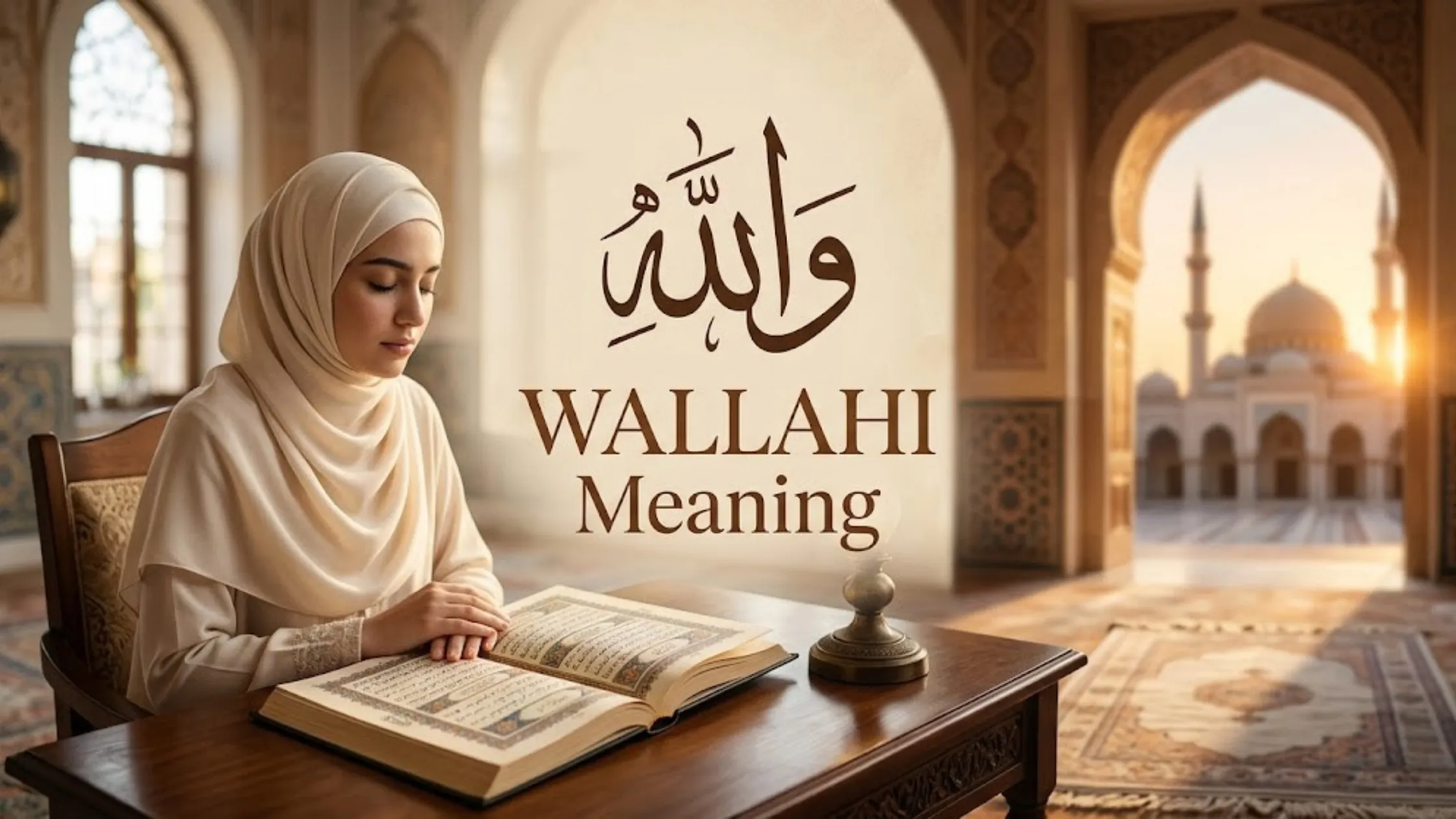
When a Muslim says Wallahi, they are invoking Allah’s name as a witness to their statement. This is not a light matter. The Quran instructs Muslims to protect their oaths:
وَاحْفَظُوا أَيْمَانَكُمْ
“And protect your oaths.”
(Surah Al-Ma’idah, 5:89)
Saying Wallahi when you know you are telling the truth is permissible and sometimes encouraged. But using it carelessly, repeatedly, or to exaggerate turns it from an act of worship into a bad habit, or worse, a sin.
Scholars advise Muslims to say Wallahi sparingly and only when genuinely affirming truth, out of respect for Allah’s name.
What Happens If You Say Wallahi While Lying? (Kaffarah)
If a person says Wallahi and then lies, or breaks a vow they made, this is considered a false oath (Yamin al-Ghamoos), which is a major sin in Islam.
However, Islam provides a path to expiation. The Kaffarah (كفارة), an act of atonement, is required. For breaking a Wallahi oath, the Kaffarah is one of the following:
- Feed 10 poor people (one meal each)
- Clothe 10 poor people
- Free an enslaved person (not applicable today)
If none of the above is possible, the person must fast for 3 days. This is based on Surah Al-Ma’idah (5:89). The existence of Kaffarah shows that Islam is both strict about oaths and merciful toward human weakness.
Understanding oaths is closely tied to broader Islamic obligations. If you’re exploring Islam’s foundations, read more about the 5 pillars of Islam, the framework that shapes a Muslim’s daily life.
How Wallahi Is Used in Everyday Life?
Wallahi appears in serious religious contexts, but it’s also woven into the fabric of everyday conversation across dozens of cultures. Here’s how to tell correct use from incorrect, and what “on Wallahi” actually means.
Correct vs. Incorrect Usage
The table below shows real examples of how Wallahi is and isn’t used properly:
Type | Example | Notes |
Correct | “Wallahi, I didn’t take it.” | Sincere oath about a serious matter |
Correct | “Wallahi, she was so kind.” | Genuine emphasis on truthfulness |
Borderline | “On Wallahi, I was just about to text you.” | Casual slang usage rather than a true oath |
Incorrect | Saying “Wallahi” to lie or exaggerate | Considered sinful and may require Kaffarah |
Incorrect | Using “Wallahi” constantly as a filler word | Can disrespect the name of Allah |
Wallahi should be used only when you are genuinely affirming the truth. It is not a filler phrase or a social media trend; it is a binding oath in the name of God.
What Does “On Wallahi” Mean?
“On Wallahi” is a slang phrase popular in UK British-Muslim communities, diaspora youth culture, and especially in online/social media spaces. It’s used the same way as “I swear to God” in casual English speech.
Examples:
- “On Wallahi, that Tajweed lesson changed everything.”
- “On Wallahi, I was just about to text you.”
From an Islamic perspective, “on Wallahi” is essentially the same oath as Wallahi, just prefixed with the English word “on.” Using it to exaggerate or joke remains the same concern: it invokes Allah’s name unnecessarily.
Wallahi meaning in the UK: The phrase has entered British youth slang, particularly in communities with Somali, Yemeni, and Arab heritage. It often signals sincerity or emphasis, similar to “no cap” in American slang, but it carries religious roots that don’t disappear just because the context is casual.
Can Non-Muslims Say Wallahi?
This is one of the most searched questions about Wallahi, and the answer is nuanced.
There is no Islamic ruling that forbids non-Muslims from saying Wallahi. The word itself is not sacred scripture; it is an oath formula. However:
- If a non-Muslim says Wallahi without believing in Allah, the oath has no theological binding.
- If said respectfully and with understanding of its meaning, there is no offense.
- If used mockingly or to imitate Muslims, this would be considered disrespectful.
Practically speaking, non-Muslims often pick up the phrase through proximity to Muslim friends or communities. As long as the usage is sincere and not mocking, most scholars do not consider it problematic.
Curious about other key Islamic terms? Explore the meaning of Zakah in Islam, one of the five pillars that every Muslim must understand.
Wallahi Across Cultures, Arabic, Somali & Beyond
One of the most interesting things about Wallahi is how far it has traveled beyond its Arabic origins. Today, it’s used across continents, in dozens of languages, and even as internet slang.
Wallahi in Egyptian Arabic
In Egyptian Arabic, Wallahi (or Wallahi in Egyptian dialect) is one of the most common everyday expressions. Egyptians use it both seriously and casually, sometimes 10+ times in a conversation, to stress the truth of something.
Examples from Egyptian dialect:
- “Wallahi ana mesh aref” (والله أنا مش عارف), “By Allah, I don’t know”
- “Wallahi el-azeem” (والله العظيم), “By Almighty Allah”, a stronger, more emphatic oath
Wallahi el-azeem is particularly powerful. It invokes not just Allah’s name but His attribute of greatness (العظيم), and is used when a person wants to emphasize they are speaking the absolute truth.
Wallahi in Somali Culture & Toronto Slang
Somalia has one of the highest Muslim populations by percentage in the world, and Wallahi is deeply embedded in Somali culture. It appears in everyday speech, oral poetry, and formal communication.
In Toronto, Canada, home to a large Somali-Canadian community, Wallahi crossed over into mainstream youth slang. By the mid-2010s, non-Somali, non-Muslim Toronto youth began using it as a general oath of sincerity, similar to “I swear.”
Wallahi, meaning in Toronto slang: “I’m being completely serious” or “No lie”, detached from its Islamic meaning but borrowed from the Somali community’s usage.
Wallahi, Billahi, and Tallahi, What’s the Difference?
In Arabic, there are three classical forms of the Allah oath, all meaning “By Allah” but using different prepositions:
Oath | Meaning | By What |
Wallahi (والله) | By Allah | Allah’s name (الله) |
Billahi (بالله) | By Allah | Allah + the preposition “بـ” |
Tallahi (تالله) | By Allah | Allah + classical/Quranic form |
Tallahi (تالله) is considered the oldest and most classical form, appearing multiple times in the Quran itself, such as in the story of Prophet Yusuf (Joseph).
تَاللَّهِ إِنَّكَ لَفِي ضَلَالِكَ الْقَدِيمِ
“By Allah, you are still in your old error.”
(Surah Yusuf, 12:95)
All three forms carry the same theological weight; they are oaths sworn in Allah’s name and treated with the same rulings in Islamic jurisprudence.
Want to go deeper into the language of the Quran? Learn about the meaning of Tajweed in Islam, the science of reciting the Quran with correct pronunciation and rules.
Common Misconceptions About Wallahi
Here are the most widespread misunderstandings, and the truth behind them:
- “Wallahi is just Arabic slang.”
False. Wallahi is a formal Islamic oath with roots in the Quran, Hadith, and centuries of Islamic jurisprudence. Its casual use in everyday speech doesn’t change its religious status.
- “Is saying Wallahi haram for small things?”
Not haram in itself, but scholars discourage excessive use. Saying it casually for trivial matters (“Wallahi, this sandwich is good”) is considered disrespectful toward Allah’s name, even if not technically sinful. The Prophet (ﷺ) encouraged not swearing frequently.
- “Wallahi and Inshallah mean the same thing.”
They don’t. Wallahi (By Allah) is an oath affirming a past or present fact. Inshallah (If Allah wills) is an expression of hope or intention for the future. They belong to completely different grammatical and theological categories.
- “If you say Wallahi, you can never change your mind.”
Not exactly. A Wallahi oath is binding. But if circumstances make fulfilling it impossible or harmful, Kaffarah (expiation) provides a religiously valid way to handle it. Islam does not trap people in impossible oaths.
- “Non-Muslims using Wallahi is offensive to Muslims.”
This depends heavily on context and intent. Respectful use by non-Muslims is generally not offensive. Mocking use always is. Most Muslims are more concerned with their own correct usage than with policing non-Muslims.
Take Your Islamic Knowledge Further
The deep theological meaning of Wallahi (Qasam) is rooted in the Arabic language of the Quran. If you want to truly connect with the gravity of what you are swearing by, or understand the language of revelation, learning Quranic Arabic is essential.
At Quran Bliss Academy, we offer structured, beginner-friendly courses for non-native Arabic speakers of all ages. Whether you seek to master Tajweed, understand key Islamic concepts like Qasam, or build a deeper relationship with the Quran’s language, we are here to guide you. so you can explore our Five Pillars of Islam online course and deepen your understanding of faith step by step.
Wallahi is far more than a word people say for emphasis. At its core, it is an Islamic oath, a solemn declaration in the name of Allah that carries real moral weight in the faith. Whether you encounter it in a religious sermon, a casual chat, or Toronto slang, knowing the wallahi meaning helps you understand both the Islamic tradition and the cultures where it lives.
FAQ about Wallahi Meaning:
Wallahi means By Allah or I swear by Allah in English. It is an Arabic oath invoking God’s name to affirm the truth of a statement. It is used both in formal Islamic contexts and in everyday speech across Arabic-speaking and Muslim communities worldwide.
Saying Wallahi for small or trivial matters is not considered haram (forbidden) by most scholars, but it is strongly discouraged. Frequent casual use of Wallahi is seen as showing a lack of reverence for Allah’s name. The Prophet Muhammad (ﷺ) advised Muslims to avoid excessive swearing, even truthfully.
On Wallahi is a slang expression popular in British-Muslim communities and online culture, particularly among youth with Somali, Arab, or Muslim heritage. It means I swear or seriously, used to emphasize sincerity. While casual in tone, it still invokes Allah’s name and carries the same Islamic considerations as Wallahi.
Yes, Wallahi and Wallah are the same expression. Wallahi is the more classical or formal pronunciation, while Wallah is a dialect variant common in Egyptian, Levantine, and Gulf Arabic. Both mean
There is no Islamic ruling that forbids non-Muslims from saying Wallahi. The oath carries theological binding only for Muslims. Non-Muslims who use it respectfully, particularly those close to Muslim communities, are not considered to be doing anything wrong. Using it to mock or imitate Muslims, however, would be considered disrespectful. What does Wallahi mean in English?
Is it haram to say Wallahi for small things?
What does Wallahi mean in slang?
Are Wallahi and Wallah the same?
Can a non-Muslim say Wallahi?


Islamic Studies Course
for Adults
Deepen your understanding of Islam’s teachings.
Learn More
The 5 Pillars of Islam
Understand the fundamental principles of Islamic faith and practice.
Learn More