

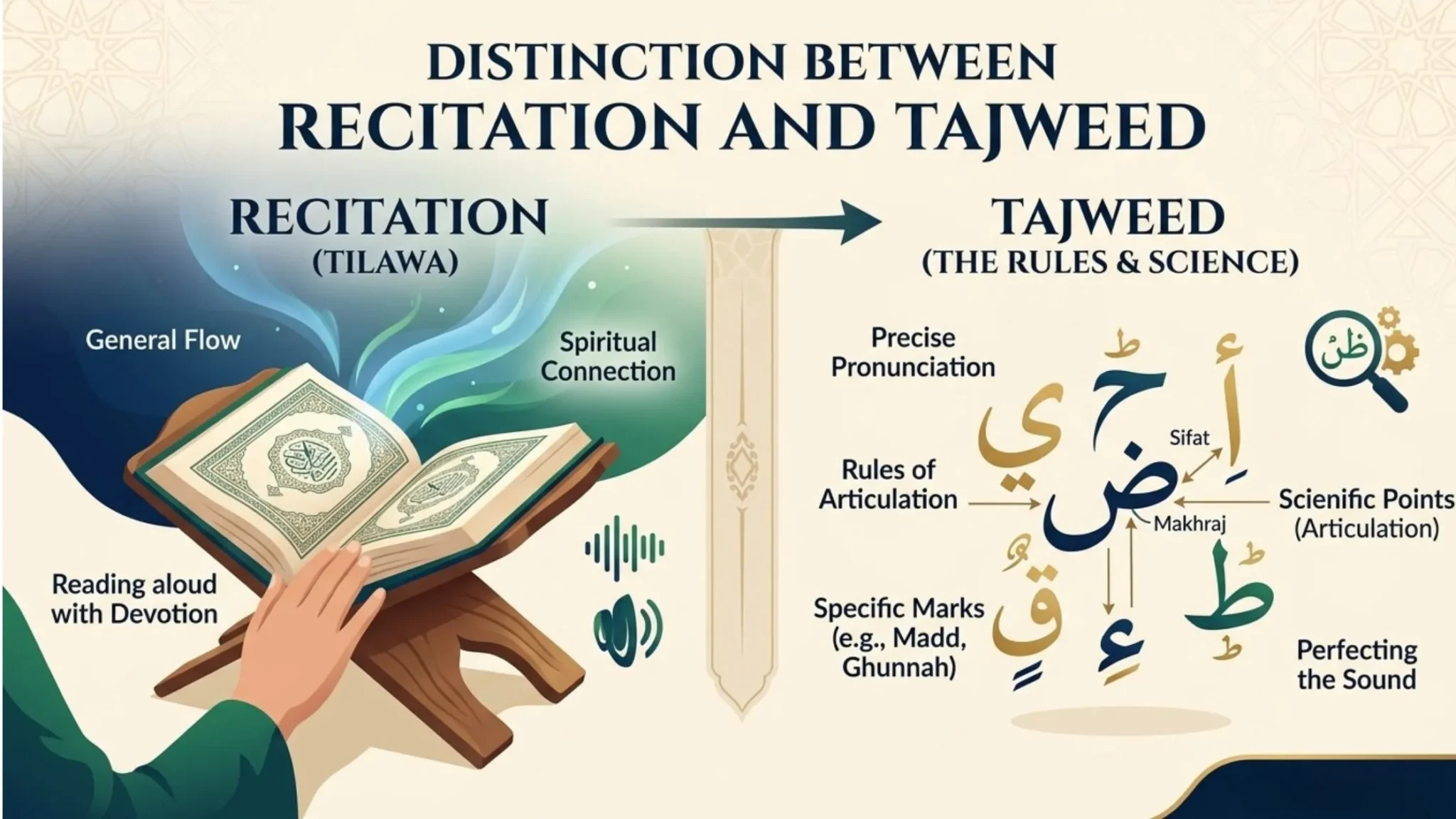
Distinction Between Recitation and Tajweed Meaning and Key Differences
The difference between recitation and tajweed is that recitation focuses on reading the Quran correctly, while tajweed focuses on pronouncing each letter accurately according to specific rules.
This comprehensive guide was created by the Quran Bliss Academy Editorial Team certified educators with over a decade of experience teaching non-Arab Muslims worldwide. We explore how to move beyond basic reading, protect the Quran’s profound meaning, and refine your recitation through the deliberate application of Tajweed rules.
What Is the Difference Between Recitation and Tajweed?
Recitation is the act of reading the Quran accurately delivering the revealed words in their correct sequence without omission or addition. Tajweed is the science that governs how each letter is articulated, covering rules of elongation, nasalisation, and points of articulation.
A person can recite fluently and still make persistent sound errors; tajweed is the system that prevents those errors and preserves the Quran’s transmitted form.
Understanding Qur’anic Recitation
When students first ask about the 3 types of quran recitation, they are usually referring to the three accepted pacing levels, Tahqeeq (slow and deliberate), Tadweer (moderate), and Hadr (fast). These are not separate styles invented for variety; they reflect how the Quran has been transmitted through different learning contexts and scholarly traditions.
Recitation, at its core, means the verbal delivery of the revealed words with attention to accuracy, sequence, and attentiveness. It includes:
- Reading from the mushaf or from memory in correct sequence
- Preserving every word, vowel, and verse without omission or addition
- Adapting pace to the context whether in prayer, memorisation review, or group learning
- Reinforcing visual and auditory recognition, which supports long-term memorisation
Recitation can be valid without full tajweed mastery provided the words are correct and the meaning is not altered. However, a learner who wants to Learn Quran recitation online will quickly find that fluency without sound correction leaves persistent gaps that become harder to fix over time.
What Is Tajweed and Why Is It Important?
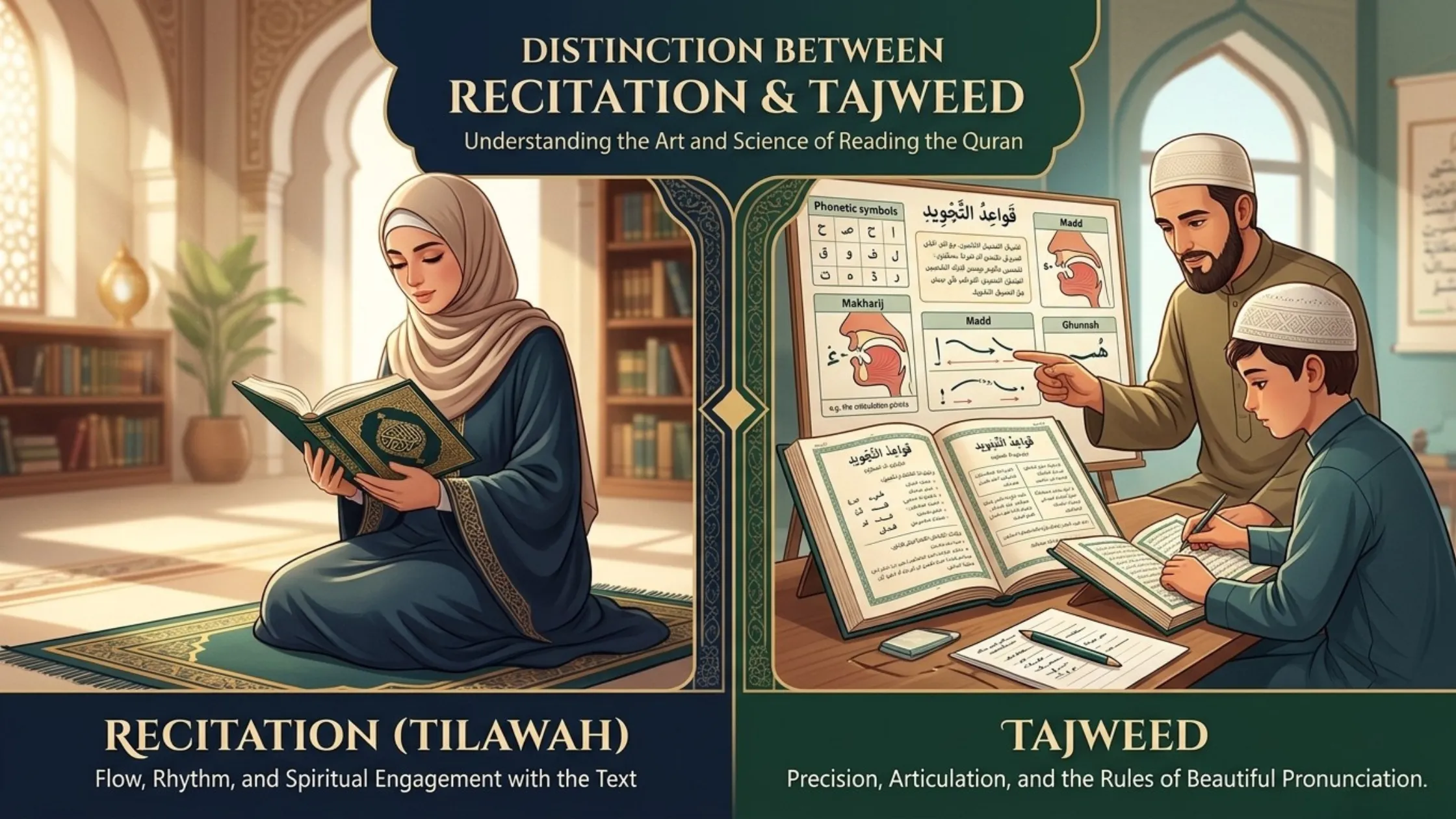
Tajweed is the science of Quranic pronunciation, the system that assigns every letter its precise point of articulation (makhraj), its inherent qualities (sifat), and its behaviour within connected speech. The meaning of tajweed in islam goes beyond beautification; it is preservation. Every rule exists to prevent unintentional changes to the Quran’s transmitted sound.
Key areas tajweed governs include:
- Makharij and Sifat: ensuring letters like س and ص, or ض and ظ, remain distinct from one another
- Madd (Elongation): controlling vowel length to avoid altering the form or meaning of words
- Ghunnah (Nasalisation): applying the nasal sound to noon and meem in the correct contexts
- Idgham and Ikhfa: managing letter merging and concealment in connected recitation
- Tafkheem and Tarqeeq: distinguishing heavy and light letters so the sound carries its correct weight
Many of our students who learn tajweed online are surprised that tajweed is not an optional refinement layered on top of recitation, it is the framework that makes recitation accurate in the first place. The importance of recitation of holy quran is inseparable from the importance of tajweed, because both serve the same goal: transmitting the Quran exactly as it was revealed.
“خَيْرُكُمْ مَنْ تَعَلَّمَ الْقُرْآنَ وَعَلَّمَهُ” “learn the Quran and teach it.” (Sahih al-Bukhari)
What Is the Difference Between Tarteel and Tajweed?
Students often ask about the difference between tarteel and tajweed, since both terms appear together in discussions of Quran reading. The distinction is straightforward: tarteel is a style or pace of reading, slow, deliberate, and unhurried, while tajweed is the rule system that governs accurate pronunciation at any speed.
A person can read with tarteel (slow pace) and still make tajweed errors. Equally, a person can read at a moderate or fast pace (tadweer or hadr) and apply tajweed correctly through trained habits and consistent correction. The types of recitation of Quran by speed are:
- Tahqeeq the slowest pace, used for learning and precise articulation
- Tadweer moderate pace, balancing clarity and flow
- Hadr faster pace, used by those with established tajweed proficiency
Is It Obligatory to Read the Quran with Tajweed?
Scholars of Quranic sciences have discussed this question at length. The majority position is that tajweed is obligatory (fard) in the sense that a reciter must not produce errors that change the meaning, this is considered an active harm to the Quran’s integrity. Rules that relate to beautification and refinement without affecting meaning fall into the category of strong recommendation (sunnah or mustahabb).
The key distinction scholars draw is between:
- Lahn Jaliyy errors that change letters or meanings, considered impermissible during recitation in prayer
- Lahn Khafiyy subtle errors in sound quality that do not change meaning but reduce the standard of recitation
So the question is reading quran without tajweed wrong depends on what type of error is made. Reading the words correctly without applying every advanced rule is permitted. But consistently distorting letters or altering vowels, even unknowingly, is what tajweed rules are designed to prevent. This is why early, guided learning is so important, especially for those joining tajweed classes online for the first time.
How to Start Right? A Practical Approach for Beginners
Many learners who grew up reciting informally benefit greatly from enrolling in quran classes online for adults to build a layer of precision on top of their existing fluency
The best time to start learning Tajweed is as early as possible, ideally as soon as you can recognize letters and read short words. By prioritizing correct articulation (Makharij) and vowel accuracy from the start, you build a foundation that makes advanced rules much easier to master later.
Instead of rushing through a full manual, we recommend a sustainable, step-by-step approach:
- Focus on Foundations: Master letter identification and short vowels before moving into rule-heavy terminology.
- Targeted Practice: Apply one new Tajweed rule at a time to short Surahs you are already reciting.
- Prioritize Feedback: Avoid relying solely on self-listening; utilize the guidance of a qualified teacher to catch errors that a trained ear would hear immediately.
- Consistency over Speed: Short, daily sessions with expert correction are far more effective than occasional, unguided practice.
Tajweed, Qirat, and Singing: What Is the Difference?
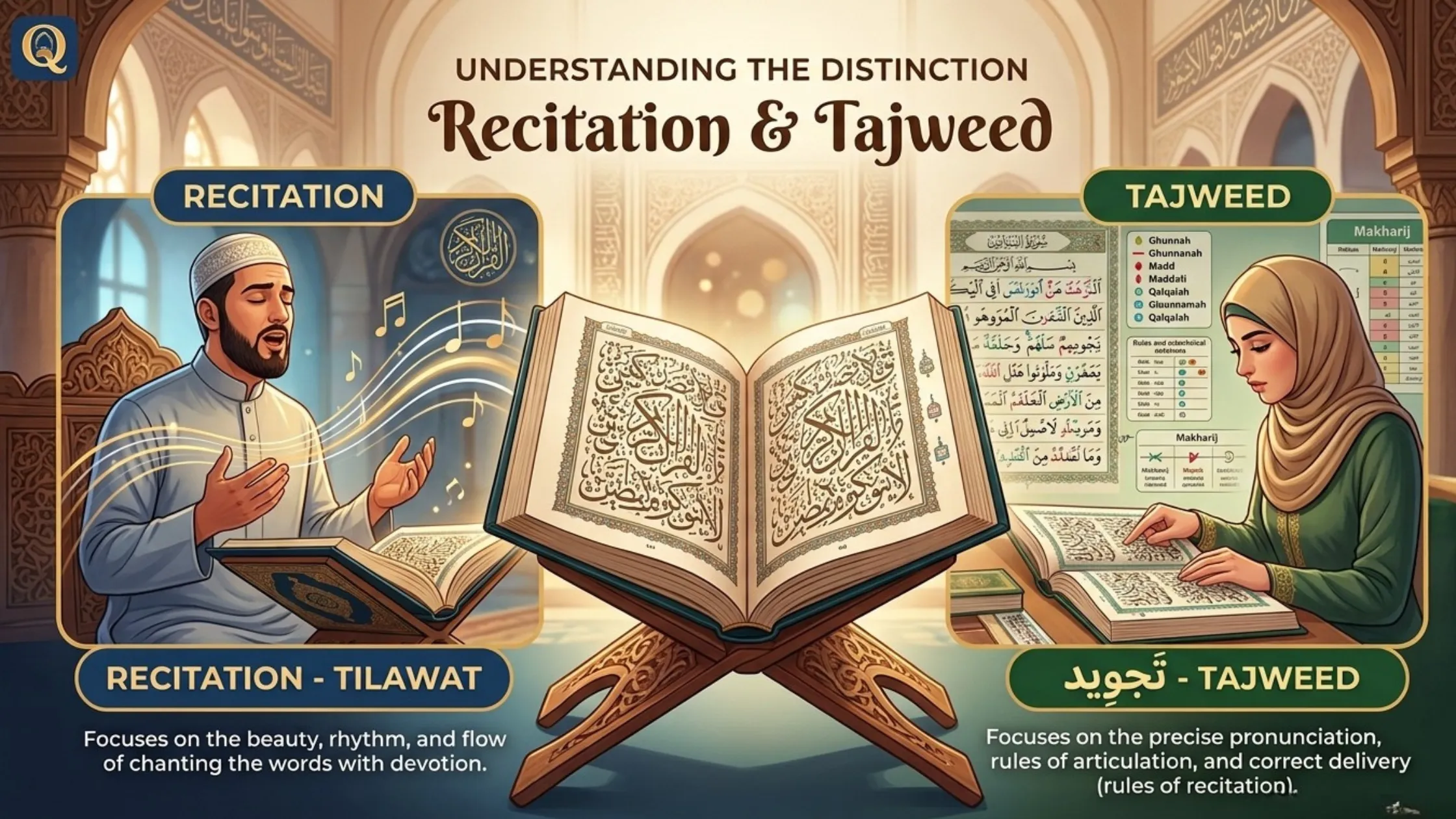
A question that comes up frequently, especially among new learners in the West, is the difference between tajweed and qirat. These are related but distinct:
- tajweed is the phonetic rule system, while qirat refers to the ten recognised modes of recitation transmitted from the Prophet ﷺ through different chains of narrators. Each qira’ah applies tajweed, but may differ in specific vowels, letters, or stopping rules within the bounds of established transmission.
- Equally common is the question about the difference between tajweed and singing.
- Tajweed is not a musical system, it governs linguistic accuracy, not melody.
- While beautiful recitation is encouraged, melodic improvisation that distorts letters, alters vowel lengths, or modifies pronunciation to fit a tune would violate tajweed rules.
- A reciter may make the Quran beautiful, but beauty must stay within the boundaries of correct articulation.
This distinction matters especially for students who have grown up listening to popular reciters and may unintentionally imitate melodic variations without understanding which elements are within acceptable tajweed and which cross into distortion.
Understanding Core Tajweed Rules
Two rules that confuse beginners most are idgham and iqlab. Understanding these early removes a major source of error in connected recitation.
What Is Idgham in Tajweed?
Idgham means merging, specifically, the merging of a noon saakinah (noon with sukoon) or tanween into the following letter when certain letters follow. Instead of pronouncing the noon fully, it is absorbed into the next sound. what is idgham in tajweed is one of the first questions students in our beginner programme ask, because it changes how connected words sound in practice.
Idgham has two types: with ghunnah (nasalisation) and without ghunnah, depending on which letter follows. Applying idgham incorrectly, or ignoring it, is one of the most audible errors in recitation.
What Is Iqlab in Tajweed?
Iqlab means to change or convert. It occurs when a noon saakinah or tanween is followed by the letter ب in this case, the noon sound is converted to a meem sound, accompanied by ghunnah. what is iqlab in tajweed is easy to understand in theory but requires ear training to apply consistently in flowing recitation.
Both idgham and iqlab are part of the noon saakinah and tanween chapter, one of the foundational areas covered in structured quran tajweed rules for beginners programmes.
How to Get Ijazah in Tajweed
For students who want to take their recitation to its highest level, the ijazah is the formal certification that a qualified teacher transmits when a student has recited the entire Quran back, without error, from an unbroken chain reaching the Prophet ﷺ.
- The path to how to get ijazah in tajweed typically includes:
- Mastering all tajweed rules with a certified teacher
- Completing the full Quran in recitation under supervised correction
- Reciting the entire Quran to the teacher, who verifies accuracy and grants the chain
At Quran Bliss Academy, we support students on this path through structured, long-term programmes with qualified teachers who hold their own ijazah certifications. While the journey requires commitment, it is accessible, many of our UK-based students have completed their ijazah entirely through consistent online study.
The Sacred Role of the Qur’an in Islamic Life
Every time a Muslim opens the Qur’an, they are not simply reading a text, they are engaging with the preserved words of Allah, transmitted orally across more than fourteen centuries without interruption. That chain of transmission is not merely historical; it is living, and it depends on each generation pronouncing correctly what they received.
This is why Muslims across different countries and languages are united in one recited form. Whether you are learning in London, Lagos, or Lahore, the recited Quran sounds the same, because it follows a regulated, transmitted standard. That standard is what tajweed protects.
“وَرَتِّلِ الْقُرْآنَ تَرْتِيلًا” “And recite the Qur’an with measured recitation.” (Surah Al-Muzzammil, 73:4)
This verse is not a suggestion toward beauty alone, it is an instruction toward precision. The Arabic word tarteel implies measured, unhurried delivery where every letter is given its due. For students enrolled in quran tajweed lessons at Quran Bliss Academy, we often begin with the spiritual understanding of the Quran before introducing a single rule.
Benefits of Reading Quran with Tajweed
When students ask about the benefits of reading quran with tajweed, the answers span both the practical and the spiritual:
- Letter distinction is preserved: essential for reading without distortion in prayer and daily recitation
- Confidence increases: learners know why a sound is correct, not just that it sounds ‘right’
- Memorisation strengthens: linking sound patterns to written patterns creates reliable long-term retention
- Spiritual quality deepens: accurate recitation in prayer is more attentive and more connected to the meaning
- Meaning is protected: avoiding lahn jaliyy (meaning-changing errors) keeps the intended message intact
Begin Your Journey with Quran Bliss Academy
Whether you are a complete beginner or someone returning to the Quran after years away, the right place to start is with structured guidance, not self-study alone.
- At Quran Bliss Academy, our certified teachers work with students across the UK and worldwide through personalised online sessions that balance recitation practice with targeted tajweed correction.
- Our programmes cover everything from foundational letter recognition to full ijazah preparation, taught by teachers who hold their own authenticated chains of transmission.
If you are ready to move from reading to reciting with confidence, we invite you to book a free trial session and experience the difference structured learning makes.
Conclusion
Understanding the Distinction Between Recitation and Tajweed is the foundation of purposeful Quran learning. Recitation grants us fluency, while Tajweed ensures the sound precision required to protect the Divine message. Together, they allow you to fulfill the command of Tarteel reciting with the measured dignity and accuracy these words deserve. At Quran Bliss Academy, we provide the structured, expert-led guidance you need to make your journey toward perfect recitation both visible and lasting.
Frequently Asked Questions
Yes, it is essential; recitation ensures text accuracy and correct sequence, while Tajweed provides the sound precision needed to articulate letters, elongations, and nasalization correctly.
While you may achieve a minimal level of valid recitation by reading the correct words, you risk persistent, meaning-altering errors that only Tajweed awareness can identify and correct.
Tajweed means giving every Quranic letter its precise origin and characteristics to ensure the faithful transmission of the Quran exactly as the Prophet ﷺ received it.
Tarteel refers to the unhurried, deliberate pace of recitation, whereas Tajweed is the technical system of rules governing accurate pronunciation at any speed.
The best path is sequential: master basic letter recognition first, then gradually introduce one Tajweed rule at a time to your daily practice with feedback from a qualified teacher. Is the Distinction Between Recitation and Tajweed important for correct Quran reading?
Can I recite the Quran correctly without learning tajweed?
What is the meaning of tajweed in Islam in simple terms?
What is the difference between tarteel and tajweed?
How can beginners learn both recitation and tajweed without confusion?
Quran Recitation
with Tajweed
Master accurate Qur’an recitation with clear Tajweed rules.
Learn More