

Inshallah Meaning : What This Powerful Arabic Phrase Really Means
Inshallah (إن شاء الله) means “If Allah wills” or “God willing” in Arabic. It is used by Muslims and Arabic speakers worldwide to express hope, intention, or humble submission to Allah’s will when referring to future events.
The phrase is rooted in the Quran (Surah Al-Kahf, 18:23–24) and reflects the Islamic belief that every future outcome is ultimately in the hands of Allah.
What Does Inshallah Mean in Arabic?
You’ve probably heard it dozens of times — in conversation, on social media. But what does Inshallah actually mean at its deepest level? Understanding the phrase goes far beyond a simple translation.
When Arabic speakers say Inshallah, they are not just filling space in a sentence. They are making a profound theological statement about the nature of time, power, and human limitation.
The Literal Breakdown (إن + شاء + الله)
Inshallah is made up of three Arabic words fused together:
- إن (In) means ‘if’
- شاء (Sha’a), means ‘He willed’ (past tense of the verb ‘to will’)
- الله (Allah) means ‘Allah’ (God)
Together, they form: “If Allah wills it.” This phrasing shows that the speaker recognises that even their best-laid plans are subject to a higher authority.
The correct written form is إن شاء الله, three separate words. Writing it as إنشاء الله is a common mistake that actually changes the meaning to ‘the creation of Allah’, which is a completely different phrase.
Read More: Define the 5 pillars of islam
How to Pronounce It Correctly (InshaAllah vs Inshalla vs Inshallah)
Pronunciation varies by region and transliteration style, but they all refer to the same phrase:
- Inshallah, the most common Western spelling
- InshaAllah, phonetically more precise spelling
- Insha’Allah, academic spelling with an apostrophe to show the glottal stop
- Inshalla, a colloquial form used in parts of North Africa and the Levant
The standard pronunciation is: in-SHA-allah. The stress falls on the second syllable. The ‘ a ‘ at the end of ‘sha’ and the beginning of ‘Allah’ blend naturally in fast speech.
The Quranic Origin of Inshallah
The use of Inshallah is not merely a cultural tradition. It is a direct instruction from the Quran, making it one of the few phrases in Islam whose utterance is considered a religious obligation in certain contexts.
This is a point that is often missed in Western discussions of the phrase, Inshallah is not optional small talk for Muslims. It carries genuine spiritual weight backed by clear Quranic text.
Surah Al-Kahf (Verses 23–24), The Command to Say It
Allah commands believers directly in Surah Al-Kahf:
وَلَا تَقُولَنَّ لِشَيْءٍ إِنِّي فَاعِلٌ ذَٰلِكَ غَدًا إِلَّا أَن يَشَاءَ اللَّهُ
“And never say of anything, ‘I will do that tomorrow’, except [when adding], ‘If Allah wills.'”
(Surah Al-Kahf, 18:23–24)
This verse was revealed in a specific context: the Prophet Muhammad (peace be upon him) was asked about the People of the Cave and the man with two gardens and promised to bring an answer the next day, but did not say Inshallah. Revelation was delayed as a reminder of the correct etiquette.
Why Does the Quran Make It Obligatory?
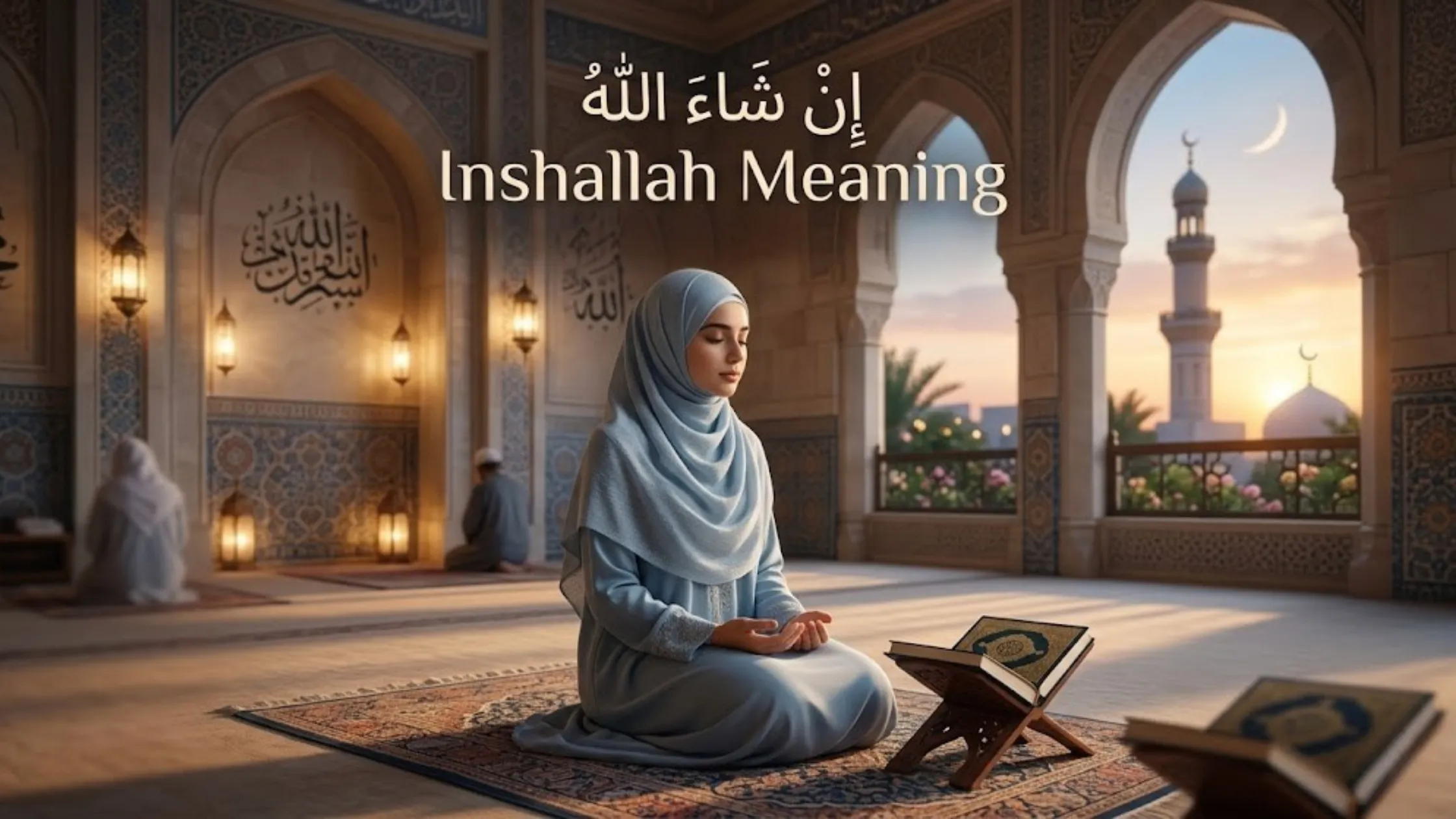
Saying Inshallah when speaking about future events is considered wajib (obligatory) by many scholars because the verse uses a direct prohibition (‘do not say’) and a clear conditional (‘except if Allah wills’).
Deliberately omitting Inshallah when making a firm claim about the future can be considered a form of kibr (arrogance), acting as though one has control over what only Allah controls. Saying it is an act of tawadu’ (humility) and iman (faith).
Why Do Muslims Say Inshallah? The Deep Meaning
To understand the Inshallah meaning properly, you need to understand what it reveals about the Islamic worldview. It is a phrase that ties language directly to theology every single time it is said.
Far from being a casual filler, Inshallah is a micro-expression of three of the most important concepts in Islam: tawakkul, tawheed, and the limits of human knowledge.
Submission to Allah’s Will (Tawakkul)
Tawakkul means relying completely on Allah while still taking every reasonable action available to you. Saying Inshallah embeds this concept into everyday speech.
A Muslim who says “I will meet you tomorrow, Inshallah” is not being non-committal. They are making a sincere promise, while acknowledging that illness, accident, or any unforeseen event may intervene, and that such outcomes are in Allah’s hands, not theirs.
A Reminder That Only Allah Controls the Future
Islamic theology teaches that humans have limited knowledge of what will happen even one second from now. No one can guarantee the future; only Allah has complete knowledge of it (Al-Ghayb, or the unseen).
The Prophet Muhammad (PBUH) said: “Whoever says Inshallah will not be frustrated.” (Ibn Majah).
This is not superstition; it reflects the belief that aligning your intentions with Allah’s will frees you from the anxiety of trying to control what lies beyond your reach.
Connection to Tawheed (Oneness of Allah)
Every time a Muslim says Inshallah, they reaffirm tawheed, the belief that Allah alone is the ultimate authority over all things. It is a small but consistent rejection of the idea that humans are independent agents acting outside of Allah’s sovereignty.
This is why practicing Muslims say Inshallah dozens of times a day. It is not mere routine; it is worship woven into language.
How Inshallah Is Used in Daily Life?
Knowing the theological depth of Inshallah does not mean every usage is a formal religious act. In Arab-majority cultures, the phrase weaves naturally into almost every conversation involving plans, hopes, or future events.
Here is a closer look at how the phrase functions in real-world communication, and why some of its uses get lost in translation.
Expressing Genuine Hope & Intention
This is the most sincere and common use. The speaker genuinely intends to do something and expresses that intention with humility:
- “I will finish the project by Friday, Inshallah.”
- “We will visit you next Eid, Inshallah.”
- “She will recover quickly, Inshallah.”
In each case, the speaker is committed to the outcome, but recognises that only Allah can guarantee it.
As a Polite Way to Decline (and Why That’s Misunderstood)
Western observers have noted that Inshallah is sometimes used to mean “no” or “probably not”, and this is partially true in certain cultural contexts.
When someone says, “We should get coffee sometime!” and the other person replies “Inshallah” with no concrete plan, it can function as a soft, face-saving non-commitment. But this is a cultural usage layered on top of the religious one, not the meaning of the word itself.
Understanding the difference is key. Inshallah does not mean no. It means “if Allah wills it”, and whether the speaker is genuinely hoping for something or politely avoiding it is entirely dependent on tone, context, and relationship.
Real Conversation Examples
- Planning: “I’ll call you at 8, Inshallah.” → Sincere commitment with divine awareness
- Hope: “Inshallah, she gets into university.” → A prayer and a wish combined
- Reassurance: “Inshallah, everything will be fine.” → Comfort, trust in Allah’s plan
- Soft avoidance: “Sure, Inshallah.” [no follow-up planned] → Culturally polite non-commitment
Inshallah vs Mashallah: What’s the Difference?
People often ask about the difference between Inshallah and Mashallah. While both phrases invoke Allah, they serve completely different purposes and are used at different times.
Feature | Inshallah (إن شاء الله) | Mashallah (ما شاء الله) |
Meaning | If Allah wills / God willing | What Allah has willed / How wonderful! |
Tense | Future events and intentions | Past or present events |
Usage | “I’ll call you tomorrow, inshallah.” | “Mashallah, your baby is beautiful!” |
Feeling | Hope and submission to Allah’s plan | Admiration, gratitude, and protection from the evil eye |
Quranic Root | Surah Al-Kahf 18:23–24 | Surah Al-Kahf 18:39 |
Inshallah looks forward (the future), Mashallah Meaning looks back (the present or past). If you’re expressing hope or intention, use Inshallah.
If you’re expressing wonder or gratitude at something that has already happened, Mashallah.
Who Uses Inshallah? (It’s Not Just Muslims)
One of the most interesting aspects of the Inshallah definition is how far beyond Islam it has spread. The phrase is not exclusive to Muslims; it belongs to a much wider cultural and linguistic family.
Arab Christians, Secular Arabs & Other Communities
- Arab Christians across Egypt, Lebanon, Syria, Jordan, and Palestine use Inshallah just as naturally as their Muslim neighbours.
- For them, the phrase is cultural and linguistic first, a shared expression of hope and humility that transcends denominational lines.
- Secular Arabs who may not practise religion regularly still use Inshallah as a cultural identifier.
- It is part of the Arabic language’s expressive ecosystem, much like ‘bless you’ after a sneeze in English; the religious origin does not require active religious intention every time.
How the Word Spread to Spanish (“Ojalá”) and Other Languages
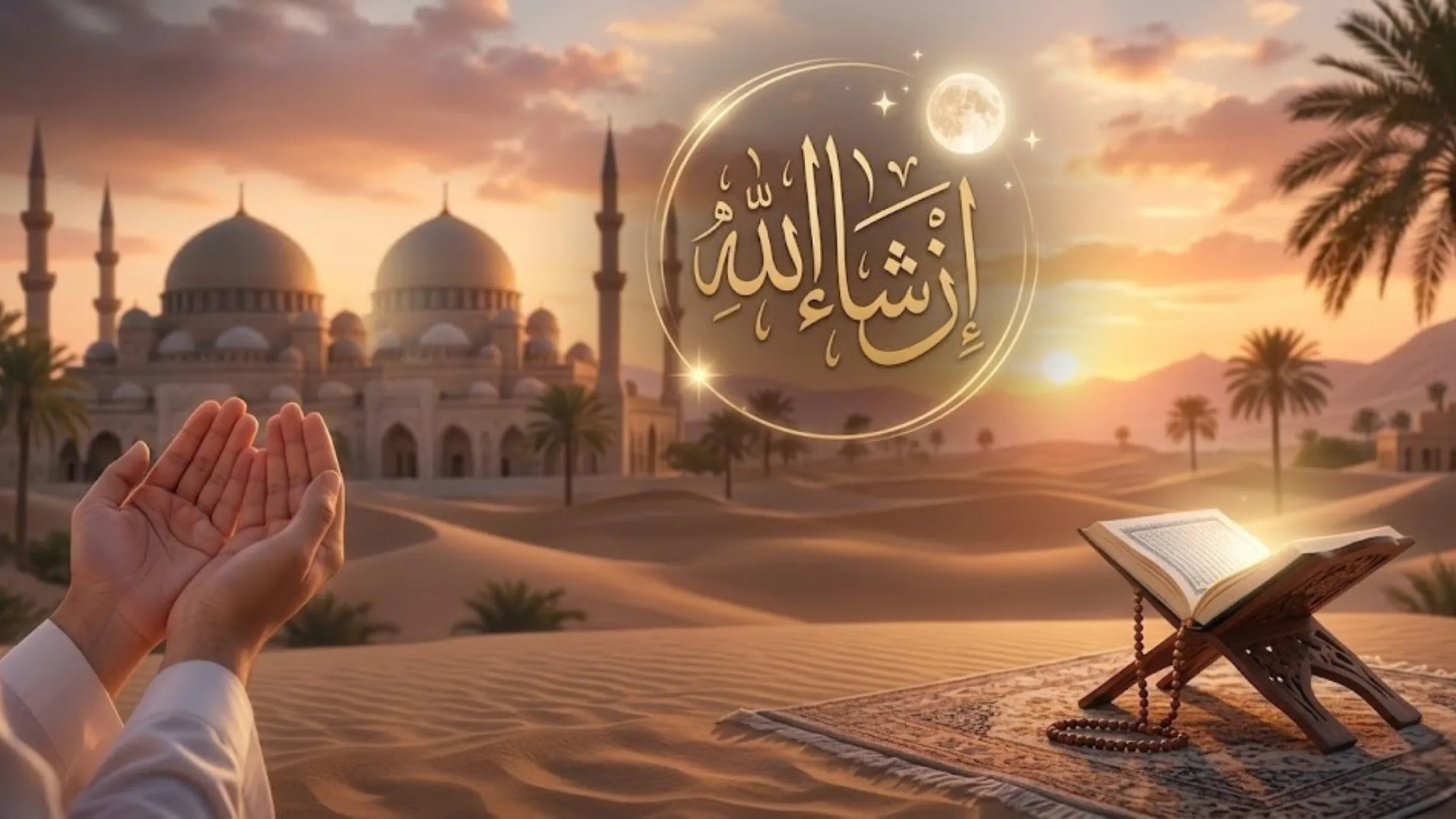
Perhaps the most remarkable example of Inshallah’s reach is the Spanish word “Ojalá”, which means ‘hopefully’ or ‘I wish’. This word comes directly from the Arabic “law sha’ Allah” (لو شاء الله), meaning ‘if Allah wills’, carried into Iberian Spanish during the centuries of Moorish presence in Al-Andalus.
You can also find similar expressions of divine submission in Turkish (“İnşallah”), Persian (“Inshallah”), Urdu (“InshAllah”), Somali, Swahili, and dozens of other languages influenced by Islamic culture.
How to Respond When Someone Says Inshallah?
If someone says Inshallah to you and you’d like to respond in kind, here are some natural replies:
- Inshallah, echo it back to confirm shared intention
- Inshallah, Ameen, adding Ameen (“so be it”) turns it into a shared prayer
- Barakallahu feek / feeki, “May Allah bless you”, a warm acknowledgement
Non-Muslims can nod, say “hopefully” in reply, or, if you’re comfortable, use “Inshallah” yourself. Arabic speakers generally welcome non-Muslims using the phrase respectfully; it signals cultural awareness and goodwill.
Want to Learn More Arabic & Islamic Phrases?
Understanding Inshallah is just the beginning. Arabic is one of the richest languages in the world, and the Quran is its greatest literary achievement. Whether you’re learning Arabic from scratch or deepening your Islamic knowledge, exploring the language opens up a world of meaning. Start your journey today with Five Pillars of Islam Online Course.
Understanding Inshallah is understanding something profound about how millions of people across the world relate to time, intention, and the divine. And that understanding — inshallah — will serve you well.
Frequently Asked Questions
In Arabic, the correct form is إن شاء الله, three separate words. In English transliteration, all of the following are acceptable: Inshallah, InshaAllah, and Insha’Allah. The one to avoid is إنشاء الله (as one Arabic word), which changes the meaning entirely to ‘the creation of Allah’.
Scholars differ on this, but many consider it discouraged (makrooh) at minimum to say Inshallah without any genuine intention. Deliberately using it as a lie or a guaranteed false promise could be sinful. Casual cultural usage by non-religious speakers is generally treated separately from intentional religious dishonesty.
Yes, absolutely. Arab Christians and secular Arabic speakers of all backgrounds widely use Inshallah. Non-Arabs who use it respectfully and in context are generally welcomed. It is a phrase about humility and hope, values that transcend any single religion.
Inshallah refers to the future: (If Allah wills, this will happen). Mashallah refers to something that has already happened: ‘What Allah has willed, this is wonderful!’ Use Inshallah when making plans or expressing hope. Use Mashallah when expressing admiration for something that exists or has already occurred.
In texts, Inshallah (or the abbreviation ISA or insha’Allah) most commonly means the sender genuinely hopes something will happen, or that they intend to do something while leaving room for circumstances beyond their control. In informal texting between friends, it can occasionally be a soft ‘maybe’ or polite non-commitment; context and relationship determine which meaning applies. What is the correct way to write Inshallah?
Is it haram to say Inshallah without meaning it?
Can non-Muslims say Inshallah?
What's the difference between Inshallah and Mashallah?
What does Inshallah mean in a text message?


Islamic Studies Course
for Adults
Deepen your understanding of Islam’s teachings.
Learn More
The 5 Pillars of Islam
Understand the fundamental principles of Islamic faith and practice.
Learn More