
Meaning of Shahadah in Islam: The Declaration That Changes Everything
The Shahadah (شَهَادَة) is the Islamic declaration of faith: “There is no god worthy of worship except Allah, and Muhammad is the Messenger of Allah.” It is the First Pillar of Islam, the entry point into the religion, and the most important statement a Muslim can ever utter. Its meaning encompasses pure monotheism (Tawheed) and acceptance of prophetic guidance (Risalah).
In this guide, you will learn the linguistic roots of the word, the full text with its translation, the two pillars it rests on, the seven conditions that make it valid, and exactly what happens when someone says it to enter Islam.
What Is the Shahadah? Definition & Arabic Root
The word Shahadah (شَهَادَة) appears in every Muslim’s life from the first moment they enter the world to the last breath they take. Yet for many, its depths remain unexplored.
The Linguistic Meaning of “Shahada” (root ش-ه-د)
The Arabic root of the word is ش-ه-د (Sh-H-D), which carries the core meaning of witnessing, testifying, and being present. From this same root comes the word shaheed (شَهِيد), the martyr who bears the ultimate witness, and tashahhud, the sitting testimony recited in every prayer.
When a Muslim says the Shahadah, they are not simply claiming a belief. They are testifying to it, standing as a witness before Allah and all of creation.
The Full Arabic Text, Transliteration & Translation
The complete Shahadah consists of two sentences spoken together:
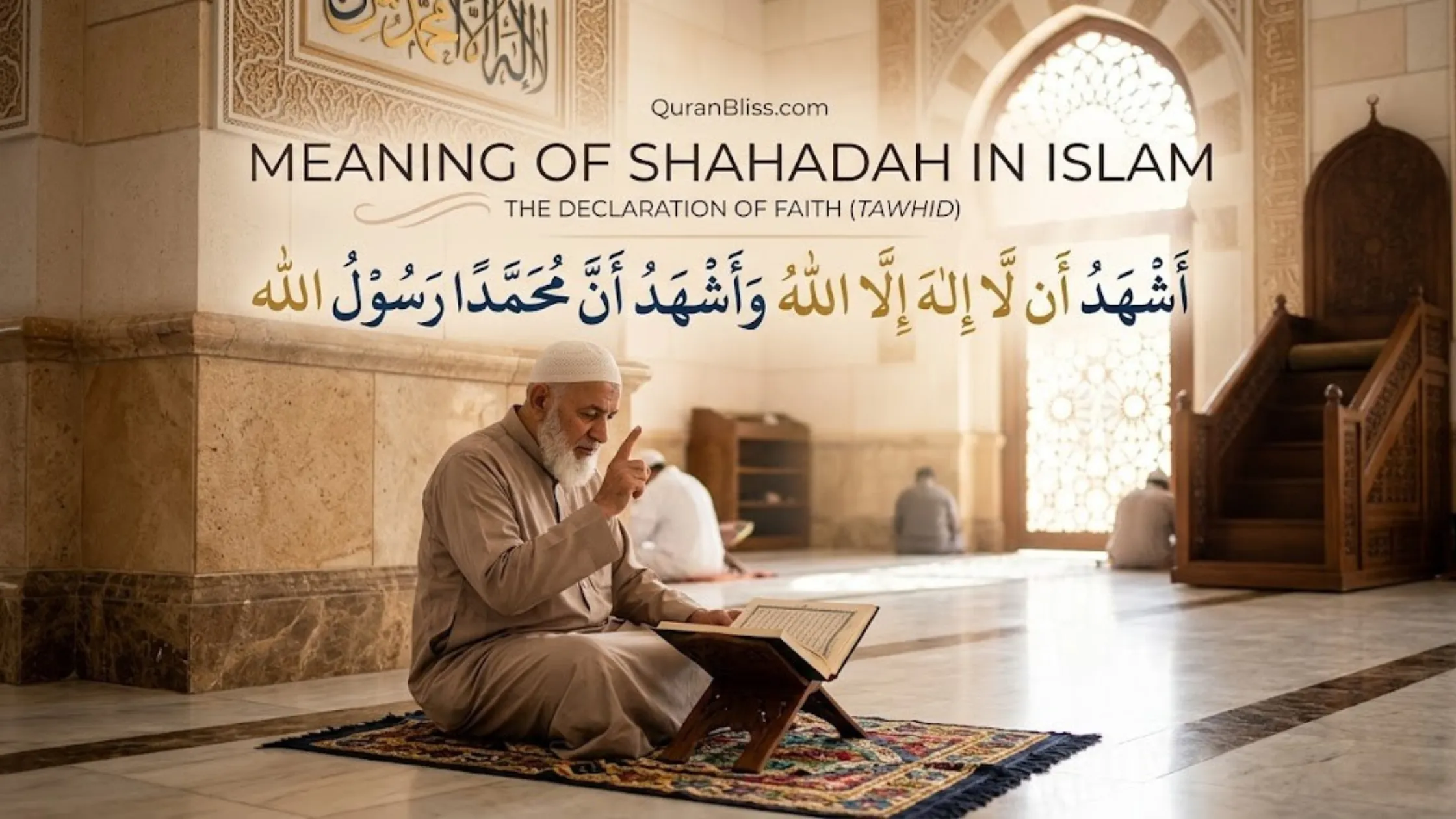
أَشْهَدُ أَنْ لَا إِلَٰهَ إِلَّا ٱللَّٰهُ وَأَشْهَدُ أَنَّ مُحَمَّدًا رَسُولُ ٱللَّٰهِ
Ash-hadu an lā ilāha illallāh, wa ash-hadu anna Muḥammadan Rasūlullāh
“I bear witness that there is no god worthy of worship except Allah, and I bear witness that Muhammad is the Messenger of Allah.”
The Two Parts of the Shahadah
Scholars of Islam have always explained the Shahadah as two inseparable testimonies. Remove one, and the declaration is incomplete. Together, they form what is often called the Shahadatayn, the two testimonies.
Part 1, Tawheed (Lā ilāha illallāh): The Oneness of Allah
The first part, “There is no god worthy of worship except Allah”, is the cornerstone of Islamic belief. In Arabic, it works through a powerful grammatical structure: negation (lā ilāha, no god) followed by affirmation (illallāh, except Allah).
This is not merely saying “God exists.” It is a complete declaration that:
- No one and nothing shares divinity with Allah
- All false deities, idols, and rivals are rejected absolutely
- Worship in all its forms belongs exclusively to Allah alone
Arabic: “فَٱعْلَمْ أَنَّهُۥ لَآ إِلَٰهَ إِلَّا ٱللَّهُ”
English: “So know that there is no god except Allah.”
Reference: (Surah Muhammad, 47:19)
Part 2, Risalah (Muḥammadur Rasūlullāh): The Prophethood
The second part, “Muhammad is the Messenger of Allah”, is equally essential. Believing in Allah alone, without accepting the Prophet ﷺ as His final messenger, would leave a person without a guide on how to worship correctly.
This testimony means:
- Prophet Muhammad ﷺ is the final prophet, there is no prophet after him
- His Sunnah (teachings and practice) is divine guidance to be followed
- The Quran was revealed through him and is the last word of Allah
“بُنِيَ الإِسْلاَمُ عَلَى خَمْسٍ: شَهَادَةِ أَنْ لاَ إِلَهَ إِلاَّ اللَّهُ، وَأَنَّ مُحَمَّدًا عَبْدُهُ وَرَسُولُهُ…”
“Islam is built upon five pillars: the testimony that there is no god but Allah and that Muhammad is the Messenger of Allah…”
Source: Sahih Al-Bukhari, Vol. 1, Hadith 8
Comparison Table: Part 1 vs Part 2 of the Shahadah
| Aspect | Part 1, Tawheed | Part 2, Risalah |
| Arabic phrase | Lā ilāha illallāh | Muḥammadur Rasūlullāh |
| Meaning | There is no god worthy of worship except Allah | Muhammad is the Messenger of Allah |
| Core concept | Tawheed, Oneness of Allah | Risalah, Prophethood & Revelation |
| Negates | All false deities and partners with Allah | Any claim to prophethood after Muhammad ﷺ |
| Affirms | Exclusive worship of Allah alone | Following the Sunnah as divine guidance |
Why the Shahadah Is the Most Important Declaration in a Muslim’s Life
Of all the words a human being can speak, Muslim scholars have consistently described the Shahadah as the most consequential. This is not exaggeration, it is rooted in clear theological reasoning.
The Prophet ﷺ said: “The best remembrance is Lā ilāha illallāh.”
(Sunan Ibn Majah, Hadith 3800, classified Hasan by Al-Albani)
Its importance lies in several dimensions:
- It is the key to entering Islam, nothing replaces it
- It defines a Muslim’s entire relationship with Allah
- It is recited in the Adhan five times a day, heard across the world
- It is the first words a newborn Muslim hears
- It is the last words every Muslim strives to say before death
- It will be the most important testimony on the Day of Judgment
Why It Comes First Among the Five Pillars
The five pillars, Shahadah, Salah (prayer), Zakat (charity), Sawm (fasting), and Hajj (pilgrimage), form the backbone of Islamic practice. To truly understand the Five Pillars of Islam, you need to start where Islam itself starts: with the testimony of faith.
The Shahadah is the foundation. Salah without Shahadah is meaningless. Zakat without it carries no divine reward. To learn more about how charity fits into this structure, explore the meaning of Zakah in Islam and see how each pillar reinforces the next.
It comes first because before a person can pray, fast, or perform any act of worship, they must first know Whom they are worshipping, and accept the channel through which that worship was revealed.
Its Place in the Adhan, Salah, Birth & Death
The Shahadah is woven into the fabric of a Muslim’s entire life:
- Recited five times daily in the Adhan that calls every Muslim to prayer
- A form of the Shahadah is declared in the sitting position of every prayer
- The first words whispered into a newborn’s ear are the Adhan, which includes the Shahadah
- Muslims strive to make the Shahadah their last words, a final testimony before meeting Allah
For those who want to understand all five pillars in depth and how they connect, our Five Pillars of Islam Online Course offers a structured, guided journey through each one.
The 7 Conditions of a Valid Shahadah
Islamic scholars teach that simply pronouncing the Shahadah with the tongue is not sufficient. For it to be accepted by Allah, seven internal conditions must be met. These are not barriers, they are the very soul of the declaration.
1. Knowledge (Ilm, العلم)
The person must understand the basic meaning of the Shahadah. Ignorance of what you are declaring makes the testimony hollow. Allah says in the Quran:
“فَٱعْلَمْ أَنَّهُۥ لَآ إِلَٰهَ إِلَّا ٱللَّهُ”
“So know that there is no god except Allah.”
Reference: (Surah Muhammad, 47:19)
2. Certainty (Yaqeen, اليقين)
The believer must hold the Shahadah with absolute conviction, no doubt whatsoever. The Quran describes the true believers as those who never doubt after they believe (Surah Al-Hujurat, 49:15).
3. Acceptance (Qabool, القبول)
The heart must accept the Shahadah fully, not merely acknowledge it intellectually. This is the difference between the one who knows the truth and the one who embraces it.
4. Submission (Inqiyad, الانقياد)
True testimony leads to obedience. The one who says the Shahadah must submit to what it requires: worshipping Allah alone and following the Prophet’s ﷺ way in all aspects of life.
5. Truthfulness (Sidq, الصدق)
The Shahadah must be spoken with the heart matching the tongue. The Prophet ﷺ said that whoever testifies truthfully from the heart will be saved. Hypocrisy, saying with the tongue what is not meant in the heart, invalidates the testimony.
6. Sincerity (Ikhlas, الإخلاص)
The declaration must be made purely for Allah, not for social acceptance, family pressure, or worldly gain. This sincerity is what purifies the testimony and makes it accepted in the sight of Allah.
Arabic: “قُلْ إِنِّى أُمِرْتُ أَنْ أَعْبُدَ ٱللَّهَ مُخْلِصًا لَّهُ ٱلدِّينَ”
English: “Say: I am commanded to worship Allah, sincere in faith to Him.”
Reference: (Surah Az-Zumar, 39:11)
7. Love (Mahabbah, المحبة)
The highest condition: the believer must love the Shahadah, love its meaning, and love Allah and His Messenger ﷺ more than anything else.
The Prophet ﷺ said: “None of you truly believes until Allah and His Messenger are more beloved to him than everything else.” (Sahih Al-Bukhari, 15)
How to Say the Shahadah to Convert to Islam
One of the most beautiful aspects of Islam is its simplicity of entry. No complex rituals, no intermediaries, no ceremony is strictly required. The door to Islam opens the moment a person sincerely declares the Shahadah.
Step-by-Step Process:
- Purify your intention, resolve sincerely that you are accepting Islam for Allah alone.
- Perform ghusl (ritual bath) if possible — while not strictly required, it is a recommended way to begin anew.
- Recite the Shahadah aloud: Ash-hadu an lā ilāha illallāh, wa ash-hadu anna Muḥammadan Rasūlullāh.
- It is recommended (though not obligatory) to have Muslim witnesses present.
- Learn the basics of prayer (Salah) as soon as possible, it is the next obligation after the Shahadah.
Note: Taking the Shahadah in front of witnesses is recommended but not mandatory. Islam is, at its core, a matter between a person and their Lord.
2. What Changes After Taking the Shahadah?
The moment the Shahadah is sincerely declared, something profound happens:
- All previous sins are completely wiped away, the person begins life with a clean slate
- They are now Muslim, with all the rights and responsibilities that entails
- They are entitled to Islamic burial and prayer (Salah Al-Janazah) when they die
- They become part of the global Muslim community (Ummah)
Arabic: “الإِسْلَامُ يَجُبُّ مَا قَبْلَهُ”
English: “Islam wipes out whatever came before it.”
Source: Sahih Muslim, Hadith 121
Common Misconceptions About the Shahadah
For anyone trying to define the 5 pillars of Islam or understand Islamic fundamentals, these are the most common misunderstandings about the Shahadah that must be addressed:
- “The Shahadah is just a formality.”, In reality, it requires knowledge, certainty, sincerity, and love. A hollow recitation without these conditions is not a valid testimony before Allah.
- “Non-Muslims who live righteous lives do not need the Shahadah.”, Islamic theology is clear that acceptance of the Shahadah is the defining entry into Islam. Good character alone, without testimony of faith, does not constitute Islam.
- “The Shahadah is only said once, when converting.”, Muslims reaffirm it in every prayer through the Tashahhud, in the Adhan, and continuously throughout their lives as a renewal of covenant with Allah.
- “There is only one Shahadah.”, The full declaration is actually called the Shahadatayn (“two testimonies”), the testimony of Tawheed AND the testimony of Prophethood. Both are required.
Ready to Deepen Your Understanding of Islam?
Understanding the Shahadah is just the beginning of a beautiful journey of faith. At Quran Bliss Academy, we offer one-on-one online classes in Quran recitation and Tajweed, Arabic, and Islamic Studies, taught by certified native tutors, for both kids and adults.
Whether you’re a new Muslim looking to strengthen your foundation or a lifelong learner wanting to go deeper, our flexible online classes are designed to fit your schedule and your level.
Book your free trial class today at Quran Bliss Academy and take the next step in your Islamic journey.
Start Your Islamic Learning Journey
The Shahadah opens the door, education keeps you walking through it with confidence and clarity. Quran Bliss Academy makes learning accessible, personal, and rooted in authentic scholarship.
- One-on-one sessions with certified native Arab tutors
- Flexible scheduling for adults and children worldwide
- Courses in Quran recitation, Tajweed, Arabic language, and Islamic Studies
- Free trial class, no commitment required
Start your journey at Quran Bliss Academy.
The meaning of Shahadah in Islam extends far beyond a phrase. It is a covenant with Allah, a rejection of all false worship, and a commitment to following the path of His final Prophet ﷺ. When said with knowledge, certainty, sincerity, and love, it is the most transformative declaration a human being can make.
Frequently Asked Questions (FAQ)
What does Shahadah mean in English?
The word Shahadah translates to testimony or witness in English. It refers to the Islamic declaration of faith: There is no god worthy of worship except Allah, and Muhammad is the Messenger of Allah. It is the most sacred statement in Islam.
How many times is the Shahadah mentioned in the Quran?
The exact Shahadah phrase as a complete sentence does not appear verbatim in the Quran, but its two components, the oneness of Allah (Tawheed) and the prophethood of Muhammad ﷺ, are affirmed throughout the Quran in many verses, such as Surah Muhammad (47:19) and Surah Al-Fath (48:29).
Can a non-Muslim say the Shahadah?
Yes, and when a non-Muslim sincerely says the Shahadah with understanding and genuine belief, they become Muslim at that moment. This is the entry point into Islam. The sincerity of the heart is what matters most.
Is the Shahadah enough to become a Muslim?
Yes, sincerely reciting the Shahadah with its seven conditions met is sufficient to enter Islam. However, once a person becomes Muslim, they take on the full obligations of the faith, beginning with the five daily prayers (Salah), as part of living out the declaration they have made.
What is the difference between Shahadah and Shahadatayn?
The Shahadah refers to the declaration of faith as a whole. The Shahadatayn (شَهَادَتَيْن) literally means two testimonies, it highlights that the declaration has two parts: the testimony of Allah’s oneness (Tawheed) and the testimony of Muhammad’s prophethood (Risalah). Both parts must be said together for the testimony to be complete and valid.
Islamic Studies Course
for Adults
Deepen your understanding of Islam’s teachings.
Learn More
The 5 Pillars of Islam
Understand the fundamental principles of Islamic faith and practice.
Learn More