
Dhuhr Prayer: Time, Rakats, and How to Perform It Step by Step
Dhuhr prayer is the second of the five daily prayers in Islam, performed after the sun passes its zenith (midday). It consists of 4 obligatory (Fardh) rakats, along with Sunnah and optional Nafl rakats, totalling up to 12 rakats in total. On Fridays, it is replaced by Jumu’ah prayer for men attending the mosque.
What Is Dhuhr Prayer?
At Quran Bliss Academy, we teach that understanding the purpose and timing of Dhuhr prayer is one of the most effective ways to build consistency in daily worship and strengthen one’s connection with Allah throughout the day.
Before diving into the timings and steps, it is worth understanding what Dhuhr actually means and where it sits within the framework of Islamic worship.
The word Dhuhr (ظهر) comes from the Arabic root meaning midday or noon, referring to the time when the sun reaches the peak of the sky. This prayer is also known as the noon prayer or the midday prayer in English-speaking Muslim communities in the UK and elsewhere.
Dhuhr is the second of the five daily prayers that every adult Muslim is obligated to perform. Understanding where it stands among the five is essential for building a consistent prayer routine.
Among the five pillars of Islam, Salah (daily prayer) is the second, and Dhuhr is one of its five essential parts. Understanding salah in Islam means recognising that each of these five prayers has its own time window, intention, and spiritual value.
Allah (SWT) explicitly commands the observance of prayer times in the Quran:
“أَقِمِ الصَّلَاةَ لِدُلُوكِ الشَّمْسِ إِلَىٰ غَسَقِ اللَّيْلِ وَقُرْآنَ الْفَجْرِ ۖ إِنَّ قُرْآنَ الْفَجْرِ كَانَ مَشْهُودًا”
“Establish prayer at the decline of the sun until the darkness of the night, and the Fajr (dawn) prayer. Indeed, the recitation of Fajr is witnessed.”
(Surah Al-Isra, 17:78)
Scholars understand “the decline of the sun” (duluk al-shams) to mark the beginning of Dhuhr time, making this verse a direct Quranic foundation for the midday prayer.
When Is Dhuhr Prayer Time?
According to the educational approach followed by Quran Bliss Academy, organizing your daily schedule around prayer times rather than fitting prayer into your schedule helps create a stronger and more sustainable relationship with Salah.
Knowing the correct time window for Dhuhr helps you plan your day and ensure you never miss this important prayer, especially in the UK, where daylight hours vary significantly across seasons.
Dhuhr begins after the sun passes its zenith (highest point) and begins to decline, typically around 12:30–1:30 PM in the UK, depending on the time of year. The exact time shifts daily, so using a reliable prayer time app or local mosque timetable is strongly recommended.
Here is how the time window works:
- Dhuhr starts: Just after the sun passes its highest point (zawal). This is typically 1–2 minutes after solar noon.
- Dhuhr ends: When the shadow of an object equals its own length (plus the shadow at zawal). This marks the entry of the Asr time.
What About Dhuhr on Fridays?
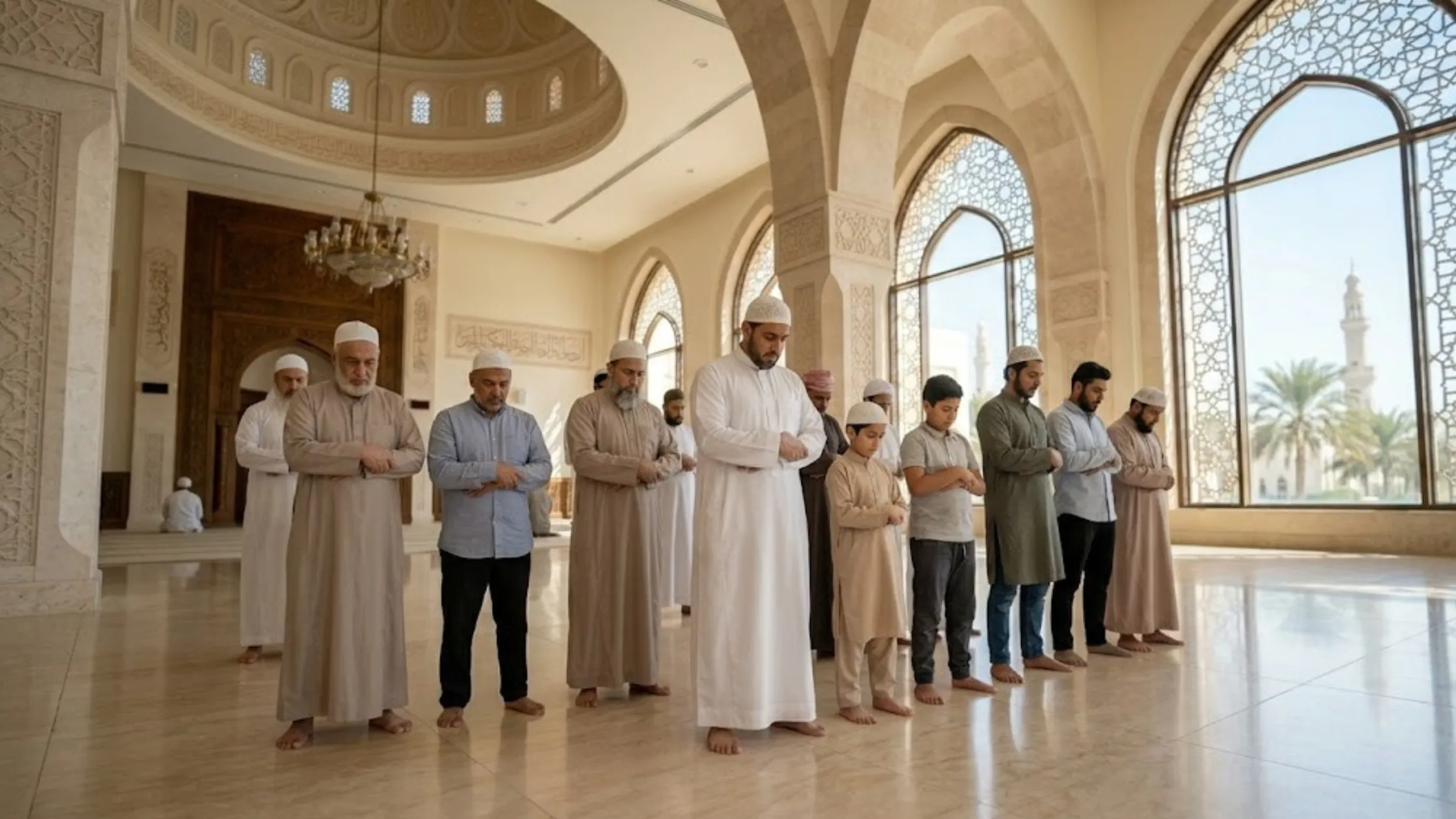
For men attending the Friday congregation, Dhuhr prayer is replaced by Jumu’ah (Friday prayer). The Friday sermon (khutbah) followed by two rakats of Jumu’ah fulfils the obligation of Dhuhr on that day. Women, travellers, and those with valid excuses may continue to pray Dhuhr as normal at home.
To find your accurate Dhuhr time in any UK city, London, Birmingham, Manchester, Leicester, use apps like Muslim Pro, IslamicFinder, or your local mosque’s published timetable. These automatically calculate times based on your precise location and the chosen calculation method.
How Many Rakats in Dhuhr Prayer?
This is one of the most-searched questions about Dhuhr, and the answer varies depending on whether you are counting only the obligatory rakats or the full recommended set.
The 4 Fardh (obligatory) rakats are the core of Dhuhr prayer, the ones every Muslim is required to perform. Missing these without a valid reason is a major sin.
Beyond the obligatory, the Prophet Muhammad (ﷺ) regularly performed Sunnah Mu’akkadah rakats, both before and after the Fardh. These are strongly encouraged and carry great reward:
- 4 Sunnah rakats before the Fardh
- 2 Sunnah rakats after the Fardh
There are also optional Nafl rakats:
- 2 additional Nafl rakats after the 2 Sunnah, bringing the total to 12 rakats for those wishing to maximise reward.
Madhab Comparison: Dhuhr Rakats
Madhab | Sunnah Before Fardh | Fardh | Sunnah After Fardh | Nafl After |
Hanafi | 4 | 4 | 2 | 2 |
Shafi’i | 2 | 4 | 2 | 2 |
Maliki | 2 (optional) | 4 | 2 | 2 |
Hanbali | 4 | 4 | 2 | 2 |
Total Dhuhr Rakats Summary
Category | Rakats | Status |
Sunnah Before Fardh | 4 | Strongly Recommended |
Fardh (Obligatory) | 4 | Obligatory |
Sunnah After Fardh | 2 | Strongly Recommended |
Nafl | 2 | Optional |
Total | 12 | Full Dhuhr |
“مَنْ حَافَظَ عَلَى أَرْبَعِ رَكَعَاتٍ قَبْلَ الظُّهْرِ وَأَرْبَعٍ بَعْدَهَا حَرَّمَهُ اللَّهُ عَلَى النَّارِ”
“Whoever prays four rakats before Dhuhr and four after it, Allah will forbid the Fire from touching him.”
(Sunan Abu Dawud, Sunan al-Tirmidhi, Sahih)
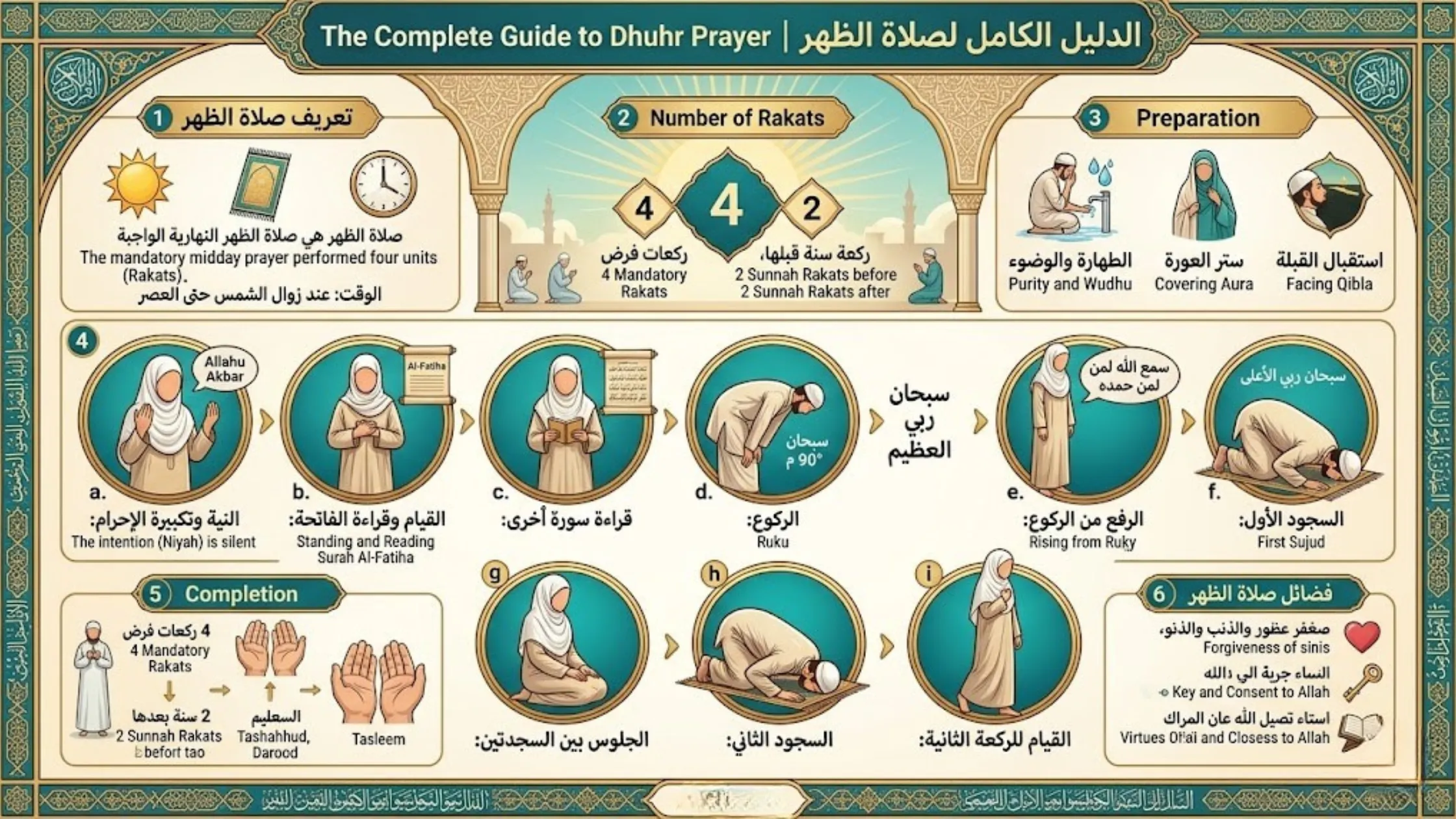
How to Perform Dhuhr Prayer Step by Step
Whether you are new to Salah or want to refresh your knowledge, the following step-by-step guide walks you through the complete Dhuhr prayer, from preparation to the final salaam.
Step 1: Make Wudu (Ablution)
Before standing in prayer, ensure you are in a state of ritual purity. Wudu involves washing the hands, rinsing the mouth, nose, face, arms up to the elbows, wiping the head, and washing the feet up to the ankles, three times each. If you are already in a state of Wudu and have not invalidated it, you may proceed directly.
Step 2: Face the Qibla and Make Niyyah
Stand facing the direction of the Kaaba in Makkah (the Qibla). In most parts of the UK, this is roughly south-east. Make your intention (niyyah) in your heart; you do not need to verbalise it aloud, though it is permissible. Your intention should be: “I intend to pray four rakats of Dhuhr Fardh for the sake of Allah.”
Step 3: First and Second Rakat
Raise your hands to your earlobes and say the opening takbeer:
- Takbeer: “Allahu Akbar”, (اللَّهُ أَكْبَرُ)
- Opening supplication (optional): Recite Thana (Subhanakallahumma…)
- Al-Fatiha: Recite Surah Al-Fatiha in full
- Additional Surah: Recite any surah or portion of the Quran
- Ruku: Bow and say “Subhana Rabbiyal Adheem” three times
- Rise: “Sami’Allahu liman hamidah”, “Rabbana lakal hamd”
- Sujood: Two prostrations, “Subhana Rabbiyal A’la” three times each
Repeat this for the second rakat, then sit for the first Tashahhud (At-Tahiyyat) after the second rakat.
Step 4: Third and Fourth Rakat
In the third and fourth rakats of Fardh Dhuhr, recite only Surah Al-Fatiha, no additional surah. This is the standard practice according to the majority of scholars. Perform ruku and sujood as in the first two rakats.
Step 5: Final Tashahhud and Tasleem
After the fourth rakat’s second sujood, sit in the tashahhud position and recite:
- At-Tahiyyat (“At-tahiyyatu lillahi was-salawatu wat-tayyibat…”)
- Salawat (Durood Ibrahim): “Allahumma salli ‘ala Muhammadin wa ‘ala aali Muhammadin…”
- Tasleem: Turn your head right, “Assalamu alaykum wa rahmatullahi”, then left the same
Dua After Dhuhr Prayer
After completing the Fardh, it is recommended to make a personal dua (supplication). You may also recite Ayat al-Kursi and the three Quls (Surah Al-Ikhlas, Al-Falaq, An-Nas). Then proceed to pray your 2 Sunnah rakats.
The Importance and Benefits of Dhuhr Prayer
Dhuhr prayer serves as a vital spiritual anchor in a Muslim’s daily life, offering a moment of profound reconnection amidst the day’s busy schedule. Far from being a mere routine, it provides essential benefits for both the soul and the mind.
- Spiritual Protection: Consistent observance of the Sunnah prayers associated with Dhuhr carries a promise of divine protection from Hellfire, as noted in the Hadith: “Whoever prays four rakats before Dhuhr and four after it, the Fire will not touch him.”
- Mental Clarity and Reset: The midday pause acts as a psychological reset, reducing stress and restoring focus by realigning one’s intentions and priorities during the peak of the day.
- Reminder of Priorities: Declaring “Allahu Akbar” at the start of each rakat serves as a powerful reminder that Allah is greater than any worldly distraction, deadline, or pressure.
Praying Alone vs. in Congregation
While praying in congregation (jama’ah) carries 27 times more reward according to authentic hadith, praying alone is fully valid and accepted. If you can find one or two Muslim colleagues, pray together; even a small congregation is a tremendous blessing.
Quick Tips for Staying Consistent
- Set a daily Dhuhr alarm, treat it as non-negotiable, like a meeting.
- Identify your prayer spot in advance, knowing exactly where you will pray removes hesitation.
- Start with just the 4 Fardh if you are short on time, then build in the Sunnah as your routine strengthens.
- Pair Dhuhr with an existing habit, such as before or after lunch, to embed it into your natural routine.
- Remember the deeper meaning, reflecting on expressions like Alhamdulillah (all praise is due to Allah) or Subhanallah (glory be to Allah) during and after prayer keeps Khushu’ alive even on the busiest days.
If you are building your Islamic vocabulary alongside your prayer practice, it is worth exploring the meaning of Shahadah in Islam, the declaration of faith that underpins every act of worship, as well as the meaning of expressions like Wallahi and other Islamic phrases and their meanings that enrich your understanding of what you recite.
Even when performing Dhuhr prayer regularly, some common mistakes can affect its validity or reduce the level of concentration and devotion (Khushu’). Being aware of these errors helps ensure that your prayer is both correct and spiritually fulfilling.
Common Mistakes to Avoid:
- Rushing through the Rakats: Move calmly and deliberately during Ruku (bowing) and Sujood (prostration), allowing enough time to complete the required supplications.
- Praying without proper Khushu’: Allowing the mind to wander excessively can reduce the spiritual benefits of the prayer. Try to focus on the meanings of the recitations and your connection with Allah.
- Incorrect or incomplete Wudu: Always ensure your ablution is valid before beginning the prayer, as prayer is not accepted without proper purification.
- Missing obligatory parts of the prayer: Skipping essential actions or recitations, whether intentionally or accidentally, can affect the validity of the prayer.
- Delaying Dhuhr unnecessarily: Although Dhuhr can be prayed within its prescribed time, postponing it without a valid reason may lead to distraction or even missing the prayer altogether.
- Not facing the Qiblah correctly: Confirm the direction of the Qiblah before starting, especially when praying in unfamiliar locations.
Start Your Dhuhr Practice Today
Dhuhr prayer is a gift Allah has placed in the heart of your day, a reminder that no matter how full your schedule is, the most important appointment is with your Creator.
Whether you are just beginning your prayer journey or looking to deepen an existing practice, start with the 4 Fardh rakats today. Build in the Sunnah when you are ready. And if you miss a day, make it up and keep going; consistency, not perfection, is what draws you closer to Allah.
At QuranBliss, we are here to support every step of your spiritual journey, from learning the fundamentals of salah in Islam to understanding the deeper meanings of the words you recite every day. May Allah make your Dhuhr, and all your prayers, a source of light, protection, and peace.
FAQs About Dhuhr Prayer
If you miss Dhuhr unintentionally, due to sleep, forgetfulness, or a genuine emergency, you must perform it as a qada (make-up) prayer as soon as you remember. Pray it in its full form even if you are outside the time window. Deliberately abandoning it without reason is a major sin. Return to Allah with istighfar and make it up promptly.
The majority of scholars (Shafi’i, Hanbali, Maliki) permit combining Dhuhr and Asr when travelling or in genuine hardship, either advancing Asr into Dhuhr’s time or delaying Dhuhr into Asr’s. The Hanafi madhab generally does not permit combining prayers except during Hajj at Arafah. Always verify with a qualified scholar based on your circumstances.
Dhuhr is prayed silently (sirr). The recitation of Al-Fatiha and the additional surah in the first two rakats is done in a quiet voice, only you should be able to hear it. This distinguishes it from Fajr, Maghrib, and Isha, which are prayed aloud
The 4 obligatory Fardh rakats take approximately 7–10 minutes when performed with proper Khushu’ and calmness. If you add the 4+2 Sunnah and 2 Nafl, the full 12-rakat Dhuhr takes around 20–25 minutes. Even just the Fardh fits comfortably within a standard UK workplace lunch break.
Yes, absolutely. Women are not obligated to attend the mosque for Dhuhr, or any of the five daily prayers. Praying at home is fully valid, and many scholars consider it preferable for women in terms of reward and ease. A clean, quiet space, facing the Qibla, with proper Wudu, is all that is needed. What if I miss Dhuhr prayer?
Can I combine Dhuhr and Asr?
Is Dhuhr prayed silently or aloud?
How long does Dhuhr prayer take?
Can women pray Dhuhr at home?


Islamic Studies Course
for Adults
Deepen your understanding of Islam’s teachings.
Learn More
The 5 Pillars of Islam
Understand the fundamental principles of Islamic faith and practice.
Learn More