
What Is Dhikr in Islam? A Complete Guide to Remembrance of Allah
Dhikr in Islam means the remembrance of Allah through specific words, phrases, and supplications mentioned in the Quran and Sunnah. It is one of the most beloved acts of worship, practiced after every prayer, throughout the day, and in dedicated sittings, bringing Peace to the heart and drawing the believer closer to Allah.
The Quran Bliss Academy Editorial Team created this comprehensive guide, with certified Quran and Islamic Studies educators with more than a decade of experience teaching non-Arab Muslims around the world.
What Does Dhikr Mean in Islam?
Before exploring the rewards and practices of dhikr, it helps to understand where this word actually comes from, and why Allah chose it so deliberately throughout the Quran.
The Arabic Root and Linguistic Meaning
The word dhikr (ذِكْر) comes from the Arabic root ذ-ك-ر (dhaa-kaf-raa), which carries the meanings of remembering, mentioning, and keeping something in mind.
- Linguistically, dhikr is the opposite of ghaflah, heedlessness or forgetfulness.
- When a Muslim engages in dhikr, they are actively choosing awareness of Allah over the heedlessness of everyday life.
- This is why scholars describe dhikr not just as an action of the tongue, but as a state of the heart. The tongue speaks what the heart already feels, or trains the heart to feel it.
Dhikr in the Quran, What Allah Commands
The Quran does not merely suggest dhikr; it commands it in clear, direct terms.
- Allah addresses the believers with a call that stands as one of the most repeated instructions in the entire Quran:
“يَا أَيُّهَا الَّذِينَ آمَنُوا اذْكُرُوا اللَّهَ ذِكْرًا كَثِيرًا”
“O you who have believed, remember Allah with much remembrance.”
(Surah Al-Ahzab, 33:41)
- Notice Allah said dhikran katheeran, much remembrance. Not occasional, not only after prayer, but abundant and continuous.
- This verse alone establishes that dhikr is not a supplementary act of worship; it is a core command addressed to every believer.
The Difference Between Dhikr and Dua
Many Muslims use dhikr and dua interchangeably, but they carry distinct meanings.
- Dhikr is the act of remembering and praising Allah, glorifying His names and attributes, as in subhanallah or alhamdulillah.
- Dua, on the other hand, is supplication, asking Allah for something specific.
- Both are beloved to Allah, but dhikr is more general and can be performed at virtually any time, while dua is a direct personal conversation with your Lord.
Think of it this way: dhikr is praising a king every time you walk through his palace. Dua is knocking on his door and asking for a favour. Both are acts of worship, and both are needed.
Why Is Dhikr So Important?
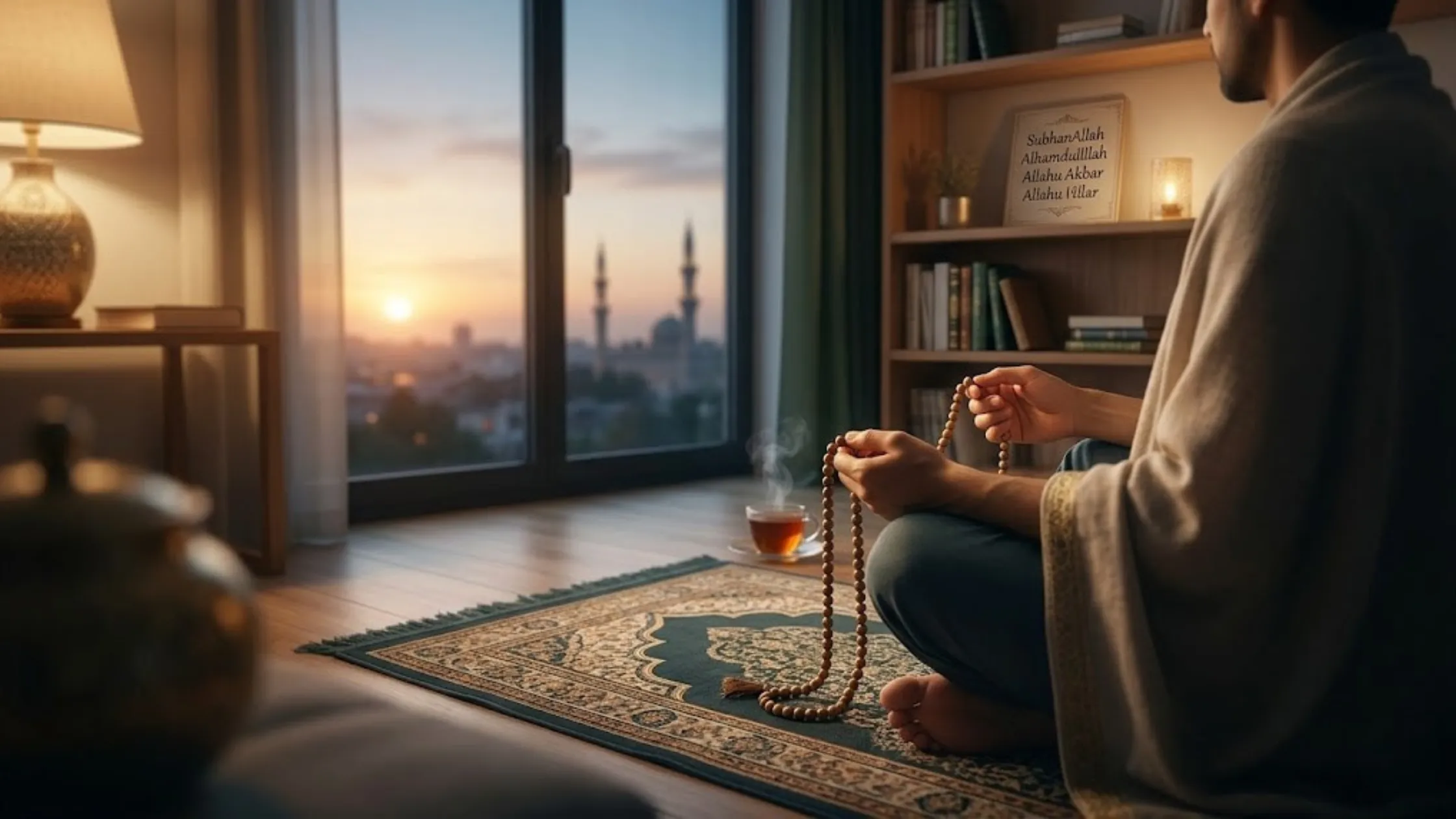
Once you understand what dhikr means, a natural question arises: why does Islam place such enormous weight on it? The answer lies in what dhikr does to the believer, and what the Prophet ﷺ and the Quran say awaits those who remember Allah consistently. Here are the key reasons dhikr holds such a central place in Islam:
- Dhikr Brings Peace to the Heart: Allah makes a remarkable promise in the Quran that applies to every Muslim who struggles with anxiety, stress, or restlessness:
“أَلَا بِذِكْرِ اللَّهِ تَطْمَئِنُّ الْقُلُوبُ”
“Verily, in the remembrance of Allah do hearts find rest.”
(Surah Ar-Ra’d, 13:28)
Tuma’ninah, the Arabic word used here, means a deep, settled stillness. Not temporary distraction, but real tranquility. Dhikr is the only thing the Quran names as the source of this Peace.
- Dhikr is the Soul of All Good Deeds: Scholars like Ibn al-Qayyim wrote extensively about how dhikr is the foundation beneath all other acts of worship. It keeps salah in Islam alive with meaning, gives fasting its spiritual dimension, and transforms everyday actions into acts of worship. Without remembrance of Allah, even worship can become a hollow routine.
- What the Prophet ﷺ Said About Dhikr: The Prophet ﷺ used a striking image to show the difference between a person who remembers Allah and one who does not:
“مَثَلُ الَّذِي يَذْكُرُ رَبَّهُ وَالَّذِي لاَ يَذْكُرُ رَبَّهُ مَثَلُ الْحَيِّ وَالْمَيِّتِ”
“The example of the one who remembers his Lord in comparison to the one who does not remember his Lord is that of the living compared to the dead.”
Sahih al-Bukhari, Hadith No. 6407
This is not mere metaphor. The Prophet ﷺ is saying that spiritual life itself depends on remembrance. A person who does not remember Allah may walk and breathe, but their heart, in a real sense, is not fully alive.
The Most Powerful Dhikr Phrases Every Muslim Should Know
These core phrases form the foundation of any serious dhikr list, and understanding what each one means transforms the way you say it. Here are the essential phrases:
Phrase | Arabic | Meaning | Best Time | Recommended Count |
SubhanAllah | سُبْحَانَ اللَّهِ | Glory be to Allah | After Salah, anytime | 33 times after each prayer |
Alhamdulillah | الْحَمْدُ لِلَّهِ | All Praise is for Allah | Morning, after eating | 33 times after each prayer |
Allahu Akbar | اللَّهُ أَكْبَرُ | Allah is the Greatest | After Salah, during Takbeer | 34 times after each prayer |
La ilaha illallah | لَا إِلَٰهَ إِلَّا اللَّهُ | There is no god but Allah | Anytime, especially in the morning | 100 times daily (Sunnah) |
Astaghfirullah | أَسْتَغْفِرُ اللَّهَ | I seek forgiveness from Allah | Evening, after Salah | 100 times daily (Sunnah) |
- SubhanAllah (سُبْحَانَ اللَّهِ): Glory be to Allah. This phrase, which forms part of the famous subhanallah meaning in Islamic praise, declares that Allah is free from every imperfection. When you say SubhanAllah, you are affirming that Allah transcends all human limitations and flaws—recommended 33 times after each of the five daily prayers.
- Alhamdulillah (الْحَمْدُ لِلَّهِ): All Praise is for Allah. The Prophet ﷺ said that alhamdulillah fills the scales of good deeds. It is a phrase of gratitude, recognition, and total attribution of blessings to Allah. Said 33 times after each prayer and encouraged after sneezing, finishing a meal, and upon waking.
- Allahu Akbar (اللَّهُ أَكْبَرُ): Allah is the Greatest. This is the phrase that opens every prayer, calls Muslims to worship five times a day, and accompanies major moments of life. It is a constant reminder that nothing- no worry, no power, no fear- is greater than Allah.
- La ilaha illallah (لَا إِلَٰهَ إِلَّا اللَّهُ): There is no god but Allah. This is the first half of the Islamic declaration of faith, and the most powerful form of dhikr. The Prophet ﷺ called it the best dhikr. Repeating it 100 times daily earns immense reward and protection.
- Astaghfirullah (أَسْتَغْفِرُ اللَّهَ): I seek forgiveness from Allah. The meaning of astaghfirullah goes beyond a simple apology; it is an acknowledgement that only Allah can lift the weight of our mistakes. The Prophet ﷺ himself sought forgiveness more than 70 times a day, teaching us that seeking forgiveness is not a sign of weakness but of spiritual awareness.
How to Perform Dhikr Step-by-Step for Beginners
The 7 Etiquettes of Dhikr Classical scholars outlined key conditions that make dhikr most effective and most beloved to Allah:
- Be in a state of purity (wudu) whenever possible, though dhikr is valid without it.
- Face the Qiblah when sitting for dedicated dhikr sessions.
- Lower your voice; the Quran praises those who remember Allah with humility, not with raised voices.
- Be present in heart, say each phrase with awareness of its meaning, not mechanical speed.
- Use a tasbih (prayer beads) or count on your fingers; both are established Sunnah methods.
- Choose a consistent time; after Fajr and after Asr are the most blessed times.
- Start small and build; even 5 minutes of mindful dhikr daily outweighs an hour of distracted repetition.
Dhikr After Every Salah, The Sunnah Routine
The most structured and rewarding dhikr list comes directly after each of the five daily prayers. This sunnah routine, confirmed in authentic hadith, forms the backbone of a Muslim’s daily remembrance. After completing salah in Islam:
- Say SubhanAllah 33 times
- Say Alhamdulillah 33 times
- Say Allahu Akbar 34 times (totalling 100)
- Then complete with: “La ilaha illallah wahdahu la sharika lah…” (the full tasbeeh seal)
This 7 powerful dhikr routine, practiced five times daily, is one of the greatest gifts the Prophet ﷺ left his ummah. It takes under three minutes and is one of the simplest ways to accumulate immense reward.
Can You Do Dhikr Anywhere?
Yes, and this is one of the most beautiful features of dhikr. Unlike formal prayer, dhikr does not require a prayer mat, a specific place, or even wudu in most cases. The Prophet ﷺ remembered Allah in all states. You can say subhanallah while driving, recite the morning adhkar while walking to work, or repeat La ilaha illallah quietly while cooking.
Why Saying Words You Don’t Understand Limits Your Connection
There is nothing wrong with saying dhikr phrases in Arabic without understanding them; the act itself carries reward.
But consider this:
- when you know that alhamdulillah means “All praise belongs to Allah, every form of praise, in every language, at every moment”, saying it changes.
- It becomes a conscious declaration, not just a habit.
This is like the difference between reading a letter in a language you don’t know and reading the same letter in your mother tongue. The words are identical. The experience is completely different.
How Learning Quranic Arabic Transforms Remembrance into Reflection?
Many students who begin learning Quranic Arabic describe a noticeable change in their spiritual lives. Instead of simply repeating familiar words, they start engaging with their meanings, making their remembrance more heartfelt and impactful. Understanding the language of dhikr can also increase khushoo (spiritual presence), as each phrase reminds the believer of Allah’s greatness, mercy, and guidance.
Benefits of Understanding Dhikr Meanings
- Deepens your connection with Allah during daily remembrance.
- Increases khushoo and concentration in worship.
- Helps transform repeated phrases into meaningful acts of devotion.
- Strengthens faith through a better understanding of Islamic teachings.
- Makes common expressions like Inshallah, Mashallah, and wallahi meaning more intentional and sincere.
- Encourages consistency in dhikr by creating a stronger emotional and spiritual connection.
- Helps believers reflect on Allah’s names, attributes, and blessings throughout the day.
The Difference Between Reciting Dhikr and Understanding It
Aspect | Dhikr Without Arabic Understanding | Dhikr With Arabic Knowledge |
Emotional Connection | Mechanical repetition that may feel routine | Words carry deeper meaning and engage the heart |
Presence of Heart (Khushoo) | Mind may wander and dhikr can become automatic | Understanding the meaning helps maintain focus and attentiveness |
Spiritual Growth | Limited by the lack of understanding | Enhanced through reflection and deeper faith |
Reflection on Allah | General awareness of worship | Greater appreciation of Allah’s names, attributes, and mercy |
Connection to the Quran | Often disconnected from the Quranic context | Dhikr phrases become linked to Quranic teachings and meanings |
Impact on Daily Life | Minimal influence on daily thoughts and actions | Encourages constant remembrance of Allah throughout the day |
Start Feeling Your Dhikr Not Just Saying It
If you are a non-Arab Muslim who has spent years reciting SubhanAllah, Alhamdulillah, and Allahu Akbar without truly feeling them, you are not alone, and it is not your fault.
- The solution is not to say dhikr louder or more often.
- The solution is to understand the language in which Allah chose to address humanity.
At Quran Bliss Academy, we have helped thousands of non-Arab Muslims move from recitation to connection by teaching Quranic Arabic in a way that is accessible, structured, and directly linked to the worship they already practice. When dhikr becomes understood, it becomes alive.
And when it is alive, it does exactly what Allah promised: it brings Peace to the heart.
If you want to move beyond recitation and truly feel every word you say to Allah, Quran Bliss Academy is here to help. Begin your journey into Quranic Arabic today, and let your dhikr become the Peace Allah always intended it to be.
Frequently Asked Questions
Dhikr is the remembrance of Allah through specific phrases, supplications, Quranic verses, and the names of Allah. It is one of the most important acts of worship in Islam, helping Muslims stay connected to Allah throughout their daily lives.
The recommended number depends on the type of dhikr. After each prayer, Muslims commonly recite SubhanAllah 33 times, Alhamdulillah 33 times, and Allahu Akbar 34 times. La ilaha illallah and Astaghfirullah are often recited 100 times daily.
Yes, and in many cases, silent dhikr is considered more sincere and protected from showing off (riya).
Scholars generally agree that the best single dhikr to say daily is La ilaha illallah, the testimony of tawhid. The Prophet ﷺ said it is the best of all speech.
Allah directly addresses this in Surah Ar-Ra’d 13:28: hearts find rest in the remembrance of Allah. Beyond the spiritual promise, there is a practical psychological dimension What is the meaning of dhikr in Islam?
How many times should I repeat dhikr?
Can dhikr be done silently?
What is the best dhikr to say daily?
How does dhikr help with anxiety?


Islamic Studies Course
for Adults
Deepen your understanding of Islam’s teachings.
Learn More
The 5 Pillars of Islam
Understand the fundamental principles of Islamic faith and practice.
Learn More