

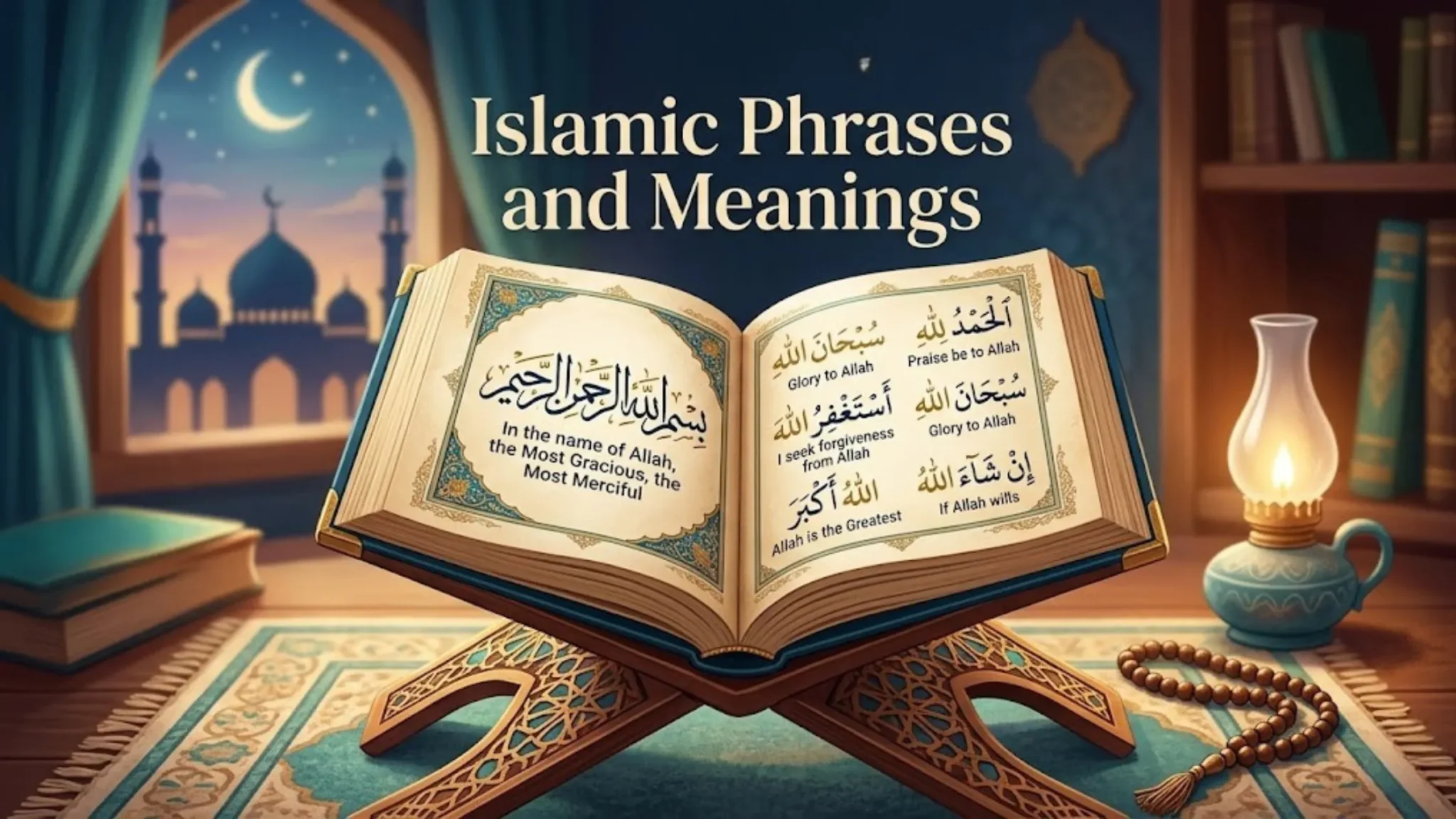
Islamic Phrases and Meanings: The Complete Guide to What Muslims Say and Why
Knowing these expressions helps you understand the profound spiritual weight they carry. This guide covers the most essential islamic phrases and meanings with Arabic text, pronunciation, and the foundational references behind each one. This comprehensive guide was created by the Quran Bliss Academy Editorial Team, certified Quran and Islamic Studies educators with more than a decade of experience teaching non-Arab Muslims around the world.
What Are Islamic Phrases and Meanings (Adhkar)?
Islamic phrases, also called Islamic Phrases and Meanings in arabic or Adhkar are short expressions Muslims say in daily life to remember Allah, express gratitude, seek forgiveness, or acknowledge His will.
They come directly from the Quran and the Sunnah of the Prophet ﷺ, and each one carries a specific meaning, occasion, and spiritual reward. They are among the most practical examples of islamic phrases for everyday use that any Muslim can build into their routine.
Why Islamic Phrases Are More Than Just Words
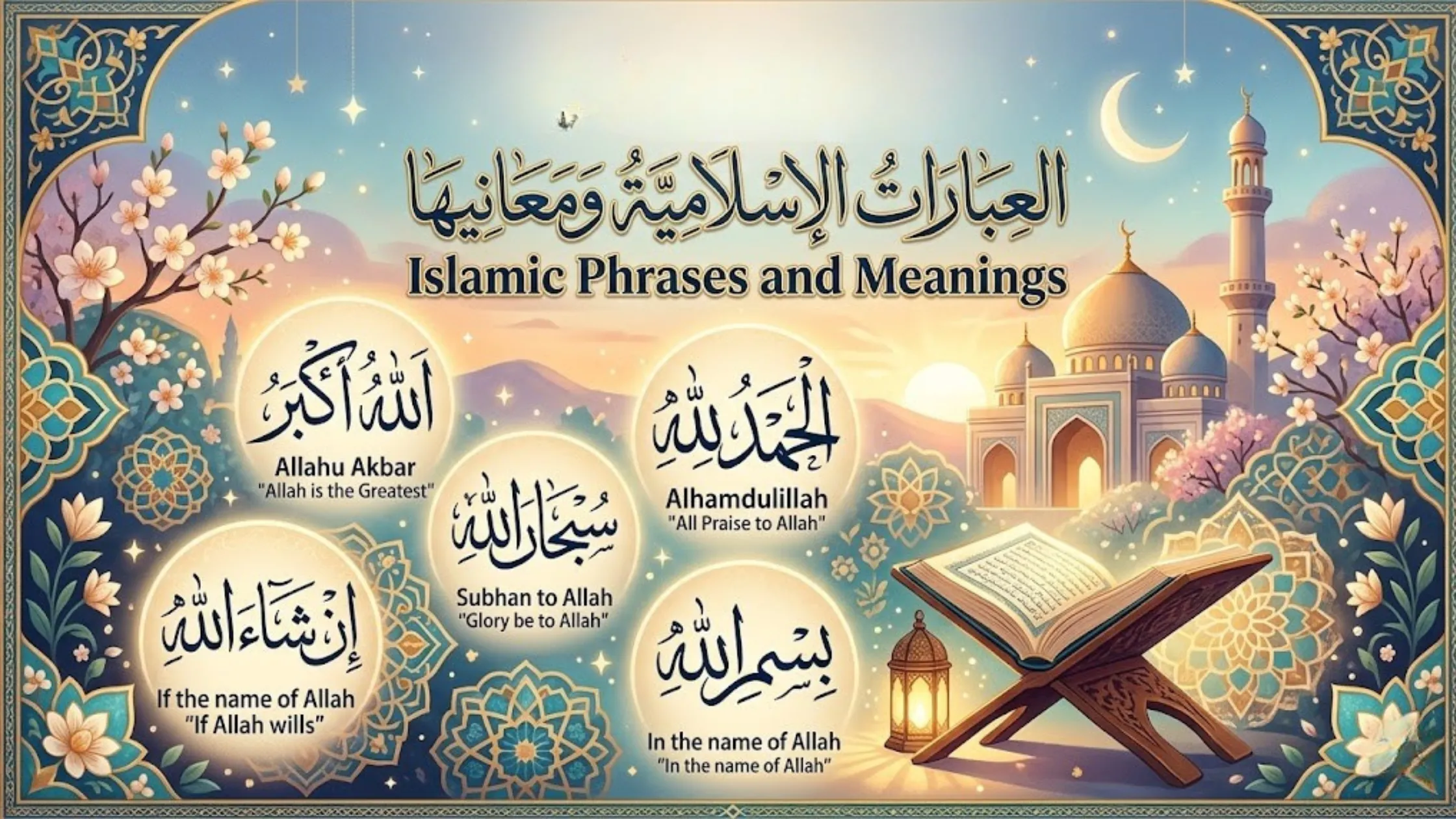
Most people encounter beautiful islamic words with meaning through conversation or social media, but rarely understand the theology behind them. In Islam, words are not neutral. What you say shapes what you believe, and what you believe shapes how you live.
The Quranic Foundation of Sacred Speech
Allah does not just encourage Muslims to speak well, He commands it and ties it directly to faith. The Quran makes a vivid comparison between a good word and a living tree:
“أَلَمْ تَرَ كَيْفَ ضَرَبَ اللَّهُ مَثَلًا كَلِمَةً طَيِّبَةً كَشَجَرَةٍ طَيِّبَةٍ أَصْلُهَا ثَابِتٌ وَفَرْعُهَا فِي السَّمَاءِ”
“Do you not see how Allah compares a good word to a good tree, its root is firm and its branches reach the sky.”
(Surah Ibrahim, 14:24)
This verse is the foundation of how Muslims understand speech. Every islamic phrase for allah is, in essence, a good word, one with deep roots in faith and branches that reach upward in reward.
How These Phrases Connect a Muslim to Allah Throughout the Day
One of the most profound aspects of Islamic practice is that it does not separate the sacred from the everyday. A Muslim is encouraged to remember Allah when waking, eating, travelling, entering a home, and even before sleeping. These positive muslim sayings are the tools that make that remembrance constant and effortless.
- They replace idle speech with purposeful words
- They build a habit of gratitude that reshapes how you see daily life
- They carry documented spiritual rewards from authentic Hadith
- They signal faith to others and open conversations about Islam
This verse is the foundation of how Muslims understand speech. Every islamic phrases for allah is, in essence, a good word—one with deep roots in faith and branches that reach upward in reward.
The Most Common Islamic Phrases and Their Meanings
Below are the essential muslim words with meaning that every Muslim uses, and that every student at Quran Bliss Academy learns to understand, not just recite. Each entry includes the Arabic, transliteration, meaning, and its source in the Quran or Sunnah.
Bismillah
- بِسْمِ اللَّهِ الرَّحْمَنِ الرَّحِيمِ (Bismillah ir-Rahman ir-Rahim).
- The opening of 113 out of 114 Quranic surahs.
- The Prophet ﷺ instructed Muslims to say it before any significant action eating, entering a home, or writing marking the beginning as an act of worship. (Surah Al-Fatiha, 1:1
Alhamdulillah
- الْحَمْدُ لِلَّهِ (Alhamdulillah). Used constantly to express gratitude in every circumstance after a meal, when sneezing, or responding to “how are you?”.
- The Prophet ﷺ noted that it fills the scales of good deeds on Judgment Day. (Surah Yunus, 10:10)
SubhanAllah
- سُبْحَانَ اللَّهِ (SubhanAllah). Declares Allah’s absolute perfection, far above any flaw .
- Muslims say it when witnessing natural beauty, hearing surprising news, or performing daily dhikr.
- This subhanallah meaning anchors the soul in awe of the Divine.
Allahu Akbar
- اللَّهُ أَكْبَرُ (Allahu Akbar). Called out in the five daily prayers, the Adhan, and moments of awe or victory.
- It declares that Allah is greater than any worldly worry, illustrating why learning quran online with context matters deeply.
MashaAllah
- مَا شَاءَ اللَّهُ (mashallah meaning).
- Spoken when admiring a blessing like achievements or beautiful children to acknowledge that all good comes from Allah.
- It also serves as protection against the evil eye (ayn).
Inshallah
- إِنْ شَاءَ اللَّهَ (Inshallah).
- A Quranic obligation when planning future actions, ensuring we recognize Allah’s ultimate control.
- The true inshallah meaning is a statement of reliance, not a polite refusal. (Surah Al-Kahf, 18:23–24)
Astaghfirullah
- اسْتَغْفِرُ اللَّهَ (astaghfirullah).
- Recited after mistakes or as a regular act of repentance.
- It stands as one of the most vital islamic phrases in english contexts for maintaining spiritual purity. (Surah Nuh, 71:10)
La hawla wala quwwata illa billah
لَا حَوْلَ وَلَا قُوَّةَ إِلَّا بِاللَّهِ. Called a treasure from Paradise by the Prophet ﷺ, this phrase (Al-Hawqala) is uttered during trials, providing some of the most beautiful islamic words with meaning to restore internal peace.
Islamic Phrases by Occasion When to Say What
One practical challenge many Muslims face, especially those new to the faith or those who learn quran online, is knowing which phrase fits which moment. This quick-reference table covers the most common occasions:
Occasion | Phrase | Arabic | Meaning |
Starting anything | Bismillah | بِسْمِ اللَّهِ | In the name of Allah |
Expressing gratitude | Alhamdulillah | الْحَمْدُ لِلَّهِ | All praise to Allah |
Seeing something beautiful | SubhanAllah | سُبْحَانَ اللَّهِ | Glory to Allah |
Future plans | Inshallah | إِنْ شَاءَ اللَّهَ | If Allah wills |
Praising someone’s blessing | MashaAllah | مَا شَاءَ اللَّهُ | What Allah willed |
Seeking forgiveness | Astaghfirullah | أَسْتَغْفِرُ اللَّهَ | I seek forgiveness |
Greeting a Muslim | As-salamu alaykum | السَّلَامُ عَلَيْكُمْ | Peace be upon you |
Condolences / loss | Inna lillahi wa inna ilayhi raji’un | إِنَّا لِلَّهِ وَإِنَّا إِلَيْهِ رَاجِعُونَ | Truly, to Allah we belong and to Him we return |
Affirming an oath | Wallahi | وَاللَّهِ | By Allah, used to affirm truth sincerely |
Islamic Phrases That Non-Muslims Often Hear But Misunderstand
Two phrases in particular are frequently heard outside Muslim communities and frequently misrepresented. Understanding them correctly matters, both for Muslims who use them and for non-Muslims trying to understand what they mean.
Allahu Akbar: The Real Meaning vs. the Misconception
- Due to media representation, many associate “Allahu Akbar” with violence.
- In reality, it means “Allah is the Greatest” a statement of humility said by over a billion Muslims daily in prayer, moments of joy, and awe. It is a central element of worship, not aggression.
- It is recited at least 17 times daily in obligatory prayers alone.
- It is called out five times a day as part of the Adhan (call to prayer).
- It is used during moments of gratitude, joy, and difficulty
Inshallah: Faith, Not Procrastination
- “Inshallah” is often misused as a soft refusal or a way to avoid commitment.
- In its true sense, it is a Quranic instruction meaning “If Allah wills,” acknowledging that the future is under Divine decree.
- Using it while genuinely intending to fulfill a promise is a sign of deep faith.
- This practice connects directly to Qadar (Divine decree), which is a core concept that scholars highlight when they define the 5 pillars of islam and the pillars of faith, ensuring a Muslim’s belief remains whole.
How Learning Arabic Deepens Your Connection to These Phrases
Understanding the true linguistic roots of Adhkar elevates your daily remembrance from a mechanical habit into a deeply felt spiritual experience:
- The Depth of “Hamd”: Reciting alhamdulillah becomes a heartfelt expression only when you realize “Hamd” means a specific kind of praise given freely, not earned.
- The Weight of Arabic Text: No English translation fully captures phrases like La hawla wala quwwata illa billah, where “Hawl” refers to movement/transition and “Quwwah” means strength.
- Surrendering Effort: Together, these precise terms cover every single dimension of human effort, surrendering all of it entirely to Allah.
- Emotional Connection: Students who study islamic phrases in arabic with proper, certified instruction consistently report a deeper emotional connection to their daily dhikr rather than just a cognitive one.
How to Start Learning the Language of the Quran
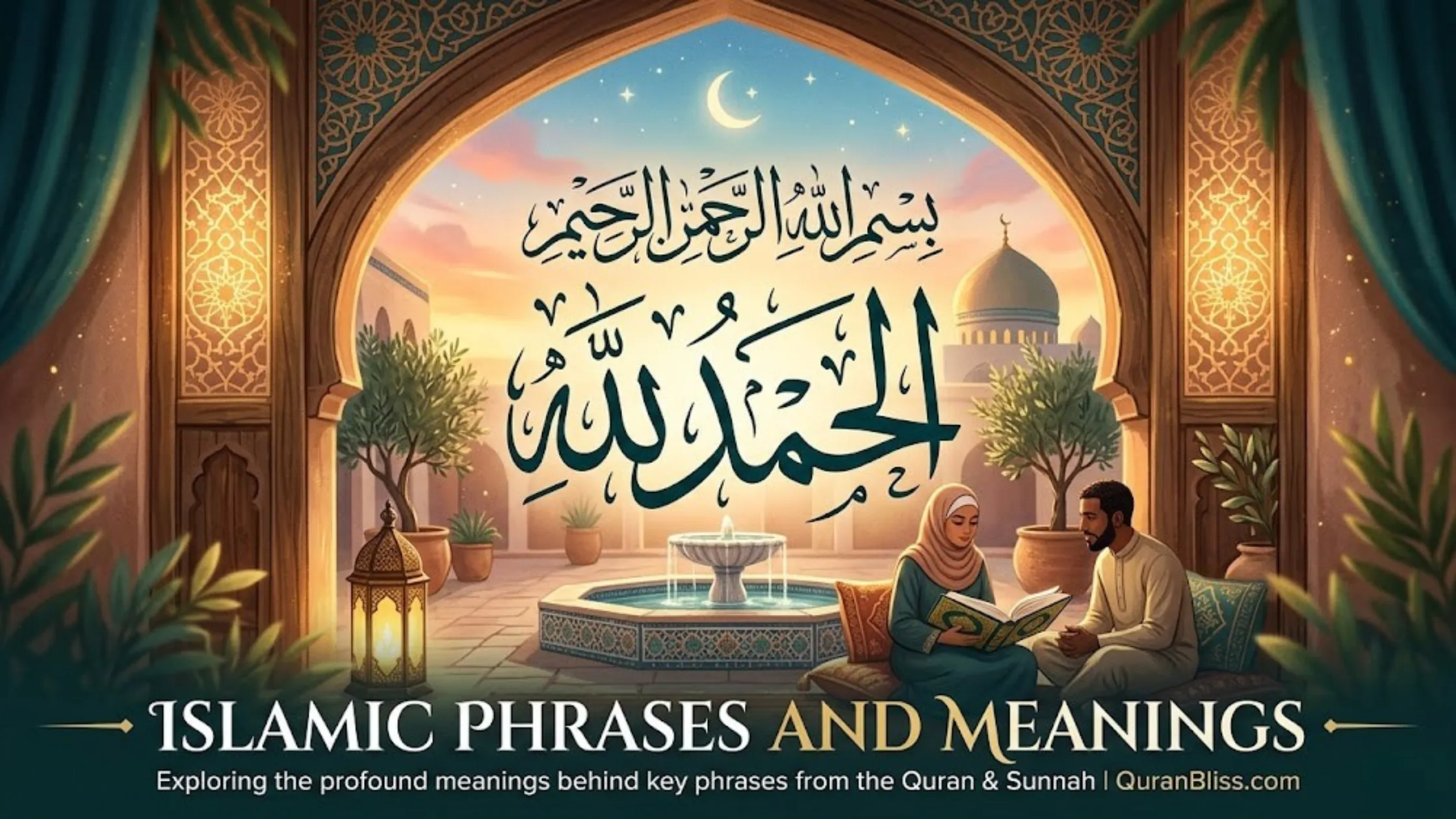
You do not need to be fluent in Arabic to begin. Most students start by learning the meanings of the phrases they already say, and that alone transforms their prayer and their daily remembrance. From there, structured Quran and Arabic classes build vocabulary and comprehension gradually.
“إِنَّا أَنزَلْنَاهُ قُرْآنًا عَرَبِيًّا لَّعَلَّكُمْ تَعْقِلُونَ”
“Indeed, We have sent it down as an Arabic Quran so that you might understand.”
(Surah Yusuf, 12:2)
At Quran Bliss Academy, our Arabic and Quran courses are designed for exactly this journey, starting with meaning, building to fluency, one phrase at a time. Whether you are looking for structured Quran lessons or want to learn quran online at your own pace, our certified teachers meet you where you are.
Book a free trial session today and experience the difference that understanding, not just recitation makes.
The islamic phrases and meanings covered in this guide are far more than conversational habits. They are living connections to the Quran, the Prophet ﷺ, and Allah. When understood rather than just repeated, they transform ordinary, everyday moments into deep acts of worship. At Quran Bliss Academy, we help you move from mechanical repetition to real understanding. Book your free trial session today, and begin transforming your daily remembrance into conscious faith.
Frequently Asked Questions
The foundational phrases tied directly to daily worship are Bismillah (before actions), Alhamdulillah (gratitude), SubhanAllah (glorification), Allahu Akbar (greatness), Inshallah (future plans), MashaAllah (blessings), and Astaghfirullah (forgiveness). Together, they form the core of the foundation of islamic phrases for everyday use.
MashaAllah means (this is what Allah has willed.) It is said when admiring something good like a person’s health, success, or a child’s achievement to attribute the blessing entirely to Allah and offer protection against the evil eye
Yes, most scholars consider it acceptable when used sincerely and with understanding. However, phrases that are specific acts of worship carry a different weight. For non-Muslims, learning the meaning of islamic phrases in english first is the best starting point.
These three form the core of daily dhikr: SubhanAllah declares Allah’s absolute perfection, Alhamdulillah expresses complete gratitude, and Allahu Akbar declares His supreme greatness. Grasping the true subhanallah meaning in Arabic makes this collective practice far more profound.
They serve as daily micro-acts of worship that reshape the mind. Saying Alhamdulillah during hardship builds active gratitude, while phrases like Wallahi invoke immediate accountability, transforming these muslim words with meaning into pillars of conscious faith. What are the most important Islamic phrases every Muslim should know?
What does MashaAllah mean and when should you say it?
Is it okay for non-Muslims to use Islamic phrases?
What is the difference between SubhanAllah, Alhamdulillah, and Allahu Akbar?
How do Islamic phrases strengthen a Muslim's faith?


Islamic Studies Course
for Adults
Deepen your understanding of Islam’s teachings.
Learn More
The 5 Pillars of Islam
Understand the fundamental principles of Islamic faith and practice.
Learn More